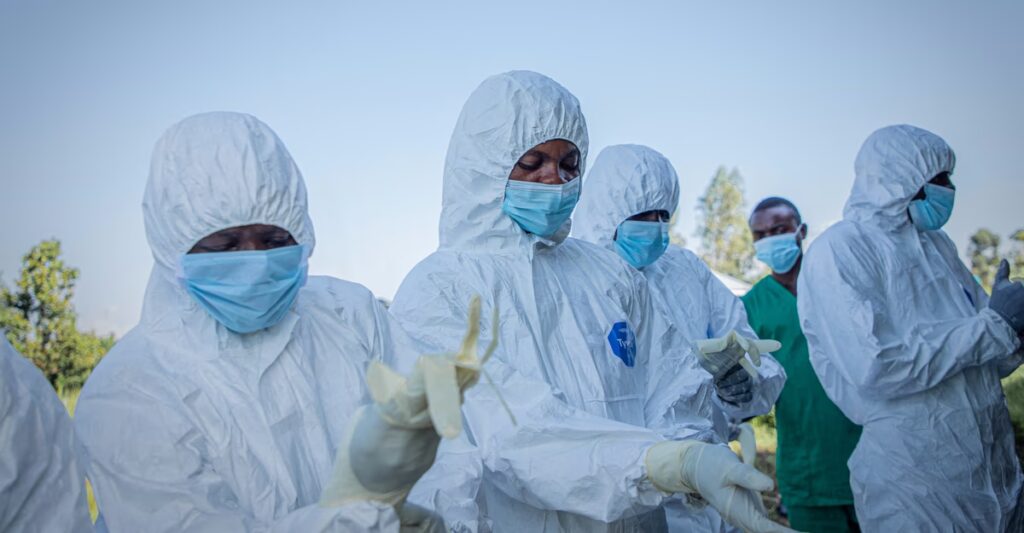
The Ebola outbreak in the Democratic Republic of the Congo is now the third-largest Ebola outbreak ever recorded. It will likely pass the second largest, an outbreak in the same region of Congo from 2018 to 2020. Already, the current outbreak has grown past 2,000 cases and to 754 deaths; according to the World Health Organization, it is likely to reach more than 8,000 cases and 1,400 deaths by mid-September. The CDC’s worst-case scenario projects more than 20,000 cases by mid-August.
I worked as a physician and epidemiologist in Guinea during the outbreak in West Africa that began in 2013. In 2014, I survived Ebola myself. I’ve followed every outbreak since, and this one worries me more than any other of the dozen that the world has undergone in the past decade.
Certainly, the world is better at containing and controlling Ebola than it was when I worked in Guinea. Much of that knowledge now lives in Kinshasa and Kampala and at the Africa CDC, in institutions that didn’t exist or weren’t ready a decade ago. When this outbreak is stopped, it will be stopped largely by people who learned what the previous outbreaks taught. Yet this outbreak is also revealing how much the United States, once the backbone of the response to crises like this one, seems willing to forget.
One of the earliest challenges in the 2013 West Africa epidemic was the monthslong delay in detecting initial cases in Guinea, where Ebola’s presentation was unfamiliar to health-care providers. In Congo, too, cases were likely occurring for months because testing was looking for the Zaire species of the virus, not the less common Bundibugyo species that was circulating.
Despite this delay, detection has improved in the past decade. The number of Ebola outbreaks is increasing: Climate change and more frequent contact between people and the animals that carry the virus mean more chances for it to spread. But most outbreaks are picked up far earlier than they once were. In 2017, for instance, an outbreak in DRC was detected at just eight cases.
And when an outbreak is declared, the ability to quickly start testing for Ebola has scaled up dramatically. In West Africa, testing often took days, during which infected people were exposing other patients in treatment centers to the virus. At the start of this outbreak, two months ago, Congo had essentially no ability to test for the Bundibugyo strain; today, capacity exists for thousands of tests a day.
Performing research and clinical trials during outbreaks is more possible than it was a decade ago, too. While treating Ebola patients in 2014, I had no vaccine or specific treatment to offer. Trials during that epidemic were slow to start, and poor methods meant that few produced conclusive results.
Since then, research has yielded a vaccine and antibody treatments for the Zaire strain. Now that a vaccine stockpile is in place, doses can be quickly deployed when an outbreak is declared. Trials are also moving faster. In a 2022 outbreak in Uganda, caused by the Sudan species of Ebola, an investigational vaccine was ready to test within three months. By then, cases were waning, but by preparing protocols and prepositioning vaccine candidates in the country, Uganda was able to launch a trial in four days when the next outbreak emerged, in 2o25. Multiple organizations are now racing to manufacture vaccines for the Bundibugyo strain; one trial to evaluate potential treatments has already kicked off.
What ultimately determines the trajectory of outbreaks, however, is the speed and scale of the response. In 2014, the world did not take the outbreak seriously until Ebola threatened Western countries. An international emergency was declared within days of the first Americans getting sick, a coincidence that didn’t escape my colleagues in West Africa who had been watching the outbreak expand for months. The WHO declared the current outbreak an emergency within two days of Congo’s and Uganda’s own declarations. Community mistrust and widespread conflict still makes the work of finding the sick and persuading them to come in for treatment difficult. But the machinery is faster and is now being run together by the WHO, the Africa CDC—an organization started in the aftermath of West Africa’s Ebola outbreak—and the Congolese government.
If in 2014 the international community was slow to respond to Ebola’s threat, it did eventually respond at scale. The U.S. committed billions of dollars in funding and extensive logistical support to ending the outbreak; USAID helped with essential tasks, such as training burial teams and setting up airport screening.
Since then, much of the capacity to find outbreaks early—whether for Ebola or other pathogens—was built with international investment, especially from the United States. The U.S. helped construct the infrastructure that now catches the sparks of what would otherwise become larger outbreaks, bankrolled much of the research and development for Ebola vaccines and treatment, and has played a central role in responding to nearly every Ebola outbreak—until the one declared in Uganda in February 2025.
For that outbreak, the CDC didn’t send specialists, USAID wasn’t deployed, and Elon Musk’s DOGE canceled multiple contracts dedicated to responding to the outbreak. The response to the current outbreak is a partial correction. The Trump administration has committed more than $700 million and has requested another $1.4 billion from Congress. It deployed a group of highly trained specialists and has finally filled the long-vacant top role at the Office of Pandemic Preparedness and Response. The secretary of state is reportedly considering appointing an Ebola czar, as the Obama administration did in 2014.
But these actions reflect deep reflexes, triggered by a big outbreak. A strong, successful response to an outbreak relies on not just quick responses, but systems that require maintenance and constant training. And the U.S. appears to be forgetting the lessons about those systems.
This amnesia is reflected in where the U.S. has aimed its effort—on keeping disease “over there” at all costs. Americans infected with Ebola have been transferred to Germany, rather than specialized treatment centers built in the U.S. after 2014; soon, Americans exposed to the virus may quarantine at a quickly constructed center in Kenya. These actions are part of a broader bet that the virus can be kept out of the U.S. It can’t. Ebola has many ways to cross a border; as we learned a decade ago, the only reliable way to protect Americans is to end the outbreak.
That work has been made harder by the Trump administration’s deep cuts to global health funding and disinterest in international coordination. After 2014, the U.S.—along with the rest of the world—spent years building a more nimble, operational World Health Organization. Now the U.S. does not appear to be fully engaging with the WHO, despite the organization’s role in leading this response. The Trump administration has also been trading disease-specific programs for transactional deals struck country by country, and a proposed plan at the State Department would remake the CDC’s overseas work along the same lines. Countries would pay à la carte for the agency’s help and skip whatever they choose to forgo, including surveillance designed to catch an outbreak like this one. The plan could close roughly a third of the CDC’s 60 overseas offices within a few years. This country-by-country approach may be advantageous politically, but it will lower our defenses against pathogens.
The world’s capacity to control infectious disease has never been fully self-sustaining. It lives in lab technicians and community health workers detecting outbreaks, in stockpiles that expire and need replenishing, and in institutions whose budgets can go up or down each year. It was built over decades, with American support and expertise, and once that support is withdrawn, the gains of the past decade are not guaranteed to hold.
American leaders are betting that the rest of the world will keep doing the work we taught it to do, with less and less help from us. White House spokesperson Kush Desai said as much in response to a request for comment, arguing that bringing global health functions once housed at USAID to the State Department “has made our Ebola response efforts more effective” and that “nothing is stopping other wealthy nations from also stepping up and contributing more to these and other efforts.” (A spokesperson for the State Department emphasized the speed of the U.S.’s response to this outbreak and said that its current strategy is still focused “on building the capacity of national and regional actors.”)
For a while, that bet may pay off. But the weakness of the systems that do exist are already showing. The health workers on whom so much of this response depends recently went on strike: They report not being paid and working without the supplies needed to safely do their job—so far, 112 health-care workers have been infected, and 35 have died. Some version of this has occurred in nearly every outbreak over the past decade, and it erodes the trust needed for a response to function successfully. When communities hear that money is pouring in, and watch Western aid workers speed by in expensive Land Rovers while local workers go unpaid, they stop believing the help is for them. Treatment reaches them just as unevenly. Since the Zaire drugs were approved in 2020, only a third of Congolese Ebola patients have received them, even though one was developed from the blood of a Congolese survivor and both were approved after a trial in Congo. The doses exist, but their manufacturers control them and most sit in American stockpiles.
Rather than work to close those gaps, the United States is testing how much stress the system can take before breaking. The outcome of the next outbreak will rest not on what we know, but on what we’ve bothered to keep.
The post The Lessons About Ebola the U.S. Wants to Forget appeared first on The Atlantic.