Photographs by Caroline Gutman
The Trump administration wants to control the Smithsonian, but it won’t be so easy. When experts talk about the institution’s relationship to the federal government, the world’s largest museum complex can start to sound like a bureaucratic outcast. The Office of Legal Counsel has called the Smithsonian a “very unusual entity” and a “historical and legal anomaly.” A law-journal article describes it as “Quasi-Government at the Private Border.” One attorney told me that it resides in the legal “netherworld.”
The Smithsonian may occupy the governmental fringes, but its museums are hardly invisible to Americans, millions of whom visit them each year. With the Trump administration renewing its efforts to crack down on the institution in recent weeks, though, overlooked legal mechanisms and obscure funding pipelines have suddenly become crucial variables that could affect whether the Smithsonian’s independence crumbles or holds.
In a 162-page report published on July 4, the White House’s Domestic Policy Council claimed that the National Museum of American History has “failed to tell America’s story and adheres to a radical, activist ideology”; it also criticized the museum’s leaders for not being patriotic enough. By far the longest public White House censure of a Smithsonian museum yet, it arrived after more than a year of pressure and suggests that the Trump administration has designs to exert greater influence on the institution’s work. The report follows a March 2025 executive order that called for ridding the Smithsonian of “divisive narratives.” In a December letter, the White House suggested that it would withhold funds if the Smithsonian did not hand over documents for a content review.
Defenders of the Smithsonian, all the way up to its secretary, Lonnie G. Bunch III, maintain that the institution celebrates a complex and imperfect country striving toward worthwhile ideals. Still, the White House has repeated the same tune: The telling of American history should be overwhelmingly positive and never confused about, in the words of two officials, “the fact that the United States has been among the greatest forces for good in the history of the world.” That the Smithsonian, which trusts its audience to handle nuanced ideas about the nation, is practically bursting with examples of American greatness and achievement is apparently not enough.
Since the president returned to office with history as one of his newfound hobbyhorses, several institutions have already gone through Donald Trump–led transformations. For all the White House has said about the Smithsonian, though, actual changes to the sprawling system have been relatively limited. As the institution faces refreshed threats, its ability to hold the line will be tested again. Legally, conceptually, and even practically, “America’s Attic” can be hard to grasp—whether you’re an administration official trying to meddle with its exhibits or a tourist trying to find the Air and Space Museum and ending up next door at the Hirshhorn Museum. The institution’s quirks could end up saving it.
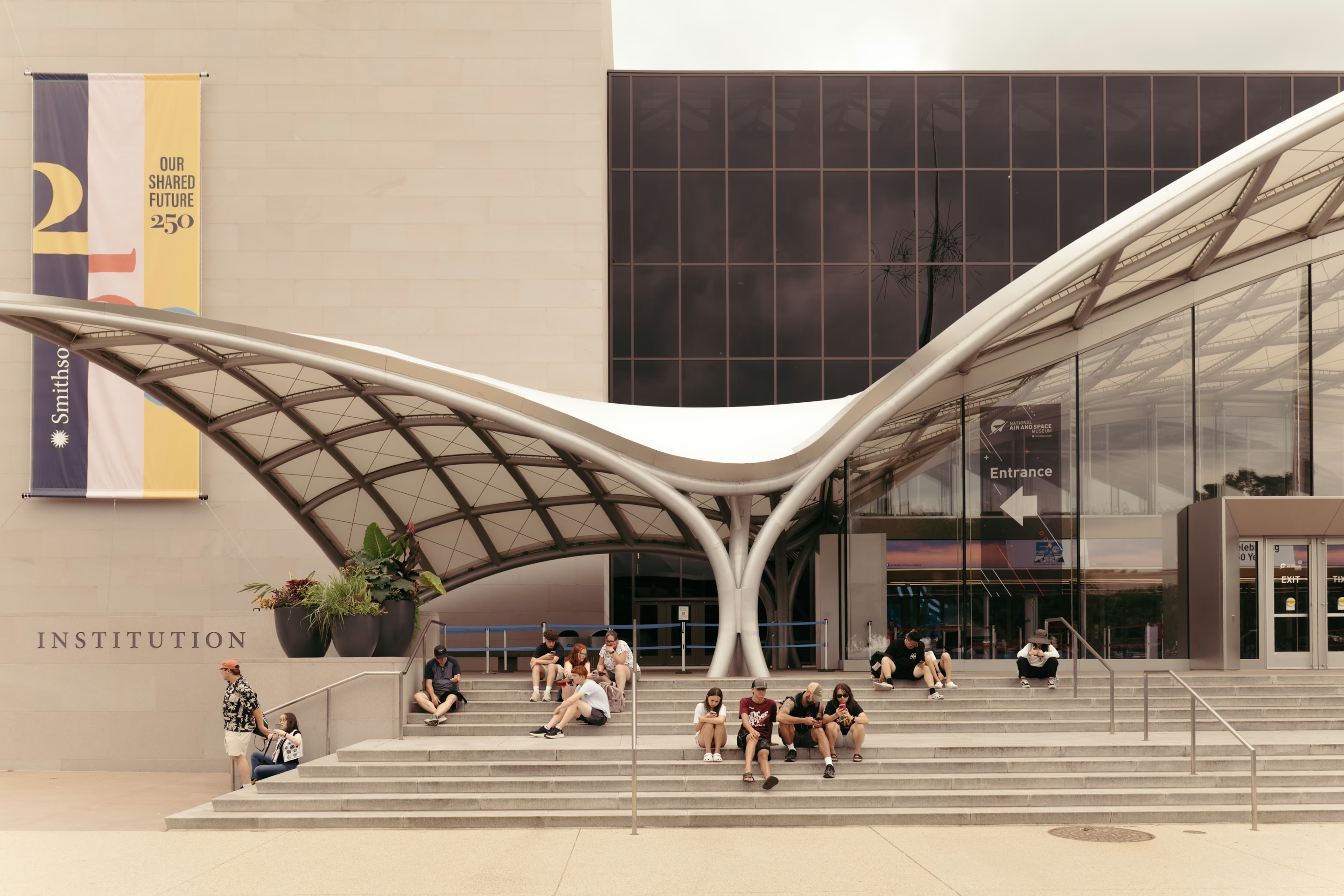
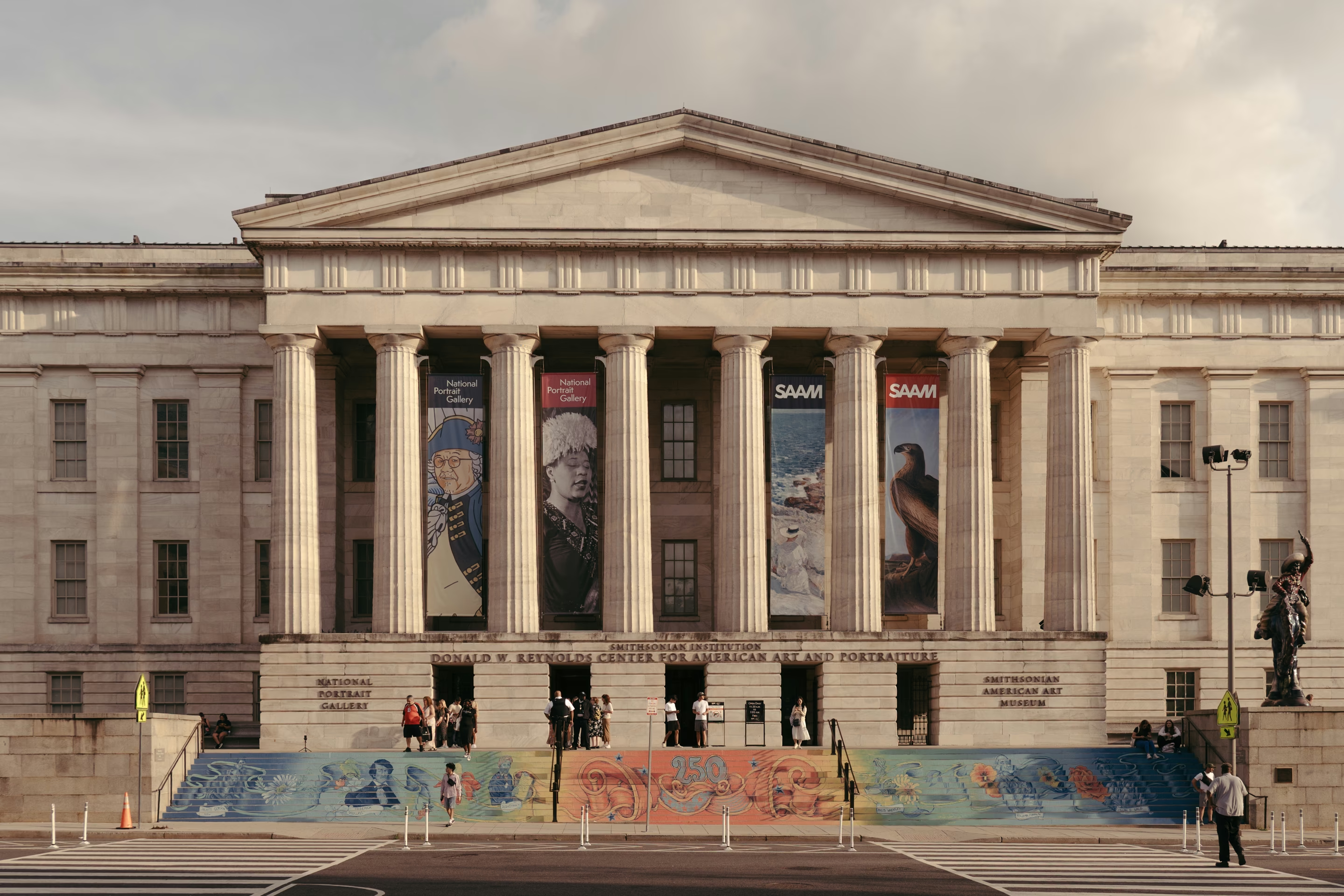
Even the way it began was unusual. The British scientist James Smithson never visited the United States during his lifetime, yet he developed such an affinity for the nascent republic’s ideals (or such a frustration with British society’s confines) that when he died, in 1829, he bequeathed his estate to the country to create an institution for “the increase and diffusion of knowledge.” Established by Congress in 1846, the Smithsonian today is made up of 21 museums, a zoo, and 14 education and research centers that are administered by a board of regents, which appoints a secretary to run the institution. A public-private partnership, the Smithsonian describes itself as an “independent federal trust instrumentality.” Generally speaking, its private funds go toward things such as landmark exhibitions, innovative research, and new facilities, and federal money, about 62 percent of its resources, is for building operations, basic research, conserving collections, and administrative services. Federal appropriations literally keep the lights on.
Emily Sexton, a lawyer who specializes in the arts, told me that the Smithsonian and entities such as the Kennedy Center, where she used to work, “were set up to essentially be like government establishments of free expression.” It sounds a little paradoxical, she admitted, but “in a government that is confident in its power, that’s not a problem.”
The continued independence of the Smithsonian is most evident when you look at its peers. The March 2025 executive order “Restoring Truth and Sanity to American History” also called for removing “improper partisan ideology” from sites overseen by the Interior Department; subsequently, Park Service officials, who are under the Department of the Interior, took down numerous signs dealing with topics such as slavery and climate change. (These directives are tied up in an ongoing legal fight.) Arts agencies were also quickly changed by the administration, as Trump fired much of the council advising the National Endowment for the Humanities last fall and reimagined the Institute of Museum and Library Services with grant guidelines that read like a Trump loyalty test.
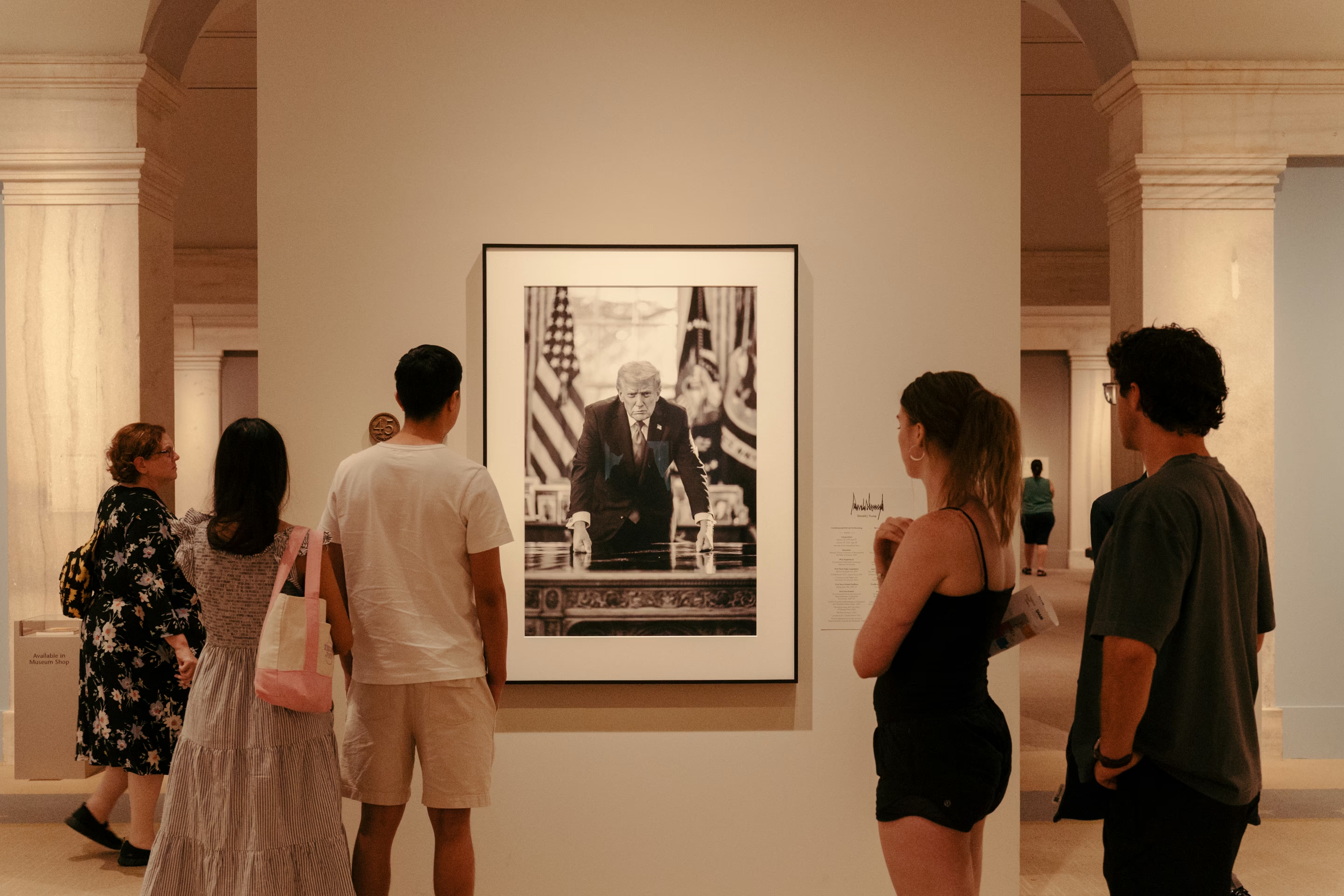
Whereas these institutions all fall within the executive branch, the Smithsonian’s status is harder to ascertain. Sometimes, the Smithsonian qualifies as part of the executive branch—as in a 1988 opinion that said that it is an “executive agency” for the purposes of the Federal Property and Administrative Services Act. Sometimes it does not, as in a 1997’s Dong v. Smithsonian, which determined that the Smithsonian is not a federal agency under the Privacy Act.
This shape-shifting leaves room for interpretation. In its report, the White House acknowledges that the Smithsonian is not subject to many laws governing executive agencies but also quotes a 1997 Office of Legal Counsel document that says the Smithsonian is “so closely connected to the Government that the two cannot realistically be viewed as separate entities.” The White House does not mention the footnote in which the office reiterated its view that the Smithsonian’s legal situation should be discussed on a statute-by-statute basis and that “broad generalizations regarding the Smithsonian’s status are inappropriate.”
The recent Supreme Court ruling in Trump v. Slaughter expanded Trump’s power to fire leaders across the executive branch, but that probably doesn’t mean Bunch is next. Although the Court found that Trump could dismiss a Democratic member of the Federal Trade Commission, the justices also wrote that the FTC falls “well within the heartland of executive power” and that they do not have “occasion today to define the bounds of what such power entails.” Anne Joseph O’Connell, a Stanford Law School professor who has studied boundary institutions, explained to me that the ruling applies only to those exercising executive power and, generally, reporting to the president. “You look at what the Smithsonian does, and it looks nothing like the Federal Trade Commission or other entities where President Trump has successfully fired people without court interference,” she said.
The Smithsonian’s other safeguard is its leadership structure. Whereas the Kennedy Center’s board of trustees includes dozens of presidential appointees, the Smithsonian’s board of regents is a much smaller body. According to the Smithsonian bylaws, the board consists of 17 members: the chief justice of the United States (who has traditionally served as the Smithsonian’s chancellor), the vice president, three senators, three members of the House, and nine citizens. Senators are appointed by the Senate’s president pro tempore, and House members are selected by the House speaker. Currently, congressional members on the regents are evenly split between Democrats and Republicans.
Installing loyalists among the citizen regents would be the most obvious way for the White House to exert control over the Smithsonian. But there, too, Trump lacks a direct route.
Citizen regents are selected by the broader board and their nominations handed over to Congress, which appoints them through a joint resolution that then has to be signed off on by the president. The citizen portion of the regents has dwindled for months, a number of their terms expiring quietly without replacements being named. Currently, the board is down by either two or three citizen seats (Denise O’Leary’s first term ended in April, and her renomination does not appear to have gone to Congress, though she remains listed online and attended a meeting after her term’s expiration as a committee chair), and this fall, three more regent terms will expire. The New York Times reported on Tuesday that Vice President Vance has been holding up sending nominees to Congress, because Trump wants to find ones better aligned with his vision —an effort that follows instructions in the March executive order calling for Vance to seek citizen members who are “committed to advancing the policy of this order.”
One person who is familiar with regents operations (and who spoke anonymously because they are not authorized to discuss these matters publicly) told me that it is highly unusual for such appointments to be delayed and that, in the past, candidates were quickly reviewed and approved by Congress. As “the ultimate and only fiduciary board” at the Smithsonian, the board has significant power, the person noted: “The hard decisions come back to the regents.” Amid the uncertainties, the person took comfort in Chief Justice John G. Roberts remaining chancellor, a role he has held since 2005. The justice’s “institutionalism applies here as well,” the person said, stressing that Roberts is invested in “the health of the institution over the long run for his kids and his grandkids.”
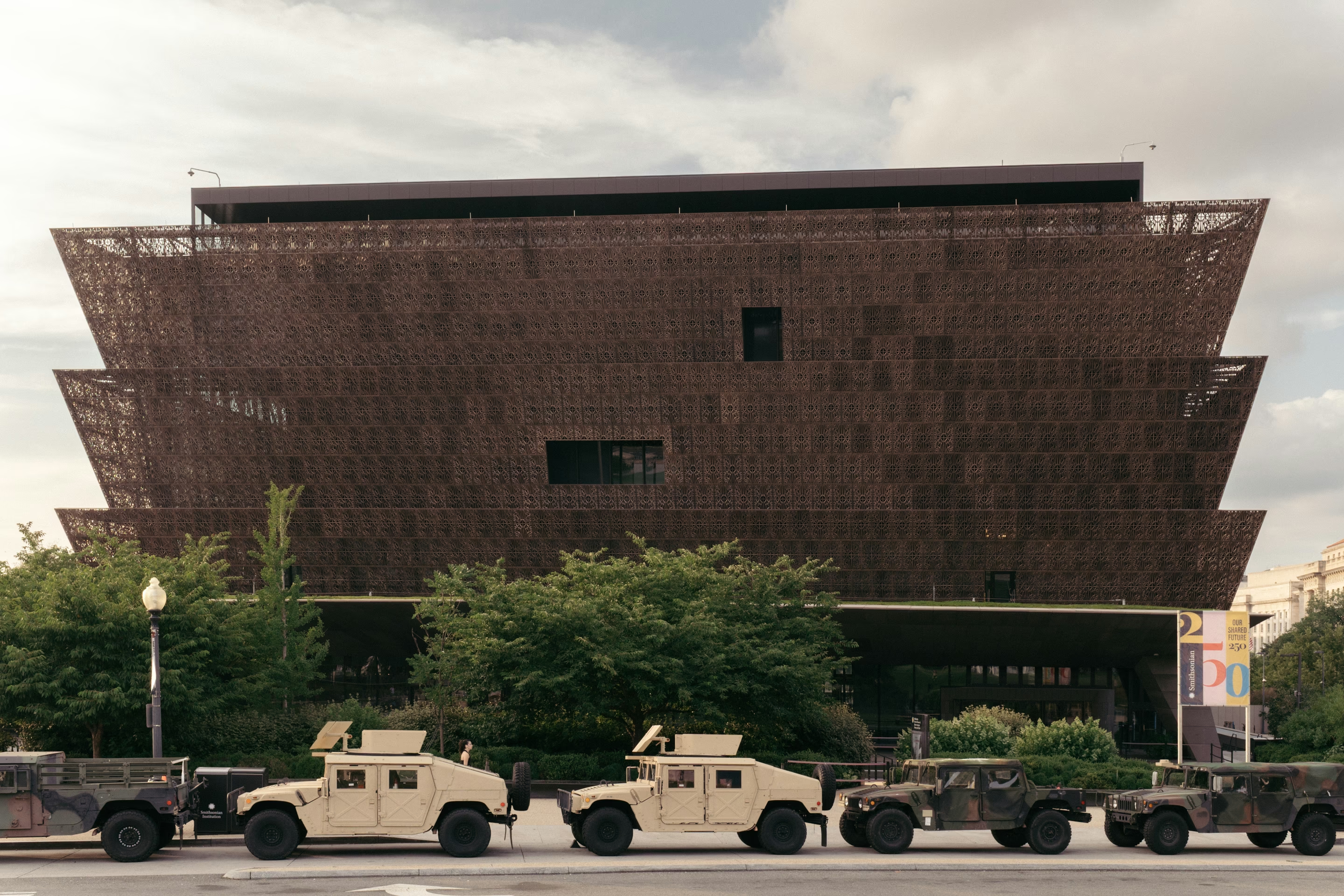
Smithsonian staff similarly laud Bunch as a source of steadiness amid political turbulence. Known to be diplomatic and evenhanded, Bunch has become more direct recently, telling CNN’s Christiane Amanpour earlier this month that “it’s our job to tell an accurate, complex, and truthful history” and that “it scares me when people aren’t brave enough to face their history.”
No ground here is entirely solid, though. The chancellor of the Smithsonian is “traditionally” the chief justice, per the Smithsonian’s website, but the regents could, in theory, choose another from their ranks. And Bunch, after more than 30 years at the institution, may be nearing the end of his time in office, possibly leaving a void at the top. Trump has tried to force out a Smithsonian leader before; last year, he attempted to fire National Portrait Gallery Director Kim Sajet via social media, a post that was met with an unusually forceful statement from the institution that essentially asserted: That’s the secretary’s job, not yours. Any more attempted firings would likely bring a similar response, but last year, Sajet stepped down anyway, illustrating how political rhetoric can effectively function as policy.
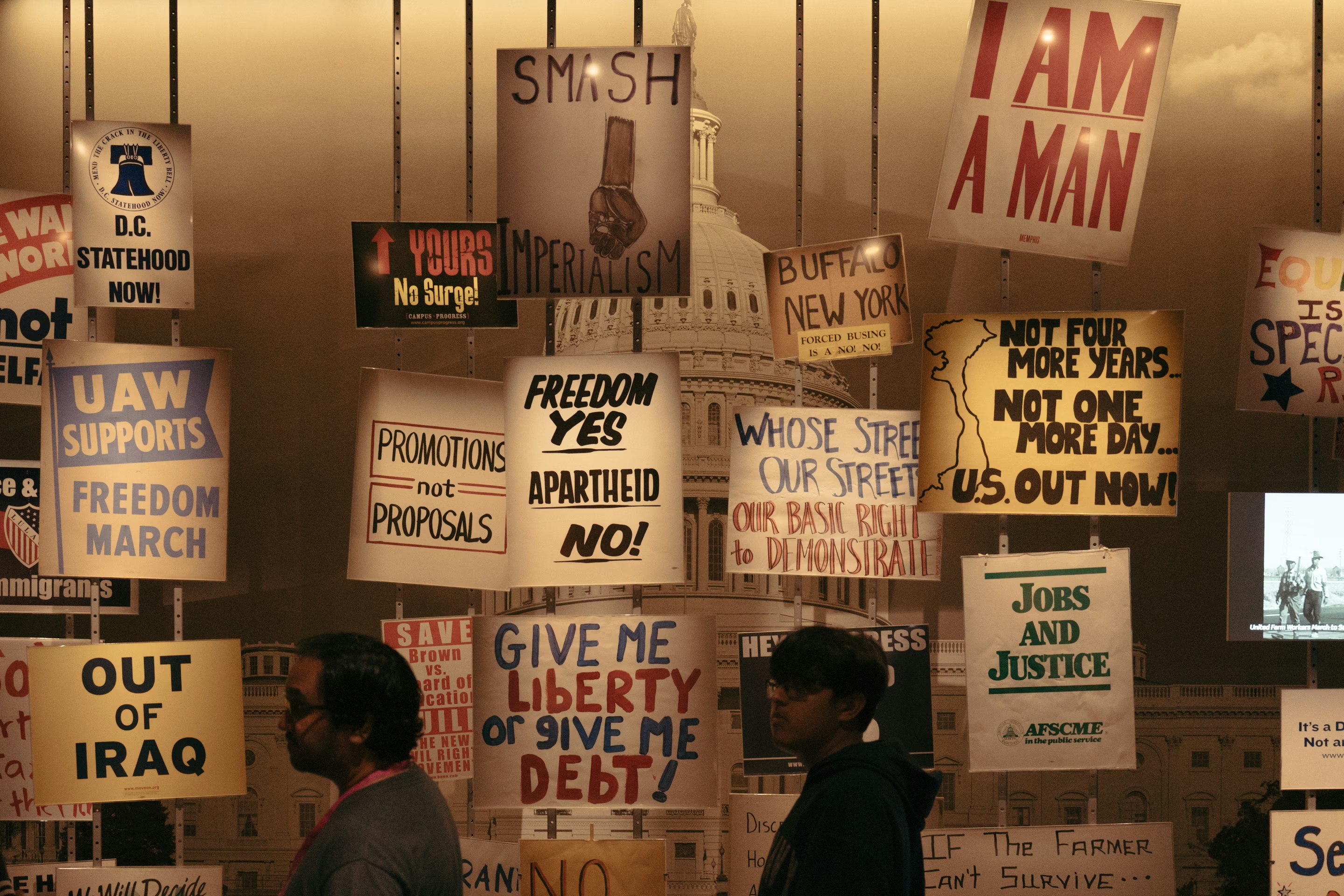
Occasionally, when a budget impasse rolls around and the government shuts down long enough, visitors have been reminded that the Smithsonians are no ordinary museums. Last year’s shutdown forced the closure of public-facing galleries across the institution for more than a month.
This government-funding piece could be the Smithsonian’s weak point—and the White House seems to know it. The administration at one point inserted since-removed footnotes into budget directives conditioning the apportionment of funds on compliance with Trump’s “Restoring Truth and Sanity to American History” order and, later, on compliance with Trump’s 2026-fiscal-year budget. In the December letter, the administration told the Smithsonian that its funds were available only for use consistent with the March 2025 executive order and an August 2025 letter that called for a more intensive content review of eight museums.
Although Congress has the final say when it comes to spending, experts told me that the Office of Management and Budget has some power to manage the dispersal of appropriations so that agencies don’t overspend or underspend. Funds cannot be held up for policy reasons, Philip Joyce, a public-policy professor at the University of Maryland, told me, so in this case, “I don’t think they’d have a leg to stand on.” That doesn’t mean the administration won’t try, though, he said: “A conclusion I have reached after 18 months or so of this administration is that a lot of the things that we thought were based on laws are really based on norms. And if people are not willing to follow the norms, then the laws don’t do you any good.”
David E. Lewis, an expert on public administration at Vanderbilt University, echoed that point, telling me that “if apportionment steps over into the realm of an illegal deferral or impoundment, that would be problematic, but it was sort of built on good faith.” Lewis doesn’t think the administration worries about winning in court anyway: “If they lose in court, they also win, because they’re seen as fighting against what they call radical leftist ideology.”
There is at least one way in which it actually loses, however. A trip to the National Mall shows you quickly enough that for all of the noise, the museums still draw visitors from across the political spectrum. Although the Smithsonian does have an endowment that could theoretically keep it afloat, the withholding of funding could bring about closures. When it comes down to it, what leader has ever won political points by keeping children from rocket ships?
The post How the Smithsonian Could Fall appeared first on The Atlantic.