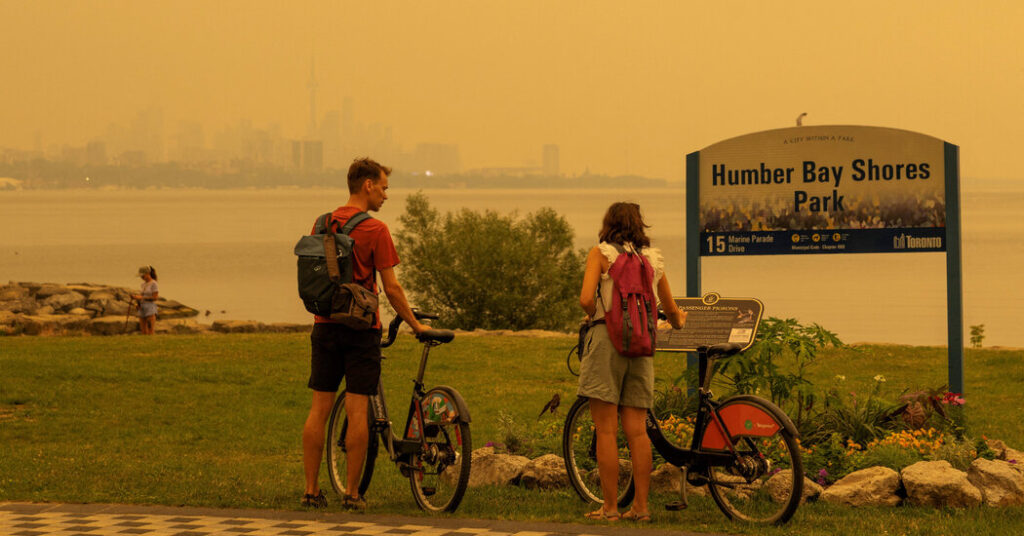
As wildfires rage in Ontario, driving a haze of smoke over New York and other parts of the United States, officials in the Canadian province are bracing for a potential escalation and widespread community evacuations.
Roughly 135 active wildfires were burning across northwestern Ontario as of Wednesday night, with more than half a dozen new fires reported late that evening, according to data from the province’s Aviation, Forest Fire and Emergency Services.
Ontario’s Ministry of Natural Resources had reported a total of more than 180 active fires across the province on Wednesday morning. On Thursday morning, an interactive forest fire map from the ministry, based on information from more than 130 regional weather stations, showed about a dozen new fires raging and little indication that the blazes were abating.
The fires in Ontario have been concentrated around Thunder Bay, a city on Lake Superior about an hour’s drive from Minnesota, with flames also igniting around Fort Frances, Dryden, Nipigon and Sioux Lookout.
So far, 15 rural communities have been evacuated. A handful are First Nations reserves — including Cat Lake, Eabameetoong and McDowell Lake — that are fly-in communities, triggering air evacuation efforts.
The northwestern area is popular among wilderness outfitters and American tourists. Two groups of Y.M.C.A. campers from Minnesota were rescued by aircraft on Wednesday, the state’s governor, Tim Walz, told reporters at a news conference.
More than 150 fire crews and nearly 50 firefighting aircraft are “working around the clock,” Doug Ford, the premier of Ontario, said on Thursday on social media.
Crews from Alberta and Yukon have also been dispatched, the province’s natural resources ministry said in an email.
The fires have prompted air quality warnings, road closures and in some communities, evacuations. Jill Dunlop, Ontario’s minister for emergency preparedness, said Thursday morning that she had formally requested Canada’s federal government prepare to assist in the region, including potentially deploying Canadian soldiers.
“The situation is evolving and impacts to communities may continue to escalate rapidly,” Ms. Dunlop wrote in a letter to federal authorities that she shared on social media.
Ms. Dunlop said in the letter, dated Wednesday, that 15 communities were evacuating or contemplating evacuations and that more could follow. She asked federal authorities to be prepared to assist with potential air evacuations “at extremely short notice.”
In Toronto, Canada’s largest city, residents are being urged to stay indoors as the air quality remains poor, and some outdoor locations, including city pools, have closed. Environment Canada, a federal agency, on Thursday morning rated the danger of the air quality at 10+, or “very high risk,” but conditions were expected to improve by evening.
The post Blazes Continue in Ontario as Officials Brace for More Evacuations appeared first on New York Times.