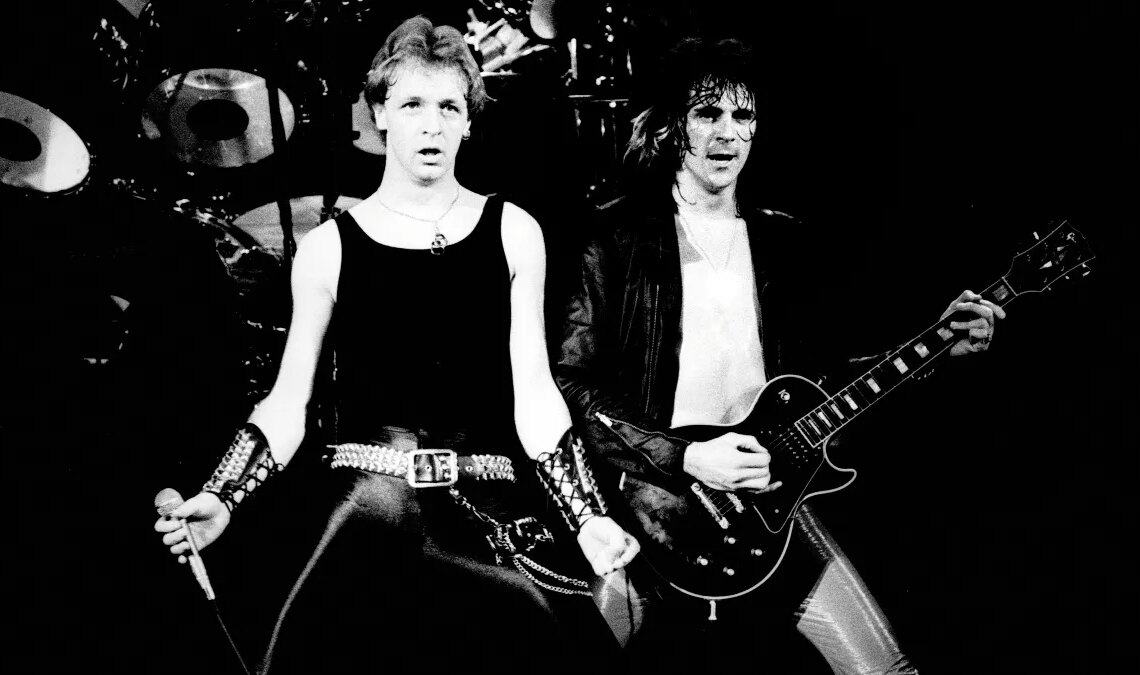
On July 16, 1990, English heavy metal band Judas Priest went to trial after being accused of adding subliminal messages to a 1978 track. “Better by You, Better than Me” was a cover of Spooky Tooth’s 1969 original, and a last-minute addition to their 1978 album Stained Class.
Twelve years later, the band was involved in a highly publicized subliminal message trial centered on that last-minute addition. The lawsuit claimed that there were secret messages within the recording that directly influenced two young men in Nevada to form a suicide pact.
In December 1985, 18-year-old Raymond Belknap and 20-year-old James Vance spent a night smoking, drinking, and listening to Judas Priest. Specifically, the Stained Class album. They then both shot themselves with a shotgun. Belknap died instantly, but Vance survived. He was left severely injured and eventually died three years later.
While Vance was still alive, his family sued the band for $6.2 million. In the suit, they claimed “Better by You, Better than Me” contained subliminal messages like “try suicide,” “do it”, and “let’s be dead”.
Judas Priest’s Rob Halford Takes the Stand to Testify Against the Accusations of Subliminal Messages
At the trial, the prosecution played the song in every possible way. Backward, forwards, sped up, and slowed down, trying to prove that Vance and Belknap had been influenced to kill themselves. But what they claimed was “backwards masking” seemed to only be inconsequential recording noise.
Judas Priest frontman Rob Halford took the stand to testify. He claimed that the alleged messages were just him exhaling while singing, which got picked up in the recording. The band’s lawyers also turned the court’s attention to Belknap and Vance’s troubled childhoods and history of substance abuse. Eventually, the case was dismissed, as no concrete evidence of subliminal messages could be found.
But the whole thing shook the band. They’d never encountered something like that before. According to Halford, who reflected on the case in 2015, it was an additional shock that the accusations came from the U.S.
“We’ve always had this fantastic relationship with America. To come from a place that we love so much was a shock,” said Halford. But as much as the experience was unsettling, it also gave Judas Priest a chance to represent heavy metal to an ignorant audience.
“The case was a great opportunity for a band like Priest to show the judge and the public that was clueless about metal and rock that we had a bunch of guys who could string sentences together and be logical and intelligent and have a deep conversation in a courtroom,” Halford explained. “I think there was the misguided belief that that wasn’t going to happen. But we’re not idiots, and we never will be.”
The post Today in 1990, This Heavy Metal Band Was Accused of Subliminally Inspiring a Teenage Pact Ending in Tragedy appeared first on VICE.