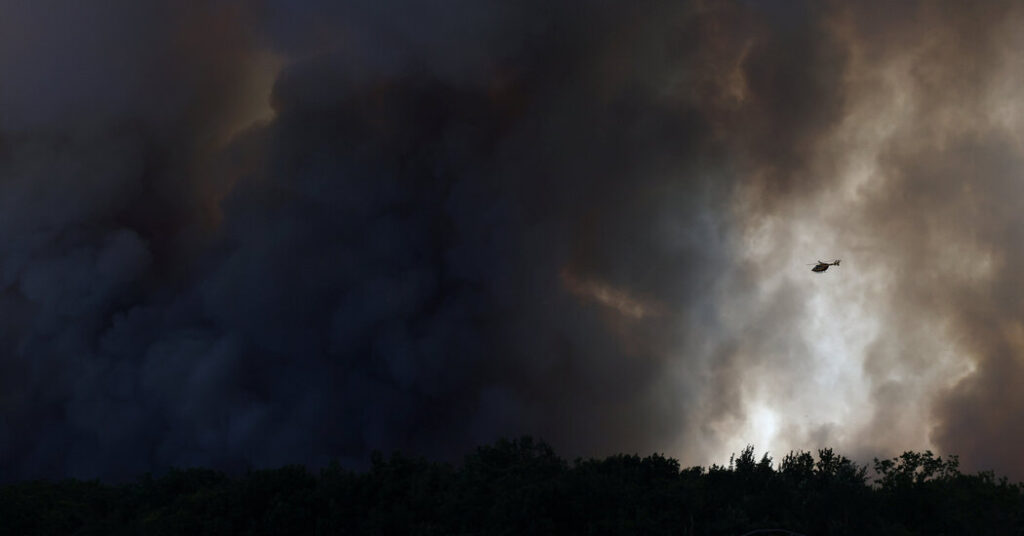
The nation’s top scientific advisory body issued a report on Thursday backing a growing field of science that could help governments hold oil, gas and coal companies responsible for the damage caused by extreme weather.
The field, known as extreme event attribution, seeks to answer an increasingly common question: How much was the latest heat wave, downpour, drought or wildfire worsened by climate change?
Scientists have long understood that global warming, driven by greenhouse gas emissions from the burning of fossil fuels, is making certain kinds of extreme weather more intense and more likely. But only in the past two decades have they developed the tools for estimating precisely how much worldwide warming is shaping particular weather events in particular places.
The new report, published by the National Academies of Sciences, Engineering and Medicine, doesn’t make recommendations on how attribution science should be used in policy and the law, though it notes that attribution findings could be relevant in several types of legal cases. In a $50 billion lawsuit against oil companies, Multnomah County in Oregon cited an attribution study that concluded that a record-shattering 2021 summer heat wave in the Pacific Northwest would have been “virtually impossible” without human-caused climate change.
As more states and localities file such lawsuits, allies of the fossil-fuel industry have attacked scientists who conduct attribution analyses as being activists against oil producers. This week, Energy in Depth, a project of the Independent Petroleum Association of America, a lobbying group, suggested that the National Academies report should be seen as “the latest deliverable in a well-funded litigation campaign.”
The National Academies report finds that researchers’ methods for extreme event attribution have advanced “considerably” in recent years. Scientists are using more sophisticated techniques and better data, the report says. That is helping them assess with greater confidence how much the searing temperatures during a particular hot spell, for instance, can be attributed to human activity as opposed to routine randomness in the atmosphere.
Pinpointing the influence of human-caused warming remains a challenge for some kinds of unruly weather, the report notes, including tornadoes and hail storms. And many developing nations lack the long-term weather records that would help scientists make confident attributions about events there, the report says.
“Attribution science is still relatively new, and I think we have made a lot of progress,” said Jim Hurrell, a professor of atmospheric science at Colorado State University who helped prepare the report. “I think there’s room for accelerating that progress even further.”
When asked about accusations of bias against fossil fuels, Dr. Hurrell noted that the National Academies checks the authors of its reports for potential conflicts of interest and that its reports are reviewed by another set of experts before being issued. “I think it’s a very objective assessment,” he said.
The National Academies of Sciences, Engineering and Medicine is a nongovernmental institution that advises American society on matters of science and technology. Its recent reports on climate science have not moved in step with the Trump administration’s efforts to dismantle climate research, erase climate regulation and halt offshore wind energy projects.
Last fall, as the administration was working to rescind a scientific determination underpinning the federal government’s authority to regulate greenhouse gas emissions, a report by the academies defended the finding’s accuracy: It is “beyond scientific dispute,” the report said, that such emissions are harming human health and well-being. The administration revoked the finding anyway.
After President Trump canceled a first-of-its-kind assessment on the health of nature in the United States, the authors compiled the report independently, and the National Academies reviewed it. The final report is slated for release this fall.
The new report on extreme event attribution was prepared by a committee of 14 scholars representing meteorology, law, sociology, civil engineering and other disciplines. It is an update to a previous National Academies report that examined attribution science in 2016, when it was still a nascent field.
The committee’s work was sponsored by the National Science Foundation; the National Oceanic and Atmospheric Administration; the Bezos Earth Fund, an initiative founded by Jeff Bezos; and the Heising-Simons Foundation, which funds research in climate science.
Scientists have several methods for evaluating how much human-caused warming contributed to a particular weather event. Using computer models of the climate, they can estimate the likelihood of similar events in a hypothetical world that industrialized nations hadn’t warmed by emitting heat-trapping gases. They can scour historical records for past instances in which atmospheric patterns lined up a certain way, then examine how much hotter or rainier the weather was when those same patterns appear today.
Some researchers are trying to go further. They want to estimate not just how much hotter a given heat wave was because of climate change, but how much deadlier. Not just how much more rain a hurricane delivered, but how much more damage to homes and infrastructure it caused.
Evaluating loss and damage is the “big, big, big way forward” for attribution science, said Davide Faranda, a climate physicist at France’s National Center for Scientific Research.
Dr. Faranda leads ClimaMeter, a project that produces rapid attribution analyses. He acknowledged that the role of researchers is to provide evidence, not determine how it gets used. Even so, he can’t help but feel disheartened by what he sees as a lack of interest among elected officials in the findings of attribution science, he said.
“It should be the job of the politicians to use all this science that is out there,” Dr. Faranda said. “That’s where we are stuck.”
The post Top Science Panel Backs Research Linking Extreme Weather to Climate Change appeared first on New York Times.