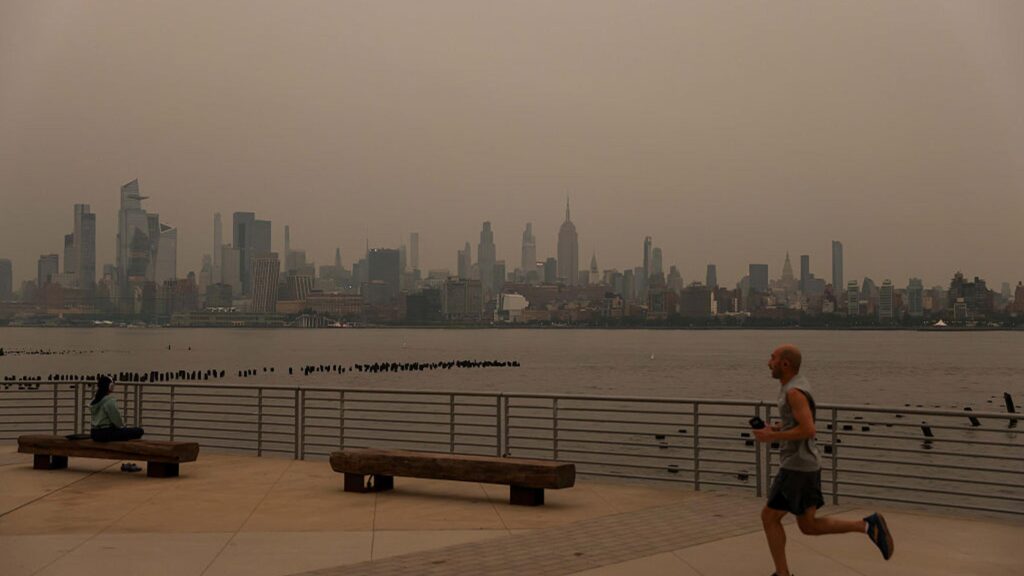
Heavy smoke from wildfires in Canada and Minnesota have brought hazy skies and poor air quality to millions across the United States. Air quality advisories are in effect across several states, including New York, New Jersey, and Wisconsin. It comes as parts of the U.S. are facing record-high temperatures this week—the National Weather Service has forecasted widespread temperatures of 95-105°F.
Heat waves contribute to poor air quality—in fact some of the worst air quality often comes during heat waves. Hot, stagnant air causes air pollution to accumulate and increases the formation of the air pollutant ozone, while hotter, drier conditions are causing more frequent, severe wildfire events that worsen air quality. “All of this together means that the population is frequently experiencing poor air quality events during the summertime that often coincide with extreme heat, and both air pollution and heat are harmful to our health,” says Mary Rice, director of the Center for Climate, Health, and the Global Environment at the Harvard T.H. Chan School of Public Health.
What are the risks of combined exposure to poor air quality and extreme heat?
The combination of extreme heat and poor air quality can be particularly harmful. Approximately 489,000 heat-related deaths occur globally each year, according to the World Health Organization, while the combined effects of ambient air pollution and household air pollution are associated with 6.7 million annual premature deaths globally. One 2022 study published in the American Journal of Respiratory and Critical Care Medicine found that mortality risk on days with combined exposureincreases by an estimated 21%.
Fine particle pollution from wildfire smoke can cause shortness of breath, coughing, dizziness, or fatigue and can aggravate heart and lung diseases and other chronic health issues, while extreme heat can exacerbate illnesses like cardiovascular disease, diabetes, and asthma.
“We know that many of the impacts of air pollution are through the ways in which it strains our cardiovascular and respiratory systems, and we know that heat also strains our cardiovascular system and our respiratory system,” says Allan Just, Nazareth-Ferguson Family University associate professor of public health at Brown University. “When it’s hot out, your heart needs to work harder to push blood out to the periphery to try to cool you down, and when it’s polluted, the small particles can get from your lungs into your bloodstream, and they cause inflammation, and they can damage your heart tissue.”
Part of the challenge is that, when there’s air pollution, it’s hard to follow the same rules you might heed during a normal heat wave.
“Both of these environmental stressors are hitting us at the same time, and the ways in which we adapt to handle them, sometimes can be counteracting,” says Just. “When it’s very hot, people are opening their windows because they want ventilation, but when it’s very polluted, we encourage people to close their windows.”
How do you stay safe when there’s both extreme heat and bad air quality?
Your phone’s weather app can tell you if there is poor air quality. The U.S. Environmental Protection Agency has a webpage and app called AirNow that gives some guidance on what kinds of air quality you may be experiencing and appropriate actions to take.
You can even configure the app to create a forecast to give you advance notice when you’re likely to experience unhealthy air, so you can make proactive decisions like modifying your plans for outdoor activities or turning on HEPA filters.
Certain groups may be more vulnerable than others. Older adults, people who are pregnant, and young children are all at a higher risk for adverse health impacts due to combined exposure. Outdoor workers and people who don’t have air conditioning at home can also be vulnerable.
Stay indoors as much as you can, but avoid opening windows to keep cool, as that can further expose you to polluted air. Set air conditioners or HVAC systems to recirculate indoor air rather than draw in outside air, and if you or a member of your household is particularly vulnerable, consider purchasing a HEPA filter, which are designed to capture small, airborne particles,
Avoid unnecessary outdoor activities, and if you have to go outside, a KN95 or N95 mask can help reduce the amount of fine particulate matter you’re exposed to.
As the planet continues to warm, the double threat of bad air quality and extreme heat is only going to get worse, Just warns. “Climate change is making this more severe, and this is going to be, unfortunately, a regular problem.”
It’s a problem we’re not yet prepared to meet. “Our way of notifying people about temperature doesn’t take into account what the air quality is, and our ways of notifying people about air quality doesn’t take into account what the temperature is,” Just notes. “We may want to think about systems that warn people about this co-occurrence because that’s going to be more common, and there’s increasing evidence that that’s more harmful than just one problem at a time.”
The post What Are The Risks of Extreme Heat Combined With Bad Air Quality? appeared first on TIME.