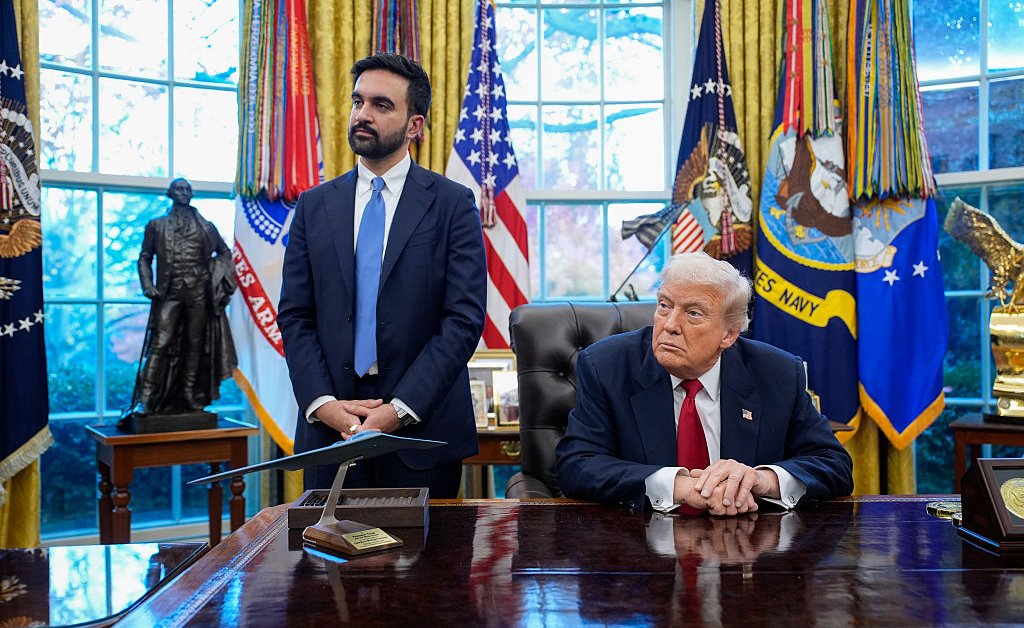
The convergence of Republican President Donald Trump with, of all people, New York’s Incumbent Democratic Socialist Mayor Zohran Mamdani in recent weeks is the kind of head-scratching event that might send adherents of political conventional wisdom spiraling. The two men could not have less in common. Or do they?
[time-brightcove not-tgx=”true”]
If there is anything this bizarre exercise of mutual puffery shows, it is that the United States is currently in an era of resurgent populism. In the last Trump decade, Republicans have largely settled into whatever definition of populism that the president has offered up, which has mostly been rhetorical even as he has largely governed according to well-worn conservative ideals of lower taxes for the wealthy and corporations and supply-side incentives. Mamdani sailed to victory in the New York City mayor’s race, first in the primary, then in the general election, on a platform of affordability undergirded by good old-fashioned class warfare.
But for Democrats, the developments in New York are being met with great skepticism. As Bernie Sanders learned well in 2016 and in 2020, the party is loath to fully embrace a political message that would put it at odds with the moneyed power brokers who hold significant influence in both parties.
To be sure, Democratic leaders have failed to learn how populism truly operates in our politics.
Centrism
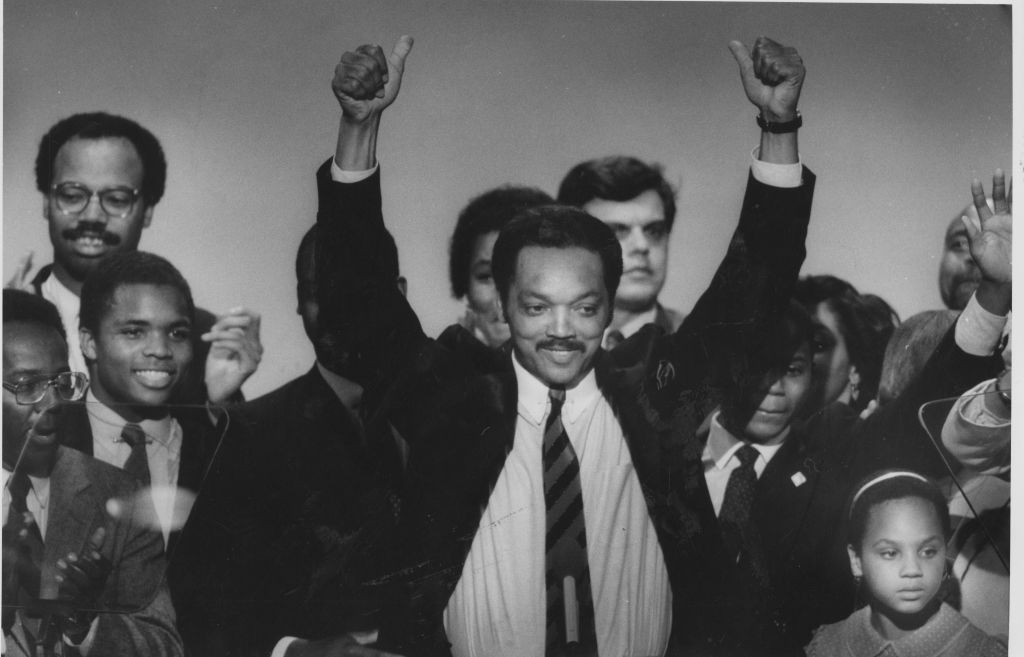
For decades, especially since the emergence of Bill Clinton-era centrism in the early ’90s, Democrats have come to believe that embracing globalization and centrism is the best political way forward. One of the reasons that lesson stuck was because Clinton had emerged a winner after a lost decade where Democrats were thumped by Ronald Reagan and his successor, George H.W. Bush. And for two of those elections, in 1984 and 1988, the party endured a primary that pitted more establishment centrist candidates (Walter Mondale and Michael Dukakis) against an insurgent firebrand Black populist, Rev. Jesse L. Jackson.
Yes, the establishment won both primaries. But what if the real lesson was not that the party failed to become sufficiently centrist, but rather, that it had failed to harness the energy behind Jackson’s grassroots appeal?
James Carville, a key political architect of Clinton’s rise, mused recently: “I carry the torch from a so-called centrist political era. Yet it is abundantly clear even to me that the Democratic Party must now run on the most populist economic platform since the Great Depression.” What he argues for sounds a whole lot like what Jesse Jackson offered in 1984 and 1988. His campaigns spoke to the farmer facing bankruptcy, the mother who can’t put food on the table, and the factory worker watching his job be shipped overseas. And tying it all together was Jackson’s argument that the “system” isn’t working for the working man or woman. It’s an argument that Democrats had largely sidelined in the era of NAFTA, and as a diverse coalition has allowed them to do more politically with less and less of the white vote.
Jackson’s campaigns explicitly threatened the natural order of things, the power brokers, and the fear inherent in modern Democratic politics of a cautious moderate voter who might be repelled by a big tent revival style politics of candidates Jackson and Mamdani.
But what if a version of Jackson’s righteous anger is exactly what the Democratic Party is missing today? That’s the question that Carville asks. And it is one that is hard to miss as a key lesson of Jackson’s campaign.
But here’s what also gets missed today that Jesse Jackson understood well: It is, in fact, possible to speak to the country’s increasingly multiracial citizenry while also focusing like a laser on their economic well-being. After all, Jackson showed the way.
Jackson’s populist legacy
There have been, of course, many times over the last 30 years when the pendulum of Democratic politics has swung in the other direction, away from progressivism. The victory of President Joe Biden in the 2020 Democratic primary over more progressive candidates, including Senator Sanders, might seem to suggest that centrism had prevailed again. In 1988, Biden was a young political star with presidential ambitions and a centrist pedigree. Early on, he took Jackson on directly, appealing to Black voters to reject tribalism.
“You must reject the voices in this movement who tell Black Americans to go it alone, who tell you that coalitions don’t work anymore, that whites and Catholics and Jews no longer care about the problems of Black America, that only Blacks should represent Blacks,” Biden said. It was a misreading of the motivations behind Black voters’ support for Jackson more than a reflection of any malice toward Jackson. But those words ring through the years, continuing to echo even in 2020, as Jackson reemerged in the Democratic presidential primary to offer his endorsement of Sanders’s insurgent campaign over Biden’s.
Biden missed a lot, including Jackson’s quiet efforts over the preceding years to bolster his support among white voters. But what Biden missed most acutely was a core tenet of Jackson’s message, which emphasized the very kind of coalition politics Biden was urging Black voters to insist upon. As a centrist political figure, Biden represented a view that submerged demands for racial justice beneath an effort to create political alliances, principally with white voters and their representatives in power. But what Jackson proposed was altogether different. The coalition he sought was one that intended to unite marginalized groups and whites to create a powerful majority. Such a coalition would not subsume a desire for social justice but would tie together aims of racial, gender, and religious justice with commonly held economic demands. “America is more like a quilt: many patches, many pieces, many colors, sizes, and shapes, all woven and held together by a common thread,” Jackson explained. That’s what makes America great.
Today, a younger generation of progressive lawmakers is challenging their party in ways that echo Jackson. In 2018, they began calling themselves “the Squad.” In recent years, Jackson watched these political developments, seeing his influence in all of it. But increasingly, age and illness took him further and further from the spotlight and further and further from the consciousness of an entire generation of Americans.
I was among them, part of a generation born at the end of the height of Jackson’s political influence. For years, my understanding of Jackson was limited to his civil rights work and his (sometimes) controversial presence at virtually every racial incident happening across the country. What I did not fully appreciate was the degree to which the political chapter of his life presaged the coming demographic and political trends that are currently shaping American politics, from President Barack Obama to Trump. Not to mention Jackson’s campaigns launched an entire generation of Black political journalists whose careers paved the way for my own. Gwen Ifill, Michel Martin, Sylvester Turner, Juan Williams—all covered Jackson’s political campaigns during a period when he was largely discounted by the biggest political reporters of the time. (Richard Ben Cramer’s seminal campaign book about the 1988 race, What It Takes: The Way to the White House hardly mentions Jackson because the candidate refused to sit for an interview.)
But even journalists like Lester Holt, who may never have been on the campaign plane or bus, can credit Jackson’s pressure campaigns to diversify media for boosting their careers. A look back at these campaigns requires a degree of soul-searching in the media as well as the political establishment. Jackson was discounted, misunderstood, and underrated for most of those eight years, until his second- place finish in the Democratic primary in 1988 changed that.
The post What Democratic Leaders Still Don’t Understand About Populism appeared first on TIME.