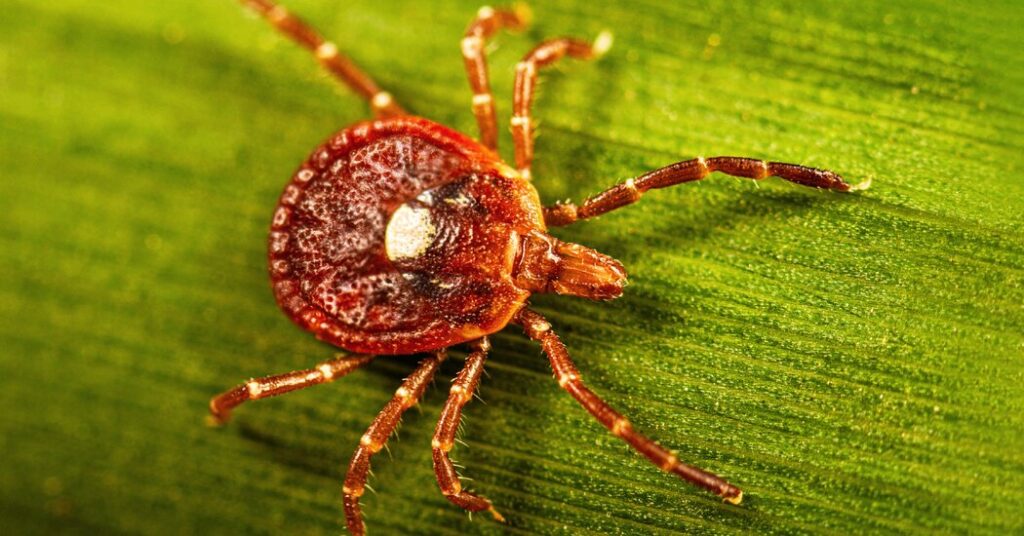
The spread of the lone star tick and alpha-gal syndrome, the red-meat allergy its bite can cause, has alarmed many Americans. But experts say the risk is still low in much of the country, and there is a lot you can do to protect yourself against it and other tick-borne illnesses.
Lone star ticks, which are native to the South, have spread over several decades, and reports of alpha-gal syndrome have increased in the past few years. It’s one of several tick species that have been driven into new regions by a warming climate, land use changes and growing deer populations.
This year’s tick season, which began in the spring, is in full swing and could last well into the fall. Here’s what to know about staying safe.
Where am I at risk?
Lone star ticks are most prevalent in the South but have expanded into parts of the Northeast and Midwest, including Long Island and Martha’s Vineyard.
While risk is widespread in the South, “one should not assume that New England is plagued by lone star ticks,” said Sam Telford, a professor of infectious disease and global health at Tufts University’s veterinary school.
Southern New Jersey, downstate New York and islands like Martha’s Vineyard are generally the limits of where it has established populations, said Maria Diuk-Wasser, a professor of ecology, evolution and environmental biology at Columbia University. The species has moved a bit into Connecticut, but you’re unlikely to find many farther north.
In most of the Northeast, Lyme disease from blacklegged ticks is still a much bigger threat.
Lone star ticks are most commonly found in wooded areas, but not exclusively, said Michael Reiskind, a professor in the Department of Entomology and Plant Pathology at North Carolina State University.
In places where their populations are large, you can find them “anywhere,” Dr. Telford said: the woods, a lawn, a compost pile.
How can I prevent getting bit?
Because there isn’t a cure for alpha-gal syndrome, taking steps to prevent bites is important if you live somewhere with lone star ticks. The same precautions can help protect you against all tick species.
Long pants and sleeves are the first line of defense. Tuck your pants into your socks to create a solid barrier. A hat can shield your scalp. Insecticides such as DEET or picaridin may help, but the best option is to spray permethrin on your clothing, experts said.
In much of the country, tick prevention should be routine, said Dr. Bobbi Pritt, a professor of laboratory medicine and pathology at the Mayo Clinic. “If you’re going outside and you put your sunscreen on,” she said, “think about the tick repellent, too.”
Inspect your body after spending time outdoors, and remove any ticks using tweezers.
Prompt removal prevents many tick-borne illnesses and probably reduces the risk of developing alpha-gal syndrome. It may be possible to get it after a short exposure, though — we don’t know for sure, said Dr. Scott Commins, an associate professor of medicine and pediatrics at the University of North Carolina at Chapel Hill.
But there’s no need to panic or avoid outdoor activities, Dr. Telford said. “People should go out,” he said. “Repellents exist for a reason.”
Do lone star ticks behave differently from other ticks?
Lone star ticks are particularly aggressive, several experts said. Blacklegged ticks, for example, generally wait for someone to brush against them. But lone star ticks seek people out — in part by sensing carbon dioxide, Dr. Diuk-Wasser said — and may travel a few meters in pursuit.
They’re not likely to cross huge distances to bite you, Dr. Reiskind said. But if you’re next to a wooded or overgrown area, or sitting around a campfire, they may approach.
It’s also worth noting that lone star ticks — like some other species — can lay thousands of eggs right around this time of year. The larvae, which are tiny brownish specks, all emerge from the eggs at once and crawl up the nearest surface, like a blade of grass, Dr. Telford said. The unlucky person who disturbs that grass can find their leg covered in hundreds of larvae, a phenomenon sometimes called a tick bomb.
Treating socks and pants with permethrin helps prevent this. But if it happens to you, remove the larvae with a lint roller, tape or the edge of a credit card, and then wash the area with soap and water.
How is alpha-gal syndrome diagnosed?
A blood test can detect alpha-gal antibodies, but a positive test doesn’t necessarily mean you have alpha-gal syndrome. In places with lone star ticks, a large percentage of people may have these antibodies, but most don’t have allergic reactions, Dr. Diuk-Wasser said.
The syndrome is diagnosed only if you react to red meat or dairy. Reactions happen hours after eating and can include hives, difficulty breathing or gastrointestinal symptoms like diarrhea and vomiting. At least one death has been linked to alpha-gal syndrome.
Since lone star tick bites can also cause bacterial and viral infections, look out for flulike symptoms as well. If you don’t have symptoms, there is no need to seek medical attention just because a tick bit you.
“The vast majority of tick bites do not transmit infections,” Dr. Telford said, “and so far as we know, the vast majority of lone star tick bites do not cause alpha-gal disease.”
Can it be treated?
There is no cure for alpha-gal syndrome, though antibodies and symptoms often decline over a few years if patients don’t get additional bites.
Unlike bacterial infections like Lyme disease, alpha-gal syndrome isn’t treatable with antibiotics. It has to be managed like any other allergy, by avoiding trigger foods and potentially keeping an EpiPen on hand.
Dr. Commins said some potentially promising treatment routes were being explored, including repurposing existing medications for other conditions. But there aren’t currently options that have been validated in large, controlled studies of alpha-gal syndrome patients.
The post How to Protect Yourself From Alpha-Gal Syndrome appeared first on New York Times.