James Story, America’s last chargé d’affaires in Venezuela before the embassy closed in 2019, left after the foreign minister passed along a message. The warning was stark, Story told me: If he stayed, he might be murdered.
When American diplomats raised the flag at the embassy in March, for the first time in seven years, they stood outside a building that had been festering in the tropical heat and taken over by black mold. The hostility between the two countries had been festering too, culminating in the moment that the Trump administration sent in special operators to snatch President Nicolás Maduro and his wife. Since then, U.S. leaders and staff—many of them working out of a Marriott two miles from the embassy—have been racing to get reacquainted with one of the most repressive regimes in the hemisphere, filled with some of the same people whom the U.S. has put under indictment for drug trafficking or who have U.S.-sponsored bounties on their heads.
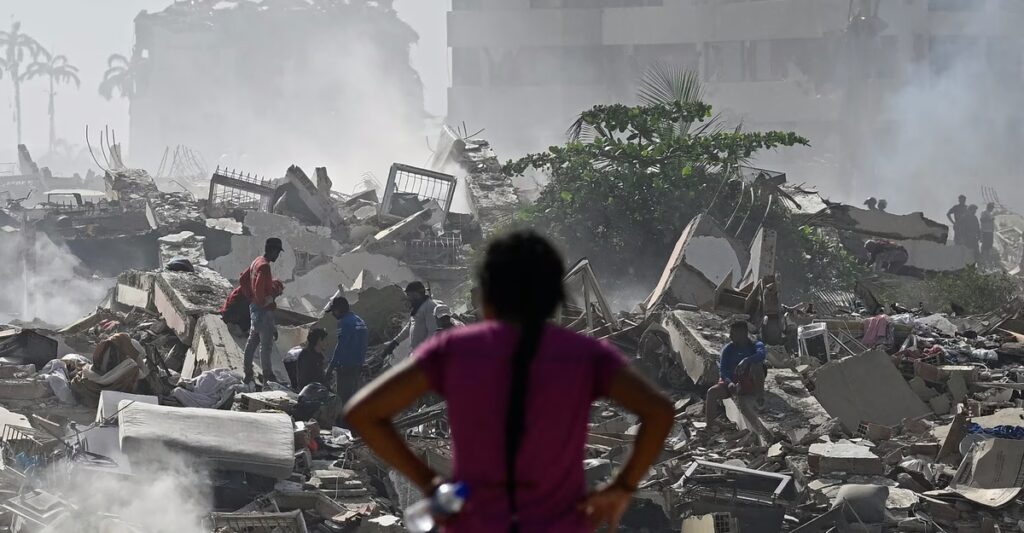
The humanitarian response to the deadly earthquakes in Venezuela last month has only deepened this bizarre partnership. U.S. Marines have become air traffic controllers at Venezuela’s main international airport and are helping run the port in La Guaira, the coastal state that was hit hardest. The State Department’s disaster-assistance team is distributing boxes, emblazoned with the American flag, of food, water, and other supplies.
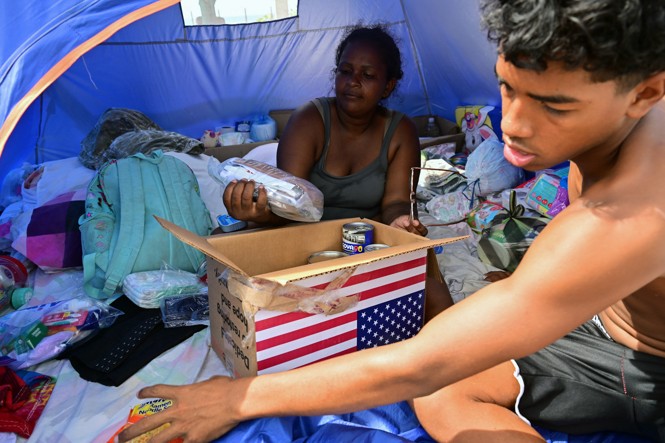
Venezuelans have welcomed such lifesaving efforts after the earthquakes left at least 4,490 people dead and close to 18,000 homeless, according to Venezuelan authorities. But the Trump administration’s approach, in concert with Venezuelan officials who have spent years treating opponents brutally and are widely reviled, risks that goodwill. Last week, the leaders of the U.S. mission on the ground—Chargé d’Affairs John Barrett and General Francis Donovan, the commander of U.S. Southern Command—faced Venezuelans’ outrage after they met with Diosdado Cabello, the interior minister, who oversaw security forces that targeted political opponents. (Previously, the U.S. had offered a $25 million reward for his capture.)
Through multiple U.S. administrations, including Donald Trump’s first term, American diplomats followed relatively consistent tenets in Venezuela: finding common cause with opposition leaders, seeking to free American prisoners, pushing for democratic elections. Then Story, who served in both Trump terms and in the Biden administration, was told the extreme opposition was plotting to kill him and precipitate a war with the U.S.—at a time when relations were so hostile with Maduro’s regime that no one wanted to risk people coming over the embassy walls. Nonetheless, he left a note on his desk saying that he was “filled with optimism that Democracy is within reach.” Now Story worries that whatever tactical success came from Maduro’s capture would be squandered without a democratic transition. “And if that is delayed now because of the earthquake, at some point the frustration will bubble over to the United States,” he said. More of the quiet work the U.S. has been doing in Venezuela since Maduro’s capture is now out in the open, and the choice to decapitate the government without changing much else is being put to a test.
Barrett has maintained that, in the aftermath of the earthquakes, the U.S. government has been fully focused on the humanitarian effort and that Venezuela’s interim government “has been fully compliant of our requests.” At a briefing with reporters last week, he did not answer a question about whether Cabello remained a wanted enemy of the United States; he stressed that the Trump administration’s three-phase plan for Venezuela remains intact.
But those phases—first stability, then economic recovery and political reconciliation, and finally a democratic transition—also seem badly damaged by the earthquakes. No date has been set for democratic elections. The 180-day period defined by Venezuela’s constitution for a temporary presidential absence passed earlier this month with the interim president, Delcy Rodríguez, still in charge. Some U.S. officials are optimistic that her government is acceding to U.S. pressure. Earlier today, her brother, Jorge Rodríguez, the president of the National Assembly, announced new negotiations starting next month with former opposition lawmakers as a way to “strengthen democracy,” after the earthquake. Also today, Delcy Rodríguez posted about “this new stage of dialogue, cooperation, and mutual respect” with the United States.
A State Department spokesperson told me that the U.S. focus remains on its humanitarian response and that “adding sensitive political issues to the mix at this time is counterproductive to our response efforts following this tragedy.” But Secretary of State Marco Rubio acknowledged last month that the earthquakes complicated the path back to democracy: “It’s a setback in that regard,” he told reporters, before reiterating his belief that “Venezuela’s going to emerge stronger from it.”
Venezuelans seem less certain. They have complained about their government’s shortcomings in the nearly three weeks since the earthquakes: its absence in the crucial hours when rescues were still possible, bureaucratic hurdles that choked the flow of aid, soldiers and police looting amid the rubble. Rodríguez has defended her government’s response, saying that widespread reports of chaos were manufactured by “media laboratories” and blaming opponents for politicizing a humanitarian tragedy. The most popular opposition figure, María Corina Machado, tried returning to Venezuela soon after the earthquakes, but the Trump administration ordered her airplane be turned around mid-flight, The Wall Street Journal reported. Her supporters worry that the U.S. relationship with the Rodríguez government could drag on indefinitely, even as its response to the earthquakes has led to more questions about its legitimacy.
[Read: Venezuelans were sorting through the rubble alone]
“There’s a real chance that we’re going to squander this opportunity,” Rebecca Bill Chavez, a former Pentagon official who is now the president of the Inter-American Dialogue, told me. “Betting that stability and Venezuelan oil basically can come first and democracy can wait indefinitely—it’s a dangerous bet.”
During Maduro’s tenure, which started after Hugo Chávez’s death in 2013 and featured a staggering economic collapse, the Venezuelan population repeatedly rose up to demand better lives and fair elections. When I visited Venezuela in this period, the scale of the daily protests against Maduro’s government felt overwhelming—as did the brutal tactics security forces used in killing and torturing their opponents, documented extensively in human-rights reports. Every day felt like a rolling street fight as shock troops chased protesters through downtown Caracas, firing tear gas and rubber bullets and bludgeoning back the waves of opposition.
Even in his first term, Trump seemed willing to take an aggressive posture toward Venezuela: Lee McClenny, who served as charge d’affaires in the first year of the Trump administration, recalled the president requesting “military options” for Venezuela. Trump’s team seemed willing, he said, “to force a decisive confrontation they felt sure they’d win.” Todd Robinson, who was in the country as the top American diplomat in early 2018, told me that he met with the wife of the imprisoned opposition leader, Leopoldo López, in her home, against the regime’s wishes. He went “toe to toe” with Rodríguez, then the president of the Constituent National Assembly, on the porch of his residence in Caracas, telling her that it was not U.S. sanctions but her own government’s failures that left so many hungry. (After an election that the U.S. described as an “insult to democracy” because it excluded opposition candidates, Maduro accused Robinson of conspiring against his government and gave him 48 hours to leave the country.) “We were visibly, vocally anti-regime when I was there,” he told me. “So the idea that we’re now going to treat the rump regime as the current government in Venezuela—to me it just doesn’t make any sense.”
Trump’s suggestion that the U.S. could run Venezuela for years worries many of these former American diplomats, who saw up close the corruption and human-rights abuses of a Venezuelan government that included Rodríguez, Cabello, and others who remain. Just two years ago, the State Department’s human-rights report on Venezuela cited credible accounts of “arbitrary or unlawful killings; disappearances; torture or cruel, inhuman, or degrading treatment or punishment; arbitrary arrest or detention,” and on, and on. Rodríguez’s government has released hundreds of political prisoners and pushed out some of Maduro’s allies in government. But many still see a difficult road ahead. “We’ve bought ourselves a big problem that will last a long time, cost a lot of money, lose us a lot of prestige, and still will not be resolved to our satisfaction,” McClenny said.
The Trump administration’s race to show up after the earthquakes—especially after cutting back foreign aid in many parts of the world—suggests that the U.S. accepts, to some degree, that Venezuela’s problems are now its own. The U.S. has spent some $310 million on the earthquake response, delivered more than 1 million pounds of relief supplies, and donated 10 containers with freezer capacity to help store the dead, according to U.S. officials leading the effort. “We are with Venezuela today,” Barrett told reporters during a briefing last week, “and we will be with you tomorrow.” The scale of this response, however, still lags far behind the billions the U.S. spent after other major disasters in the region, such as the Haiti earthquake in 2010. The head of the United Nations relief effort, Tom Fletcher, has said another $300 million is needed to help more than a million people who need “life-saving support.”
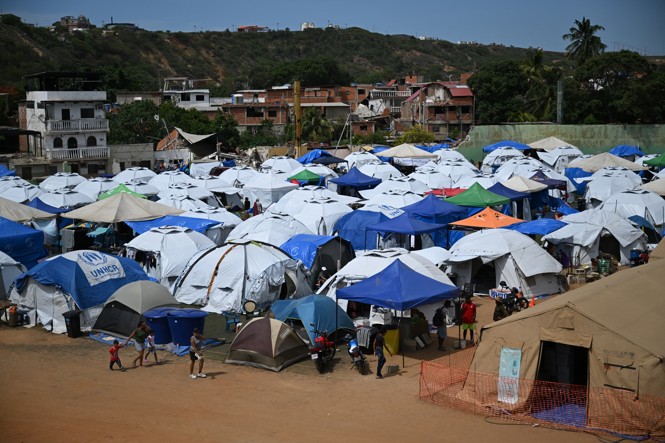
By this point, many search-and-rescue teams have returned home. Thousands of people displaced from collapsed homes are living outdoors and in tent camps in La Guaira; the Associated Press reported a surge in skin conditions and diarrheal diseases amid shortages of fresh water. “You don’t have fresh water, you don’t have sanitation,” Paolo Cravero, a spokesman for the International Federation of Red Cross and Red Crescent Societies, told me from Venezuela. “If those things are not urgently addressed, those will create public-health problems.”
For some aid workers who rushed to help Venezuelans, the U.S. military presence has been jarring. As he drove from Caracas to La Guaira last week, the chef José Andrés, who founded World Central Kitchen, told me that, although everyone was grateful for the U.S. military’s assistance, the presence of helicopters and armed troops made him feel like “they were coming to invade more than they were coming to help.” Donovan, the Southcom commander, has not given a timeline for when the roughly 900 U.S. troops might leave, but he told reporters earlier this month, “When we’re done, we will depart Venezuela.”
The embassy, though, will stay open; eventually repairs will finish and the staff will move back in. Several former diplomats and other officials told me that they wanted the U.S. to stop sidelining the opposition, to press to release the hundreds of remaining political prisoners, and to hasten elections. Some Venezuelan opposition figures still have patience: Jose Ferreira, a leader of the opposition party Primero Justicia, told The Atlantic some exiled political figures have been able to return and, despite the post-earthquake cooperation, he expects that Cabello and others facing sanctions will eventually face justice. “Venezuelans trust that the United States will help Venezuela reach its goals,” he said.
Just steps from the U.S. embassy, in the hilly Valle Arriba neighborhood, 10 to 20 Venezuelans—relatives of political prisoners—have been keeping vigil for almost a month. A Venezuelan flag hangs from a nearby tree with one word written on it: libertad. José Mendoza joined the vigil after Rodríguez’s government scrapped an amnesty law meant to free political prisoners; his son is a former soldier accused of taking part in a failed 2020 attempt to overthrow Maduro. No one from the embassy has come out to talk with them. While the diplomats are dealing with the earthquake damage, he doesn’t expect they will anytime soon.
Mariana Zuñiga contributed reporting from Caracas.
The post The Bizarre Partnership Between the U.S. and Venezuela appeared first on The Atlantic.