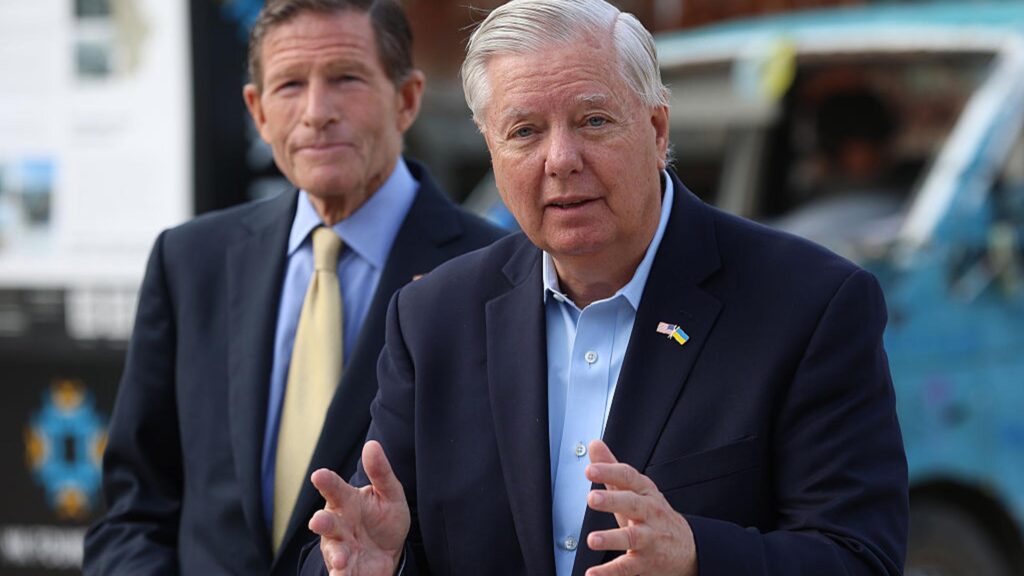
A rare display of bipartisanship unfolded in the Senate on Tuesday as a dozen Republican and Democratic senators stood shoulder to shoulder to unveil sweeping legislation aimed at squeezing Russia’s war economy, framing the bill as the defining legislative legacy of the late Senator Lindsey Graham.
One after another, lawmakers approached the podium to remember the South Carolina Republican, who died suddenly over the weekend, recalling his persistent push over more than a year to forge a bipartisan compromise that could win President Trump’s support. Sen. Katie Britt, Republican of Alabama, said Graham had worked “tirelessly, relentlessly” to bring the measure together and believed it would become the most consequential legislation of his career. Sen. Roger Wicker, Republican of Mississippi, called it Graham’s greatest achievement in the cause of preserving peace in Europe. Sen. Jeanne Shaheen of New Hampshire, the top Democrat on the Foreign Relations Committee, urged Congress to seize what she called a narrow window to pass the legislation.
The bill itself reflects months of negotiations among Senate Republicans and Democrats and the Trump Administration to strike a balance between punishing Moscow and preserving the President’s flexibility as he seeks an end to the war in Ukraine. The sweeping measure would impose mandatory sanctions on President Vladimir Putin, senior Russian political and military leaders, oligarchs, state-owned enterprises and foreign companies supporting Russia’s defense industrial base. It would also target Russia’s financial sector, energy industry, and the “shadow fleet” of aging vessels Moscow uses to evade existing sanctions.
Its most novel provision would authorize Trump to impose tariffs of up to 100% on the five largest purchasers of Russian oil and natural gas—currently China, India, Slovakia, Hungary and Azerbaijan. Countries that buy less than 15% of Russia’s natural gas exports and are demonstrably reducing those purchases would be exempted from the tariffs. The legislation would also allow penalties on those helping facilitate Russian energy sales.
If the bill passes, it would be the first time Congress has explicitly authorized the use of tariffs as a geopolitical weapon with the goal of punishing countries financing another nation’s war effort. That aspect of the bill has raised concerns that Trump might seize the new authority as another lever in the trade war that has defined much of his second term.
“It’s been referred to as a tariff bill,” Sen. Richard Blumenthal, Democrat of Connecticut and Graham’s chief Democratic partner on the legislation, said Tuesday. “But actually, it imposes full blocking sanctions on wide swaths of the Russian economy.” The tariffs, he said, were “targeted, narrowly limited” and carefully crafted to avoid penalizing European allies supporting Ukraine.
Asked by TIME about concerns that Trump might use the bill’s tariff powers to pressure countries on various other issues, Blumenthal said, “No more than he does now.” He stressed that he wasn’t concerned about giving Trump more tariff powers. “I mean, right now he is threatening to use tariffs illegally,” Blumenthal said. “He could do the same here, but this bill is very narrowly targeted, and the authority is confined to the five major purchases of oil and gas, with that 15% exemption, and then the evaders that are enabling trans-shipments and other kinds of avoidance.”
Since returning to office, the President has repeatedly relied on tariffs against allies and rivals, often invoking national security or emergency authorities to justify sweeping import taxes. The Supreme Court ruled earlier this year that Trump exceeded his authority under the International Emergency Economic Powers Act to impose sweeping global and reciprocal tariffs.
Blumenthal said he had spoken with Graham only hours before his death and had never heard him more jubilant than after learning the Trump Administration had agreed to support the legislation following what he described as painstaking negotiations. Britt said Graham also called her after speaking directly with Trump and was “overjoyed” that they had finally “landed the plane” on a proposal capable of winning broad bipartisan support.
Trump said earlier Tuesday the legislation had “a good chance” of advancing, but he also suggested expanding it to target Iran and Hezbollah. Blumenthal urged against reopening the carefully negotiated measure. “With all due respect to the President, he has approved this bill, and we should move forward with this bill rather than opening it,” he said, emphasizing that the current version is the product of nearly two years of negotiations. However, he conceded: “If there are other bills that he wants to propose, we’ll consider them.”
In recent months, Ukrainian forces have struck deep inside Russia while imposing mounting costs on Moscow’s military. Shaheen warned that as long as the Kremlin could continue financing its war through oil and gas exports, it could sustain the conflict indefinitely.
Despite broad bipartisan backing, the measure’s legislative path remains uncertain. Senate Majority Leader John Thune of South Dakota said Monday that passing the bill would be a fitting way to honor Graham but stopped short of committing to bringing it to the floor, saying leaders were still evaluating a path forward. The measure would also have to pass the House, which may have objections, particularly by the chamber’s Republicans if Trump continues to insist the bill should be expanded.
The post Russia Sanctions Bill Championed by Graham Would Give Trump New Tariff Powers appeared first on TIME.