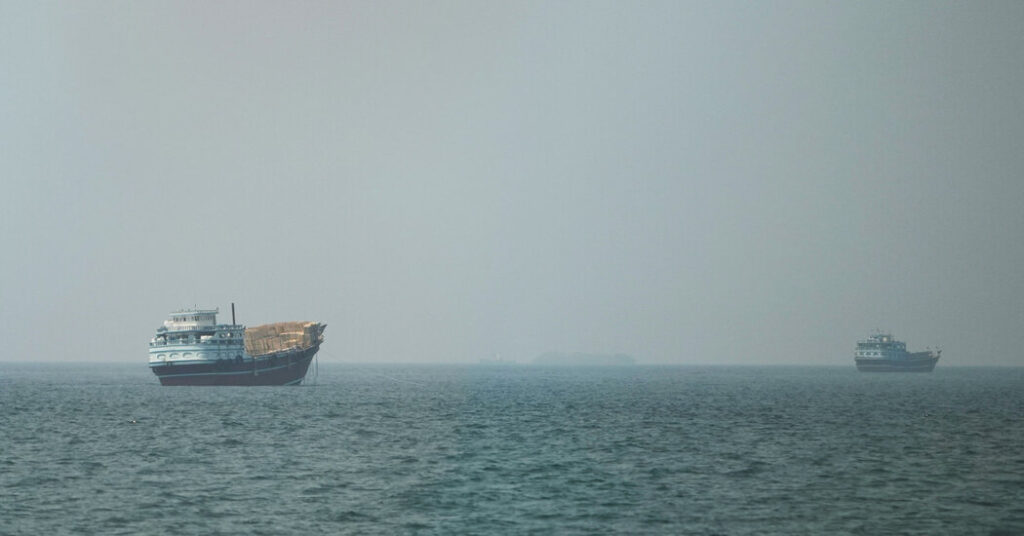
President Trump has said that the United States will charge a 20 percent fee on cargo shipped through the Strait of Hormuz, despite his own administration’s position that such fees violate international law.
He made the announcement on Monday amid an intensifying battle between Iran and the United States to control the waterway, a crucial artery for global energy supplies. The two countries have traded attacks over the strait for the past week, in effect shattering their month-old cease-fire.
Since the U.S.-Israeli attacks on Iran in February that set off the war, Iran has periodically fired on commercial ships transiting the strait as it seeks to compel vessels to use a route close to its coast, a potential precursor to charging its own fees.
Here’s what to know:
What did Trump say?
In announcing his plan to levy a toll, the president described it as a way for the United States to recover the cost of providing military protection to vessels using the waterway.
“The Hormuz Strait is OPEN, and will remain OPEN, with or without Iran,” Mr. Trump wrote on social media. He added that the United States would levy the 20 percent fee for “any and all costs necessary,” describing it as “a matter of FAIRNESS,” and also said the United States would resume a blockade of Iranian ports.
This is not the first time Mr. Trump has threatened such a toll. He raised the possibility last month after signing a temporary cease-fire agreement with Iran, even though that deal included language that Tehran has interpreted to mean it has authority over the strait. The memorandum also said that no country would collect tolls for 60 days, though it left open the possibility for such charges beyond that.
How would a U.S. toll work?
This isn’t exactly clear. Mr. Trump did not elaborate on how the 20 percent fee would be calculated or how it would be collected.
Mr. Trump and his aides also have not explained why his position contradicts the assertions of top officials in his administration.
Last month, Secretary of State Marco Rubio said that tolls could not be imposed on the Strait of Hormuz. “No country is allowed to charge tolls or fees on an international waterway. That’s existing international law,” he said.
Mr. Trump’s announcement, along with ordering a resumption of the blockade of Iran, reflected how his options for resolving the war were narrowing.
How would a toll affect shipping and markets?
A 20 percent fee on the value of a vessel’s cargo could more than double the cost of shipping oil through the strait, experts said.
For a large tanker carrying two million barrels of oil, for example, the fee could add over $30 million in costs. Consumers would likely face higher prices as a result.
Because of the high cost, some analysts said they doubted whether the fee would come into force. For ship operators in the region, the prospect of fees is less of a concern right now than an escalation of the conflict between Iran and the United States, experts said.
Do such tolls exist anywhere else?
Another crucial waterway offers a potential precedent: the Strait of Malacca, in Southeast Asia, through which transit about 23 million barrels of oil a day.
Ships passing through that strait, which is jointly administered by Singapore, Indonesia and Malaysia, pay fees when they need specific services, such as towing assistance or help navigating the narrowest stretches. But ships do not pay for passage.
The political and security environment of the Strait of Malacca is also fundamentally different, with the three countries administering it largely without major conflict, and having avoided interstate war for about six decades.
How has Iran responded?
Foreign Minister Abbas Araghchi noted the irony of Mr. Trump announcing a toll in the strait after his administration rejected the idea of Iran collecting one.
Mr. Trump was “absolutely right” that whoever provided safe passage through the strait should be compensated, Mr. Araghchi said on social media — and then repeated Iran’s claim to that role.
He added with evident sarcasm: “20% is of course too much. We will be fair.”
Since Tehran effectively blockaded the waterway earlier in the war, Iranian officials have repeatedly declared their intent to monetize the strait. Iran and Oman, which is on the southern side of the strait, are said to be exploring ways to the two countries to charge ships transiting through it.
Oman’s proposal is modeled in part on arrangements in the Strait of Malacca. It is unclear whether any payment would be voluntary or mandatory.
The post What to Know About Trump’s Plan to Charge a Toll in the Strait of Hormuz appeared first on New York Times.