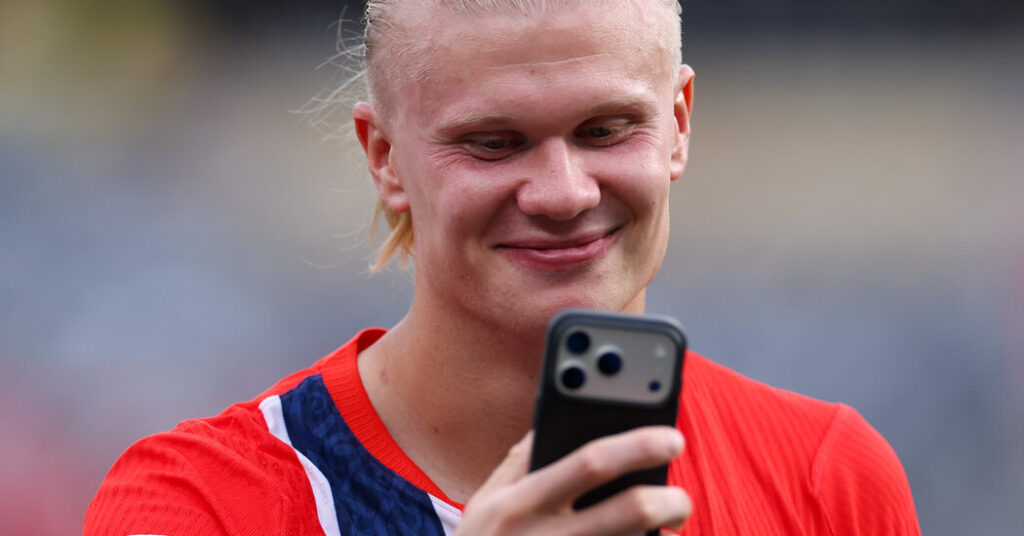
Erling Haaland, Norway’s talismanic striker, led the country’s team to its best-ever World Cup finish — but he’s also a burgeoning social media sensation, known for his sense of humor and self-deprecation. His popularity has exploded even in China, which didn’t have a team in the tournament but where he has become the face of myriad memes, from his alleged resemblance to cartoon characters to fan art depicting him as the romantic hero of a sci-fi dating game.
Mr. Haaland, already one of the world’s most recognizable soccer players, has gained legions of fans around the world over the course of the tournament. His Instagram following has grown by millions in the past few weeks, as have his Douyin and Weibo accounts — the Chinese equivalents of TikTok and X.
One of his early moments of internet fame in China came in the buildup to the tournament, when he starred in an advertisement for Walovi, a Chinese herbal tea brand. In the ad, Mr. Haaland breathes fire while holding a massive barbecue skewer in each hand, a play on the Chinese concept of “shanghuo” or “excess internal heat,” before cooling down with the drink.
On Weibo, hundreds of millions of people have viewed hashtags detailing Mr. Haaland’s endorsement of the tea, as well as the cost of the hair ties he uses for his flowing blond locks (42 yuan, or about $6.30, according to some posts) and others declaring that “Haaland is the funniest football star I’ve ever seen.”
Fans have taken to his enthusiasm for Chinese culture and willingness to engage with online memes and trends. They’ve even given him an affectionate nickname that he has acknowledged on social media: “Ha Bao,” or “Baby Ha.”
On Douyin, Mr. Haaland has delighted fans by discussing the Chinese foods he wants to try and taking part in a popular meme in which people pretend to swallow a monorail in the southwestern city of Chongqing. He’s even shown his Chinese audience how to tie his signature topknot.
Mr. Haaland’s exaggerated expressions and blond hair have been referenced in numerous memes, including one that places his hair on top of an image of a pouting Tom, the cat from “Tom and Jerry,” with some Chinese fans claiming a resemblance between their expressions.
In another meme, fan-made art depicted him as a romantic hero of “Love and Deepspace,” a popular Chinese sci-fi romance mobile game, complete with an exaggeratedly chiseled physique and layers of body jewelry.
His quirky character, relatable silliness and unmistakable appearance resonate with China’s “chouxiang” or “abstract” meme culture, which is characterized by bizarre or unconventional characters, appearances and behavior, said Tobias Zuser, a sports and cultural studies researcher at the Chinese University of Hong Kong.
Some of the memes are so popular that they have made their way into Western fandom spaces. In one such video, Mr. Haaland appeared to be startled by his own reflection, which turned out to be an A.I.-altered version of a skit posted by a Chinese content creator, Agence France-Presse’s Fact Check reported.
Mr. Haaland has long been prolific on social media — last year, he started a YouTube channel, where he provides a playful insight into his life that is at odds with the outwardly polished approach of many elite footballers. He’s also nodded to his new American fanbase, with visits to locales like Wild Bill’s Western Store, where he shopped for a Stetson hat while wearing a T-shirt with the message “Y’all can kiss my Dallas.”
Part of Mr. Haaland’s online fame has been engineered. His agent, Rafaela Pimenta, has said that Mr. Haaland’s move to seek endorsements in China was deliberate following his success in the American market, according to The Athletic.
But his marketability is also predicated on his popularity. The site reported that in the days before Sunday’s quarterfinal between Norway and England, Mr. Haaland’s camp was told that social-media algorithms were being geared toward content featuring him in response to user demand.
In China, his appeal stems in part from the fact that the Chinese national team did not qualify for the World Cup, leading many fans to throw their support behind successful players from other teams, said Jian Xu, an expert in Chinese digital media and celebrity studies and an associate professor at Deakin University in Australia. (Other fans have rallied behind Ma Ning, the tournament’s highest-ranking Chinese referee.)
When Norway lost to England on Sunday, in a nail-biting game in South Florida, Chinese fans mourned the end of Mr. Haaland’s World Cup. And after the match, he made sure to thank his fans on Weibo.
“Goodbye,” he wrote in Chinese. “This unforgettable journey!”
The post How Erling Haaland’s Brand of Weird Resonates in China appeared first on New York Times.