The U.S. military will reimpose a blockade on Iranian ports, President Donald Trump said Monday, taking away the last major concession to Tehran that had helped foster a ceasefire and significantly escalating the conflict.
“We are reinstating the THE IRANIAN BLOCKADE, so named because it is only stopping Iran’s ships or customers from entering or leaving. All other countries will have fair and open use of the Strait,” Trump wrote on Truth Social on Monday.
Trump said that the Strait of Hormuz is “OPEN, and will remain OPEN, with or without Iran.”
Iran has claimed full control over the strait and on Sunday declared that it was closed.
The U.S. decision to reinstate the blockade came after days of renewed bombing and as the two countries traded heavy airstrikes on Monday as they fight for control of the crucial shipping bottleneck. The tentative ceasefire has all but collapsed after failed talks over the weekend.
On Friday, senior U.S. officials said they hoped Iran would keep the strait open for all commercial vessels, continue negotiations with Washington and acknowledge that they “screwed up” by attacking transiting ships.
Instead, Tehran has been using drones to strike ships and deploying boats to intercept tankers that try to traverse the waterway without its permission. On Monday, Iran’s Islamic Revolutionary Guard Corps “stopped two ships because they had switched off their tracking systems and taken an unauthorized route through the Strait of Hormuz,” the official Islamic Republic News Agency reported. The agency also reported that the IRGC attacked U.S. bases in Kuwait, Jordan and Bahrain.
Trump also said the United States will charge 20 percent “on all cargo shipped, for any and all costs necessary to do the job of providing safety and security to this very volatile section of the World.” A 20 percent fee on all cargo transiting the strait would be a major new tax on global energy flows and would drive up the cost of the world’s oil and gas. About a fifth of the world’s oil supply flowed through the strait before the war began in February.
Until Monday, U.S. officials had been adamant that passage through the strait should not require paying tolls to anyone and that Iran’s efforts to charge for shipping was unacceptable.
Trump’s declaration that the U.S. will levy fees gave an opening to Iranian Foreign Minister Abbas Araghchi, who wrote in a somewhat tongue-in-cheek post on X that “POTUS is absolutely right. Whoever provides secure and safe passage of commercial vessels through the Strait of Hormuz should be compensated for this service.”
He mimicked Trump’s distinct capitalization, saying that “Iran has always been the GUARDIAN of the Strait and will remain so FOREVER. 20% is of course too much. We will be fair.”
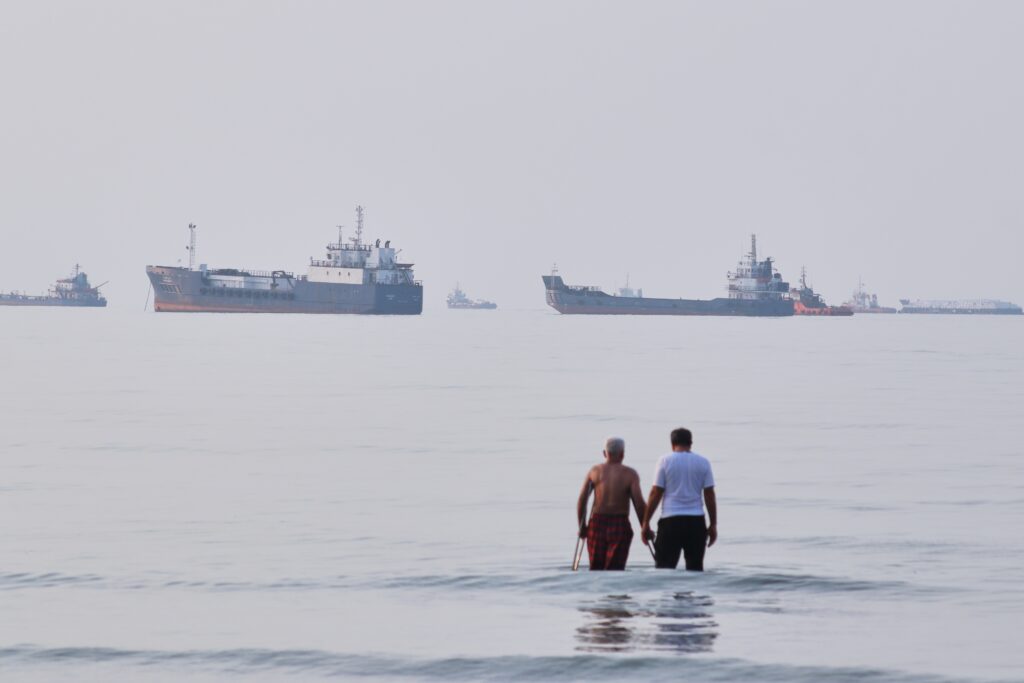
The blockade will go into effect Tuesday at 4 p.m. Eastern time, Central Command said in a statement posted to social media. Like the previous iteration, this blockade will affect any vessel departing or heading into an Iranian port, the military said. During the previous blockade, U.S. warships intercepted or turned around more than 140 commercial vessels. In nine cases in which the ship was not complying, the military fired into the ships’ engine rooms to disable them.
The decision to reimpose the U.S. blockade rolls back nearly all of Iran’s gains under the memorandum of understanding that the two countries signed last month. Washington rescinded an oil sanctions waiver and imposed fresh sanctions last week.
The renewed hostilities over the narrow waterway, which is vital to global commerce, pushed Brent crude oil prices higher, to more than $79 per barrel as of early Monday afternoon.
When asked Monday morning on the “Fox & Friends” show to respond to Iran’s claim regarding the Strait of Hormuz, Trump reacted dismissively and said, “We’re taking over the strait.”
“They have nothing; they’ve got nothing,” Trump said as he expressed frustration about the talks. “Everything was agreed to yesterday, and they leave the room and they call back and say, ‘We had to make a couple of changes.’ I said, ‘We’re not going to make changes.’”
“You know,” Trump added, “they’re professional negotiators.”
As of Monday, the Navy had at least 19 warships deployed to the Middle East, the majority of which were sailing in the northern Arabian Sea, a U.S. official said. The vessels include two aircraft carriers, the USS Abraham Lincoln and the USS George H.W. Bush; 13 destroyers; the USS Boxer, an amphibious assault ship; a cruiser; and two landing ships.
The overwhelming number of destroyers on hand gives the U.S. a large amount of firepower and presence to carry out the blockade.
The count of ships does not include any nuclear submarines that may be deployed nearby, as the Navy typically does not acknowledge where those vessels are located.
The U.S. official spoke on the condition of anonymity to provide additional details about the force presence near Iran.
Iranian Foreign Ministry spokesman Esmaeil Baqaei told reporters Monday that it was the U.S. that was to blame for the failure of mediation efforts that took place Saturday in Oman, and that Washington was repeatedly reneging on terms of the memorandum of understanding negotiated in Islamabad and signed with the U.S. on June 17.
The talks collapsed because of “overt and covert” U.S. pressure on Oman, Baqaei said, adding that the Islamabad agreement has entered “a crisis phase.”
“Interpretation against the text is not permissible,” Baqaei said, referring to the June 17 document. “Lying has become part of the U.S. administration’s behavioral pattern, and they have become addicted to it.”
On Friday night, senior U.S. officials had briefed reporters in Washington, saying they had been assured by Iranian negotiators that attacks on ships in the strait were carried out by a faction that sought to undermine the deal. The senior U.S. officials, speaking on the condition of anonymity to discuss sensitive negotiations, said that they hoped that Iran would publicly acknowledge that they “screwed up,” but that the U.S. military would retaliate with 20 times the force if the Iranian military fired.
But the weekend’s events — including a written statement by Iran’s new supreme leader, Ayatollah Mojtaba Khamenei, vowing revenge against the U.S. and Israel — suggested a continued hard-line streak within Iran’s leadership.
Alan Eyre, an Iran expert and former diplomat who served on the U.S. negotiating team that secured the 2015 Iran nuclear deal, said it is unlikely that a “faction” carried out the recent attacks in the Strait of Hormuz. Eyre said Tehran probably sees the attacks as establishing red lines, rather than undermining a possible deal.
“The regime, collectively, has realized that, for reasons of strategic deterrence, if nothing else, they must control the Strait of Hormuz going forward,” Eyre said. After years of back-to-back strategic defeats regionally, he said, Tehran believes that if it compromises on the strait, it will be inviting further attacks from Israel and the United States.
“They believe that if they do a deal that violates certain key red lines, Israel and the United States will increase pressure on them,” he said.
In the short term, Eyre said, Iran is trying to use the Strait of Hormuz to reestablish deterrence, but both sides are likely to be frustrated by vague language in the memorandum of understanding and a general lack of trust.
Meanwhile, Iranian media outlets reported explosions on Qeshm Island and outside the city of Bandar Abbas.
U.S. officials have previously said that they are targeting that stretch of the Iranian coast with missiles to weaken Iran’s ability to fire on commercial vessels in the strait.
The extent of damage to U.S. bases was not immediately clear. Kuwait and Jordan said they intercepted incoming Iranian projectiles on Monday, while sirens sounded in Bahrain.
Tara Copp, Susannah George, Mohamad El Chamaa and Suzan Haidamous contributed to this report.
The post Trump says U.S. military will reimpose blockade on Iranian ports appeared first on Washington Post.