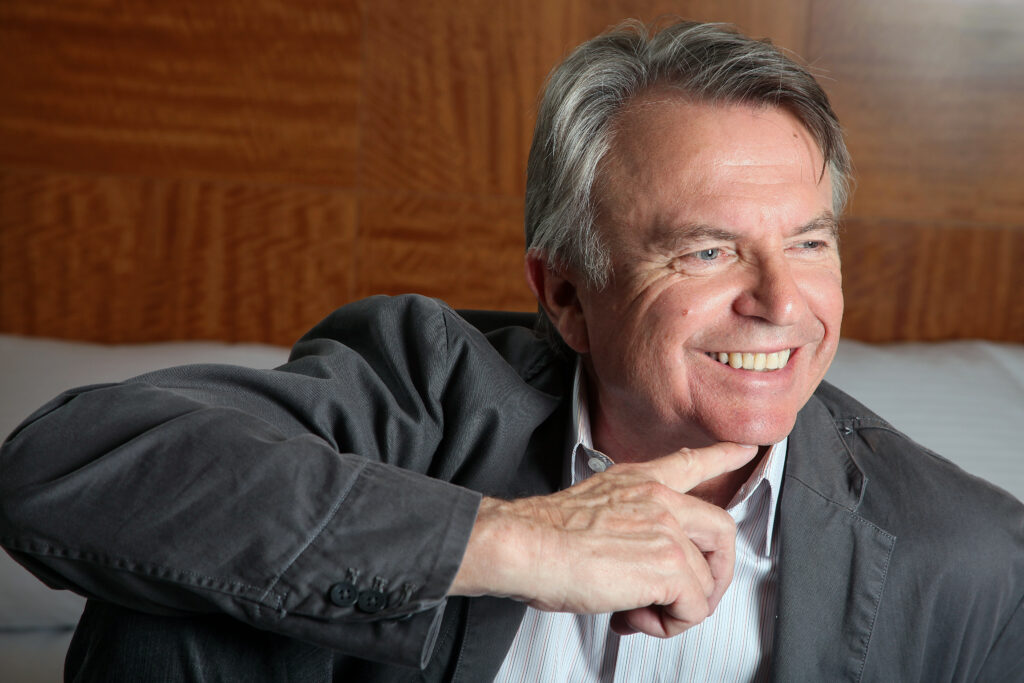
Sam Neill, a New Zealand actor who brought a quiet intensity to art-house fare and Hollywood blockbusters alike, including as a rigid husband vexed by his wife’s love of music in “The Piano” and a fedora-clad paleontologist fleeing a T-rex in “Jurassic Park,” died July 13 in Sydney. He was 78.
In a social media statement, Mr. Neill’s family described his death as “sudden and unexpected” but did not disclose a cause. He was diagnosed in spring 2022 with angioimmunoblastic T-cell lymphoma, a form of blood cancer, but in April, he announced he was cancer-free after a clinical trial of a new therapy. His family said Monday that he remained free of the disease.
In roles as loners, scoundrels, madmen and everymen, Mr. Neill proved a versatile performer comfortable in leading or supporting parts. He had started acting as a schoolboy, discovering that his childhood stutter disappeared when he was performing onstage, and went on to appear in more than 150 movies and TV shows across five decades.
Mr. Neill helped launch a new wave of New Zealand cinema while starring in the dystopian thriller “Sleeping Dogs” (1977), the first feature film made in the country in years, and gained wider notice in Australian director Gillian Armstrong’s period drama “My Brilliant Career” (1979), as a handsome blue-blood — tousled hair, mellifluous voice — courting an aspiring writer (Judy Davis).
The film’s admirers included British-born movie star James Mason, who tracked down Mr. Neill’s phone number, called him up and invited the younger actor to his home in Switzerland. He became a mentor, helping Mr. Neill get a London agent and offering what Mr. Neill recalled as “good practical advice” for screen acting: “Never eat, drink or smoke in a scene. If you do, you’ll be eating, drinking and smoking all day.”
Mr. Neill said he modeled his approach to work after Mason, whom he described as an actor who “was prepared to show the darker sides of light characters and vice versa.”
That also became true of Mr. Neill, who delivered multifaceted performances in films including the horror thriller “Possession” (1981), as a spy whose marriage and wife are both unraveling; “A Cry in the Dark” (1988), also known as “Evil Angels,” in which he and Meryl Streep played the parents of a missing child; and the thriller “Dead Calm” (1989), as a grieving father trying to save his wife, Nicole Kidman, from an intruder at sea.
For “The Piano” (1993), an erotic drama that brought him back to New Zealand to work with director Jane Campion, Mr. Neill played a 19th-century bachelor who arranges to marry a mute Scottish woman (Holly Hunter) who has a young daughter (Anna Paquin). His character is patient but remote, seemingly uncertain of his new situation, until he learns that his wife is in love with another man (Harvey Keitel). He responds by cutting off one of her fingers with an ax.
“Neill’s taciturn husband conceals a universe of fear and sadness behind his clouded eyes,” wrote film critic Roger Ebert, calling the movie “as peculiar and haunting as any film I’ve seen.”
Less than a month after “The Piano” won the top prize at the Cannes Film Festival, Mr. Neill starred in “Jurassic Park” (1993). As Dr. Alan Grant, a crusty paleontologist invited to tour a theme park of resurrected dinosaurs, he helped bring a human touch to a movie that set a new benchmark for computer-generated imagery and jumbo-sized animatronics.
When the time came for Steven Spielberg to unveil his CGI dinosaurs on-screen, the director pointed his camera at Mr. Neill, who was shown tossing off his hat, setting aside his sunglasses and hopping out of a jeep in astonishment. “It’s — it’s a dinosaur,” Grant says, pointing upward as a brachiosaurus takes a bite out of a tree.
On location in Hawaii, Mr. Neill and his human co-stars (including Laura Dern and Jeff Goldblum) had been instructed to look at a piece of paper with an X on it, marking the spot where the dinosaur would be inserted in postproduction.
The film grossed more than $1 billion, won three Academy Awards and inspired multiple sequels, although Mr. Neill was skeptical that the effects-driven movie would make him a superstar. “Maybe the T-rex,” he told the Toronto Star, “but not me.”
But the film’s success did help him find new opportunities in Hollywood, including roles opposite Robert Downey Jr. in “Restoration” (1995), Robert Redford in “The Horse Whisperer” (1998) and Robin Williams in “Bicentennial Man” (1999).
Still, he preferred to make movies closer to his homes in Sydney and New Zealand, where he ran a winery and was knighted in 2022 by a representative of Queen Elizabeth II. By his account, he was more interested in growing grapes than in cultivating the kind of consistent, recognizable screen persona expected of a movie star.
“I’ve never had an image,” he told the Chicago Tribune in 1995, “nor have I fostered one or wanted one, which has meant that I’ve had fantastic freedom to do whatever it is that appeals at the time.”
When he wasn’t acting, Mr. Neill was by all accounts self-deprecating and unpretentious, far warmer than many of the rascals he played on-screen. He steered interviews toward discussions of climate change and his left-leaning politics, avoiding examinations of his acting style or personal life. “I’m just Mr. Triviality, as shallow as my wash basin,” he told Scotland’s Glasgow Herald newspaper in 2001. “No deep glacial lakes of profundity here.”
For decades, he continued to mix independent films and big-budget productions, starring as a pipe-smoking observatory chief in the Australian comedy “The Dish” (2000), a brutal police inspector in the British drama series “Peaky Blinders” (2013-14) and a cantankerous foster parent in “Hunt for the Wilderpeople” (2016), a comic drama directed by New Zealand native Taika Waititi.
He also slipped comfortably back into character as Grant, battling a pack of angry velociraptors in “Jurassic Park III” (2001) and reuniting with Dern and Goldblum in the franchise’s “Jurassic World Dominion”(2022).
“I get stopped for different reasons on the street, but ‘Jurassic Park’ would be the most universal of them,” he told Entertainment Weekly. “If I go to the Philippines or Rwanda or something, people just know me all around the world. And they’ll start roaring like dinosaurs.”
‘A sense of complexity’
The second of three children, Nigel John Dermot Neill was born in Omagh, Northern Ireland, on Sept. 14, 1947. His mother was an English homemaker, and his father was a New Zealander who served as a British army major before joining the family business, a wholesale company that sold wine and other goods.
When Mr. Neill was 7, his family moved to New Zealand, settling near the South Island city of Dunedin. Four years later, Mr. Neill discarded his first name — “probably the best decision I made in my life,” he wrote in his memoir — and began using the nickname Sam, which he considered less “effete.”
He went to boarding school in Christchurch, where he started acting as a way to meet girls, and graduated from Victoria University of Wellington, the capital.
Finding limited opportunities to act on-screen, Mr. Neill joined the New Zealand National Film Unit, directing and editing documentary shorts and picking up some of the techniques that he later used to make an hour-long documentary, “Cinema of Unease” (1995), about the history of New Zealand cinema.
After his early breakthroughs, he acquired a reputation for playing, as he put it, “men with cold blue eyes that can drill holes through steel at 100 paces,” whether as Damien the Antichrist in “Omen III: The Final Conflict” (1981) or a demented spaceship designer who, in “Event Horizon” (1997), vivisects a colleague, gouges out his own eyes and declares, “Where we’re going, we won’t need eyes to see.”
Other films highlighted his rugged physicality. He had action roles in “Attack Force Z” (1981), a World War II film with Mel Gibson, and “The Hunt for Red October” (1990) as the second-in-command to Sean Connery’s Soviet submarine captain. He also drew praise for starring as a cold-blooded and womanizing secret agent in the British miniseries “Reilly: Ace of Spies” (1983).
The show helped bring him steady work on television, including roles as a KGB colonel in the ABC miniseries “Amerika” (1987), Cardinal Thomas Wolsey in Showtime’s “The Tudors” (2007) and the magical title character in NBC’s “Merlin” (1998), which earned him an Emmy nomination. He received a second nomination for narrating “New Zealand: Earth’s Mythical Islands” (2016), a documentary miniseries.
The rural life
When he was in his early 20s, Mr. Neill had a son, Andrew, who was given up for adoption. They reconnected 25 years later, according to Mr. Neill. He also had a son, Tim, from a relationship with New Zealand actress Lisa Harrow, his on-screen love interest in “Omen III.”
In 1989, he married Noriko Watanabe, a Japanese makeup artist who worked on “Dead Calm.” They had a daughter, Elena, and Mr. Neill also adopted Noriko’s daughter from an earlier marriage, Maiko. The couple separated in 2017. Mr. Neill was later in a relationship with Australian journalist Laura Tingle.
Information on survivors was not immediately available.
During the coronavirus pandemic, Mr. Neill was a soothing presence on social media, posting videos of himself playing the ukulele and relaxing on his winery, Two Paddocks. Located in South Island’s Central Otago region, the estate was home to animals that Mr. Neill named after some of his friends, including Laura Dern (a cow), Jeff Goldblum (a ram) and Meryl Streep (a chicken that ended up getting killed by a ferret).
Mr. Neill posted playful videos of himself doing morning stretching routines with one of his pigs and reciting positive mantras to his duck, Charlie Pickering. But the farm was no joke: He was a serious vigneron and had been interested in fine wine ever since Mason poured him his first glass of Burgundy.
“My wine has many more dimensions than I could possibly aspire to have,” he told the Times of London in 2014. “I don’t expect people to take me seriously, but I’m determined that they respect my wine. A few weeks ago it won a trophy and two gold medals in London. I call that the ‘up yours’ factor.”
correctionA previous version of this article incorrectly said that “Jurassic World Dominion” (2022) is the latest film in the Jurassic Park franchise. The newest film in the franchise is “Jurassic World Rebirth” (2025).
The post Sam Neill, versatile actor who starred in ‘Jurassic Park,’ dies at 78 appeared first on Washington Post.