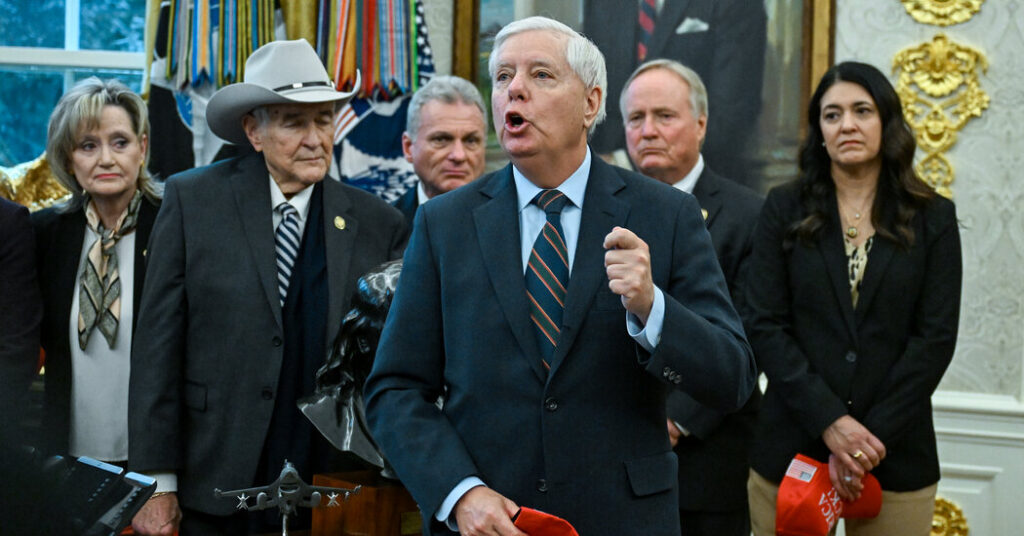
Lindsey Graham always insisted on being part of the Senate conversation, even when the conversation wasn’t necessarily about him.
The South Carolina Republican, who died on Saturday, was a player in the institution in an old-school sense, injecting himself into the big debates on foreign policy, the judiciary, immigration and fiscal policy in a singularly determined way as he strove to stay relevant in an institution where relevancy is power.
He was a complex and sometimes conflicted figure, torn between doing what he thought was right — including pressing an interventionist foreign policy and pursuing bipartisan deals on immigration and other issues — and the political imperatives of a party and state that increasingly demanded hard-right fealty and international isolationism.
After winning election to the House as a right-wing foot soldier of the Republican revolution of 1994, he elevated his profile in Washington with his folksy Southern-lawyer presentation as a House manager for President Bill Clinton’s impeachment trial in 1999. “Is this Watergate or Peyton Place?” he famously quipped, cutting through the dry and legalistic proceedings with an acknowledgment of the sordid nature of the proceedings.
It was not long before he would win election to the Senate in 2002, where he quickly put his personal assets of political canniness and sharp humor to work pushing the chamber’s levers of influence to advance his aggressively hawkish views — his priority — while also playing a major role on judicial confirmations and budget policy.
He also established a reputation for reaching across the aisle on major issues, including immigration, and for his willingness to criticize his own party. That included when Donald J. Trump first burst on the political scene in 2015, and Mr. Graham warned that he was a “demagogue” and a “race-baiting, xenophobic, religious bigot” who should be rejected by the party.
But he quickly reversed course after Mr. Trump’s election and, apart for a brief interlude after the Jan. 6, 2021, assault on the Capitol — “All I can say is count me out,” he said, suggesting a final break with the president that never materialized — fully ingratiated himself with Mr. Trump. Through regular rounds of golf, flattery and incessant phone calls, he always made sure he had Mr. Trump’s ear, apparently unconcerned with looking hypocritical. Mr. Graham’s over-the-top praise of the president sent eyes rolling, but he had an endgame in mind.
“He was a consequential senator who wanted to be in the middle of the action and make a difference,” said Senator Susan Collins, Republican of Maine, a frequent companion of Mr. Graham on his frenetic trips to world capitals. “He had a passion for defense and foreign policy. To his credit, he helped turn around Trump on Ukraine over and over again by repairing the relationship and developing it in the way he did to help Ukraine.”
In the Senate, Mr. Graham was most influenced by Senator John McCain of Arizona, who along with Mr. Graham and Senator Joseph I. Lieberman, the Connecticut Democrat and vice-presidential nominee-turned-independent, formed the “Three Amigos” — a trio of senators traveling the globe to try to assert U.S. dominance in international affairs.
Mr. McCain regularly ribbed Mr. Graham and treated him as a junior partner in the relationship, while Mr. Graham, who lost his parents at an early age, revered the Arizonan as a father figure. He was devastated by Mr. McCain’s death in 2018 and recounted silently watching their favorite movie, “The Man Who Shot Liberty Valance,” together in the months before his mentor’s passing from brain cancer.
In an increasingly partisan Senate, Mr. Graham remained a senior member eager to cut deals with Democrats if he saw it in his — and the nation’s — interest, keeping alive a fading art of compromise and pushing bipartisan initiatives, like a measure to crack down on Russian oil exports in retaliation for its war against Ukraine.
“I will forever remember our last lengthy conversation this weekend, when he exulted at reaching an agreement on our Russian sanctions bill and said, ‘This is a big effing deal — we all did good, ’” said Senator Richard Blumenthal, Democrat of Connecticut and co-author of the sanctions bill. “When we last spoke, he was as enthusiastic and exuberant as I’ve ever seen him. Passing the sanctions bill right away would be a fitting tribute.”
Unlike some Republicans more recently elected to the Senate, Mr. Graham always had kind words for former President Joseph R. Biden Jr., with whom Mr. Graham served on the Judiciary Committee, once calling him “as good a man as God ever created.” Yet in a demonstration of his political conflicts, Mr. Graham injected himself into the 2020 effort to overturn the presidential outcome in Georgia, urging state officials to reconsider the election results and drawing a grand jury subpoena as a result.
Mr. Graham’s bipartisanship extended to his handling of federal judicial nominations on the Judiciary Committee, where he regularly pointed out that he had backed President Barack Obama’s Supreme Court nominees at a political cost to himself while Democrats dug in against Mr. Trump’s court picks — a stance that infuriated him.
“You can’t lose the election and pick judges,” Mr. Graham chided Democrats. “If you want to pick judges, you better win.” He had already been preparing to reclaim the chairmanship of the panel if he won re-election in November and if Republicans held on to the Senate majority, replacing the term-limited current chairman, Senator Charles E. Grassley of Iowa.
He often expressed bewilderment at suggestions by some of his Republican colleagues and Mr. Trump that they should jettison the Senate filibuster and loosen other procedural tools that senators can employ to their advantage. To him, those were the very things that empowered individual senators and made serving in the Senate superior to being a member of the House, where he served four terms.
Yet Mr. Graham, the chairman of the Budget Committee, last year stretched the Senate budget rules by unilaterally declaring that extending tax cuts enacted during the first Trump administration would not add to the deficit — provoking Democratic accusations of weakening the filibuster he so often defended. Mr. Graham’s stewardship of the Budget panel was outside his usual zone of interest, and he often joked to his colleagues about his lack of familiarity with the arcane congressional budget rules.
Mr. Graham celebrated his 71st birthday on July 9 and was, not surprisingly, on an international trip to the NATO conference in Turkey at the time. His Republican colleagues on a text chain that he regularly supplied with information on foreign policy and military issues used it to commemorate his birthday. He thanked them and made a frequent plea: Send money.
Mr. Graham’s death will have immediate consequences for the Senate, where he could confound his colleagues with his tempestuousness, as he did when he single-handedly held up a late-night budget deal in January in a fit of pique. But he was also revered for his passion, wit, willingness to deal and dedication to the institution.
He dined at the NATO summit on his birthday with Senator Chris Coons, Democrat of Delaware.
“While we disagreed fiercely on many policy issues, he was complicated and could not be pigeonholed,” Mr. Coons said in a statement. “Of my colleagues, few have been able to frustrate and anger, amuse and engage me in a single conversation the way Lindsey could.”
Mr. Graham’s death was all the more shocking since most of the Senate’s — and the nation’s — attention has been on the health of another senior Republican, Senator Mitch McConnell of Kentucky, who has been hospitalized for weeks. Only on Sunday, after furious social media speculation, did Mr. McConnell release more information about his condition, saying he had been left unconscious by a fall at home but did not suffer a stroke or heart attack.
Now the loss of Mr. Graham and the continued absence of Mr. McConnell will leave Republicans two votes short on the Appropriations Committee, stalling efforts to pass spending bills by the Oct. 1 deadline.
But in the contemporary Senate, where the characters often do not seem to measure up to the figures of the past, Mr. Graham was a major presence and his loss will be felt in many more ways than his vote.
“Lindsey was a giant in the Senate,” said Senator Sheldon Whitehouse, the Rhode Island Democrat who jousted with him on the Judiciary Committee. “No one loved being a senator more, or was more energetic. The Senate will be a lesser place without him.”
The post Mercurial and Magnetic, Lindsey Graham Was a Force in the Senate appeared first on New York Times.