On summer mornings in the southern Lebanese town of Marjayoun, when wildflowers bloomed and the sky stretched clear across the horizon, life and business were usually good for Hikmat Farha. Travelers stopped at the gas station his family had owned for decades. Friends and relatives drifted in and out of his nearby home, where he brewed coffee and shared vegetables from his garden.
That routine has been completely upended this year.
Flare-ups of violence between Israel and the Iran-backed Lebanese militant group Hezbollah have transformed life in Lebanon’s south. In Marjayoun, near the border with Israel, many businesses have shuttered. Homes sit quiet behind padlocked gates. And the eerie silence is broken only by those who, like Mr. Farha, have chosen to remain, traversing town for groceries and medicine.
“We have stayed steadfast on the land, but Marjayoun is like a ghost town,” Mr. Farha, 73, said. “We want peace.”
Civilians in the south fear more than just a continuation of the fighting.
Israel’s occupation of territory in south Lebanon and a prolonged war could turn temporary evacuations into permanent ones. Many residents still recall Israel’s occupation of southern Lebanon from 1982 to 2000, when access to homes and farms was restricted for years.
The region became heavily militarized then, and for years it was shaped by repeated bombardment, surveillance, patrol checkpoints and large-scale displacement. Israeli forces operated alongside the South Lebanon Army, a local militia allied with Israel that spread horror across the region during the occupation.
“We are very afraid that history will be and is repeating itself in the south,” said Saiid Zaher, 80, from the town of Arqoub. “We have been at war for decades, and our land and our lives are the price.”
A U.S.-Iran framework peace agreement reached last month also called for an end to the war in Lebanon. But clashes between Israel and Hezbollah continued.
Israel and Lebanon then signed a preliminary agreement aimed at establishing lasting peace. It called for Israel to gradually withdraw from occupied territory that stretches more than six miles deep into Lebanon. Israel conditioned the withdrawal on the disarming of Hezbollah, a huge challenge for Lebanon that added uncertainty to the process.
Hezbollah, which is not controlled by the Lebanese government, was not part of the negotiations and has rejected the terms of the deal.
In the months since Hezbollah attacked Israel in early March in solidarity with Iran, entire areas across southern Lebanon have emptied as the Israeli military has issued evacuation warnings, occupied dozens of towns and villages and reduced entire neighborhoods to rubble.
For the civilians who chose to remain, those broader fears of occupation have become part of daily life. Many are Christians, Druse and Sunni Muslims. They are not members of the Shiite community — the base of Hezbollah’s support — whose towns have borne the brunt of Israeli strikes.
Prime Minister Benjamin Netanyahu of Israel recently said that some Lebanese Christians wanted Israeli annexation — an argument that some Christian leaders in the country rejected.
The decision to stay, residents say, reflects a mix of conviction and necessity: a deep attachment to their land but also limited financial means. Many say they have nowhere else to go and prefer to stay home rather than move into crowded shelters or roadside tents.
By staying, residents have become witnesses to a war unfolding at their doorsteps. They describe nights punctuated by artillery fire, airstrikes and explosions in nearby villages. Reports of Israeli ground incursions into their towns have become more common, along with home raids, arrests, abductions and killings, according to Lebanese officials. Israel says it is carrying out operations to locate Hezbollah infrastructure and detain people it suspects of militant involvement.
Daily life has steadily unraveled. Schools have closed and health services have dwindled. Fuel, water and agricultural supplies have become harder to obtain, leaving many residents coping not only with the violence around them but also with the slow collapse of essential services.
“Ever since I was born, there have been wars in this country,” Mr. Farha said. “But the wars have always been the hardest on the south.”
We visited several southern towns in May — Marjayoun, Arqoub and Hasbaya — as part of a government tour by Lebanon’s social affairs minister, Haneen Sayed. She traveled to the villages to start a cash assistance program for families who had remained. We stayed in touch with those residents and others in the weeks afterward as their situation grew more dire.
In Marjayoun, a mostly Christian town, we gathered with local leaders at the municipality building, where Ms. Sayed offered encouragement to civilians who had not evacuated.
“Supporting those who have remained in the south is just as important as supporting the displaced, because people staying on their land is the first line of defense against displacement schemes,” Ms. Sayed said.
The residents’ resilience, she added, “strengthens the prospects for the return of their displaced neighbors, and facilitating that return remains a priority for us.”
Residents were grateful for the help but said that the cash being offered fell far short of what they needed. The United Nations and aid groups warn that the war is deepening a social and financial crisis, on top of Lebanon’s economic challenges, political paralysis and failed public services.
The U.N. Lebanon office recently appealed for an additional $331.5 million to assist 1.4 million people.
Hunger has also become an urgent concern. Assessments backed by the U.N. estimate that about 1.24 million people in Lebanon are projected to face high levels of acute food insecurity, with the sharpest increases recorded in southern districts, including Marjayoun.
This is striking given that southern Lebanon is a fertile agricultural heartland that has long supplied markets nationwide.
Residents, Lebanese officials and aid workers say shelling, damaged roads and restricted access have cut off farmers from land, irrigation systems and their livestock. Planting and harvests have been delayed or missed entirely, and in some cases, crops have been left to rot because they couldn’t be gathered or transported to market.
“We are living under a siege,” said Mr. Zaher of Arqoub. He said Israeli forces had barred him from a 100-acre apple and cherry farm in Habbariyeh that he and others had invested in, which once brought him up to $6,000 per harvest every few months. He said he was unhappy with the government and the limited support it had provided.
“They are talking and talking and giving speeches,” he said. “And we are here waiting for death.”
As the conflict has widened across southern Lebanon, few humanitarian organizations have been able to reach the region regularly.
The Order of Malta, a lay religious order, is among the groups still delivering assistance to border villages, including Rmeish, Debel and Ain Ebel, where residents remain despite deteriorating security conditions. In frontline areas, visits by humanitarian convoys are now often limited to once or twice a month because of damaged roads and a lack of safe routes, said Oumayma Farah, the development and communications director for the order in Lebanon.
As hard as it is for those who have remained, the deeper rupture is felt by the Shiite families who have fled and cannot return.
Israel’s defense minister, Israel Katz, has said that Lebanese who had fled their homes in the south “will be completely prohibited” from returning “until the safety and security of northern Israeli residents is ensured.”
Ali Hussein Ali, 70, fled his home in Houla, a border town where Israel has issued evacuation warnings and instructed residents not to return. A teacher and poet, he and his wife, Maryam Krayam, 68, are living in a small room at a former courthouse in the coastal city of Sidon that has been converted into a shelter for displaced people. Israeli forces have razed Houla, with satellite images showing ashen smudges spreading across the once lush landscape.
“Where are we going to go?” he asked on a recent afternoon. “This is the journey of slow death.”
For those who remain, that destruction is never far from mind.
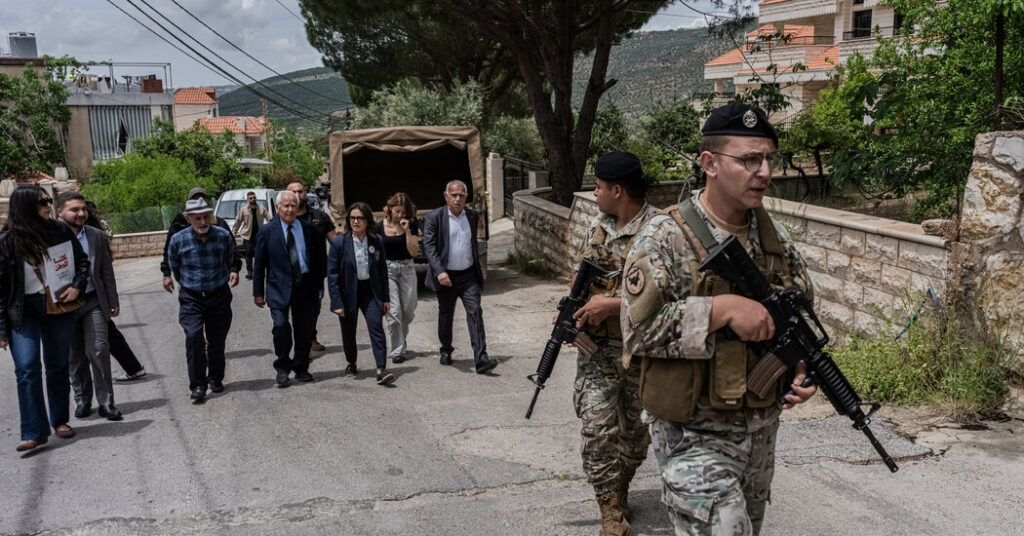
That afternoon in May, Ms. Sayed, the government minister, took a walk through Arqoub, saying she wanted to see the area firsthand. From his home, Issam Mohamed, 74, stepped outside and handed her a flower, a small gesture of civility in a region marked by violence.
Later, he and his wife, Fawziya Hassan, 62, spoke about life in the town that still stands but no longer feels whole. He said they had stayed despite his health problems, including a stroke from which he is still recovering. Water comes intermittently. And most nights are marred by the sound of explosions nearby, tearing through neighboring Shiite villages.
“This is our reality,” he said.
A moment later, as Ms. Sayed’s convoy pulled away, a distant thud of shelling rolled through the hills.
Sarah Chaayto contributed reporting.
The post Lebanese Hold Fast to Their Land Despite Threat of Long Israeli Occupation appeared first on New York Times.