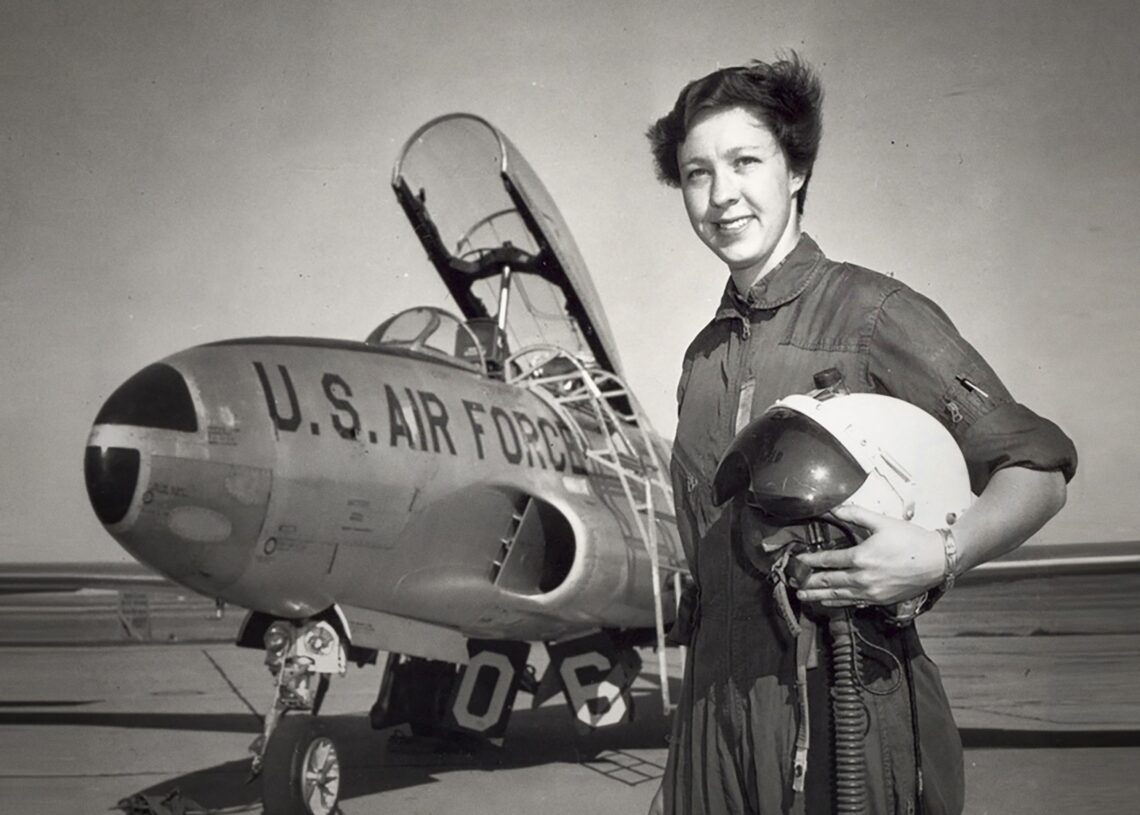
When Wally Funk was 5, she donned a Superman cape and leaped from the roof of her family’s barn in New Mexico, dreaming of flight and landing in a haystack.
She decorated her bedroom ceiling with model planes, earned her pilot’s license as a teenager and began a six-decade journey to space at age 22, joining a private program in 1961 that tested whether the country’s finest female pilots could become astronauts.
Ms. Funk was the youngest woman to pass the tests and became part of a cohort known as the Mercury 13. Despite doing just as well as men at the time, if not better, they never went to space: The program was not sanctioned by NASA, and astronauts such as John Glenn dismissed the idea of women joining their ranks.
As historian Margaret A. Weitekamp later put it, the female pilots had the “right stuff” but the “wrong sex.”
Yet Ms. Funk never stopped trying to touch the cosmos. A bridge between the space race of the Cold War and the ongoing competition between billionaire space barons, she applied four times to become a NASA astronaut, reserved a seat on a space tourism flight in her 70s and finally got her chance to fly in July 2021, when Amazon founder Jeff Bezos announced that she would join him as an “honored guest” aboard the first crewed flight of his rocket company Blue Origin.
“I didn’t think that I would ever get to go up,” Ms. Funk said in an Instagram video posted by Bezos, who owns The Washington Post. “Nothing has ever gotten in my way. They said, ‘Wally, you’re a girl, you can’t do that!’ I said, ‘Guess what: doesn’t matter what you are, you can still do it if you want to do it.’ And I like to do things that nobody has ever done.”
Traveling aboard the New Shepard rocket later that month, the 82-year-old Ms. Funk became the oldest person to reach space, a record that was later broken by actor William Shatner and Air Force veteran Ed Dwight, at age 90. Arriving back on Earth, she spread her arms in joyful triumph, later telling reporters: “I want to go again, fast!”
Ms. Funk was 87 when she died July 8 at her home in Grapevine, Texas. Her death was announced by the city of Grapevine, a suburb of Dallas and Fort Worth, which did not cite a cause.
Launched on the 52nd anniversary of the Apollo 11 moon landing, New Shepard carried Ms. Funk, Bezos, his brother and a Dutch teenager more than 60 miles to the edge of space. They did not enter orbit but experienced a few minutes of weightlessness before parachuting back to the West Texas desert, where they had blasted off 10 minutes earlier.
In his Instagram post, Bezos said that “no one has waited longer” to go into space than Ms. Funk, who had logged 19,600 hours of flight time and taught more than 3,000 people to fly.
Asked what she would say when the hatch opened upon their safe return, she replied, “Honey, that was the best thing that ever happened to me.”
Ms. Funk traced her spaceflight dreams back to the summer of 1960, when she read a Life magazine article about pilot Jerrie Cobb, who had passed a series of astronaut fitness tests designed by physician William Randolph Lovelace II. He had helped select astronauts for Project Mercury, the first American spaceflight program, and was now looking for female pilots to take a nearly identical version of the tests.
While America’s astronaut corps was open only to men, some scientists argued that women were ideally suited for space travel because they were typically lighter and smaller. Lovelace sought to test that theory, working with Air Force Brig Gen. Don Flickinger and supported by Jacqueline Cochran, the first female pilot to break the sound barrier.
They enlisted 19 female pilots, including Ms. Funk, who was a few years younger than the women they were looking for but had already logged 1,300 flying hours and was working as a civilian flight instructor at Fort Sill, an Army base in Oklahoma.
On her first day of tests at Lovelace’s Albuquerque clinic, researchers injected ice water into her ear to induce vertigo. She later swallowed three feet of rubber hose and guzzled a pint of radioactive water so scientists could study her metabolism.
To prepare for the emptiness of space, she went into an isolation tank, floating atop water that matched her body temperature. Some participants had hallucinations and were plucked from the tank after a few hours. Ms. Funk lasted 10 hours and 35 minutes, napping at times before the researchers decided she had been in there long enough.
By the summer of 1961, she was one of 13 First Lady Astronaut Trainees, or FLATs, as Cobb called the program’s graduates. But the initiative ended abruptly when the Navy refused to allow further testing on military equipment. At congressional hearings later that year, astronauts testified against the possibility of women in space.
“The fact that women are not in this field is a fact of our social order,” said Glenn, who had recently become the first American to orbit the Earth. “It may be undesirable.”
As Ms. Funk later put it, “The old-boy network didn’t want us.”
Soviet cosmonaut Valentina Tereshkova became the first woman in space in 1963. The first American woman, Sally Ride, lifted off in 1983.
Ms. Funk closely tracked the progress of female astronauts, traveling to the launchpad with other surviving FLATs in 1995 to watch as Eileen Collins became the first female space shuttle pilot, and returning four years later when Collins became the first woman to command a shuttle.
She also continued astronaut training on her own — undergoing centrifuge tests, entering a high-altitude chamber and visiting a Russian training site to experience zero-gravity conditions — while working as a flight instructor and competing in air races.
By her account, she applied to become a commercial pilot in the 1960s but was rejected by airlines that told her they didn’t have women’s bathrooms at their training facilities.
Undaunted, Ms. Funk kept flying and moved into aviation safety, becoming the Federal Aviation Administration’s first female safety inspector in 1971. Three years later, she was named one of the National Transportation Safety Board’s first female air safety investigators.
“In flying, you’re always preparing for an alternative,” she told the Dallas Morning News in 1998. “So I went to my alternative. I’m still kicking in doors to keep on going.”
‘I wanted to go higher’
Mary Wallace Funk II was born Feb. 1, 1939, and grew up in Taos, New Mexico. Her parents ran a five-and-dime shop and encouraged her interests in horse riding, skiing, marksmanship and flying, taking a different approach from her maternal grandfather. As Ms. Funk told it, he had declared “Young ladies do not fly!” after her mother zipped above her Illinois hometown with a barnstormer in 1918.
“I did everything that people didn’t expect a girl to do,” Ms. Funk said.
At age 16, she enrolled at Stephens College in Missouri. But while home for Christmas break, she suffered a ski accident, crushed two of her vertebrae and was told she would never walk again. Within weeks, she was back at Stephens, where a guidance counselor suggested she take aviation classes to distract from her recovery. She said that on her first flight, “the bug bit and that was it,” according to Stephanie Nolen’s book “Promised the Moon.”
Ms. Funk graduated in 1958 and studied secondary education at Oklahoma State University, where she flew in collegiate air meets while wearing white coveralls and cowboy boots, the uniform of the Flying Aggies aviation club.
She never married and has no immediate survivors.
Ms. Funk was inducted into the Women in Aviation International Pioneer Hall of Fame in 1995. A few years later, she identified a new route to space, becoming one of the first customers of Space Adventures, a tourism company that ended up reimbursing her and others when a suborbital flight proved out of reach at the time.
In 2010, she reserved a $200,000 ticket to space from Virgin Galactic. She was still in the queue when the company’s founder, Richard Branson, went into space more than a decade later.
In a 2012 interview with Time magazine, Ms. Funk said that space travel had lost none of its luster. She had flown on the supersonic Concorde jet, she said, and admired the curvature of the Earth while traveling back from Europe at an altitude of some 60,000 feet.
“I wanted to go higher, to be free,” she recalled, “and I didn’t care if I ever came back.”
The post Wally Funk, trailblazing aviator who waited 60 years to go to space, dies at 87 appeared first on Washington Post.