Eighteen months ago and apropos of nothing, Megyn Kelly tweeted a direct if singularly bizarre threat to Netflix: “If you wokeify ‘Little House on the Prairie,’ I will make it my singular mission to absolutely ruin your project.”
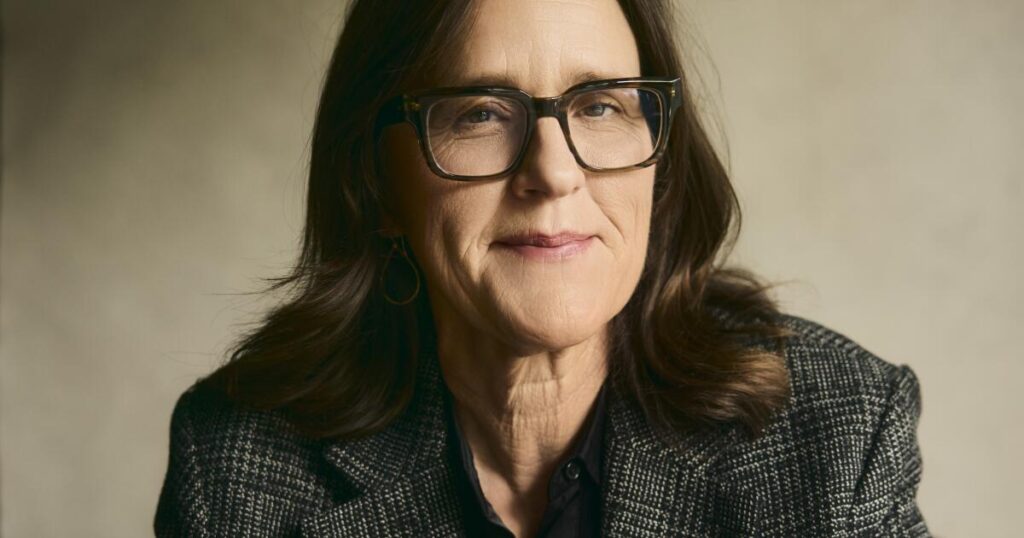
Rebecca Sonnenshine, showrunner, writer and producer of the latest adaptation of Laura Ingalls Wilder’s “Little House on the Prairie,”which debuted on Netflix Thursday, isn’t concerned. “Whatever anyone’s definition of ‘woke’ is,” she said in an interview in May, “and I think it has lost all definition, when she watches it, she will understand that it is very much in keeping with the spirit of the books.”
Nor is she concerned about other criticisms “Little House” devotees might have: That Mary Ingalls (Skywalker Hughes) isn’t blond (“she was the best actress and I’m not going to dye a kid’s hair”); that Jack is not a brindle bulldog (“Brindle bulldogs are very stubborn and untrainable for TV. We chose a border collie/cattle dog mix”); that the Ingalls spend a lot of time in Independence, Kan., which, in the book, was 40 miles away (“they lived much closer [than depicted in the novel], we moved them a bit closer still.”)
Adaptations of beloved works are always tricky and in this case, Sonnenshine is dealing not only with Wilder’s novels but also the beloved 1974 series of the same name. Still, even for this longtime and well-versed fan of Laura Ingalls Wilder, Sonnenshine’s passion for the “Little House” books is wildly impressive — mention Aunt Docia’s “blackberry” buttons and she knows exactly what you’re talking about.
“Everything in my life has been jump-started by these books,” she said. ”Reading about a female protagonist, written by a female author, I thought ‘I can do all that.’ It led me to writing, led me to film school, gave me confidence.”
Sonnenshine, a writer/producer best known for “The Housemaid,” “The Boys,” “Outcast” and “The Vampire Diaries,” grew up in Oroville, Calif. “It was pretty rural and my parents were very Ma and Pa,” she said. “My father built a cabin and gardened; we raised chickens and sheep. My mother was a schoolteacher who sewed all my clothes and dolls.”
Like many Americans, she read “Little House in the Big Woods” when she was a child and immediately fell in love with Laura “Half-pint” Ingalls, her family, friends and the world they inhabited. She has wanted to take a crack at adapting the tales pretty much ever since.
Too young to watch early seasons of the original series, she was still a child when she caught some of the later episodes. And though she liked the show, she thought it strayed too far from the books. “My mother said, ‘Well that’s just how they’ve adapted it,’ and I said, ‘I’m going make a version of these books someday.’“
So when she heard that Paramount was looking for someone to do just that, she made sure she got a meeting with everyone involved, including Friendly Family Productions, which owns the licensing rights. (The series was produced by CBS Studios and Anonymous Content.)
“I’m pretty dark,” she said, “so I’m not the first person who comes to mind for ‘Little House,’ but it is my origin story.”
She told them she wanted to do a faithful adaptation of the books but also “open up the world to have more historical context. You read the books differently as a child and then as an adult. I wanted to bring child and adult perspectives together.”
And that’s precisely what she’s done.
Wilder’s novels, beginning with “Little House in the Big Woods” and ending with the posthumously published “The First Four Years,” were written with the aid of her daughter Rose Wilder Lane when Wilder was in her 60s and 70s. They are almost all based on her memories (the second novel, “Farmer Boy,” is culled from her husband’s childhood) with a viewpoint that matures with each subsequent book. Her third novel, “Little House on the Prairie,” dwells beautifully and vividly on the experiences of a very young Laura as she and her parents traveled from Wisconsin to Kansas to build and cultivate a homestead on land they believe is open to white settlers.
In terms of narrative, however, there is not enough to sustain a full season without some serious padding. (The 1974 series covered the entire book in its hour-long pilot, before moving the family to a farm near Walnut Grove, where they stay, in variance from the books, for most of the eight seasons.)
Sonnenshine was determined to stay true to the original material, while also providing historical texture to the Ingalls experience, including the emotional impact of the recently concluded Civil War, the ongoing conflict between the U.S. government and Native American tribes and the racial diversity of Kansas, which became home to many free and formerly enslaved Black people.
In this “Little House on the Prairie,” Charles “Pa” (Luke Bracey) and Caroline “Ma” (Crosby Fitzgerald) Ingalls are granted more romance and deeper backstories (and Caroline more agency), but they are still the kind, capable and music-loving parents Wilder first conjured. Baby Carrie has not been born yet at the start of the series, in part so the show could explore pioneer pregnancy and childbirth. And though Sonnenshine aged them a bit to allow for more complex storylines, Laura (Alice Halsey) is all curiosity and mischief compared to Mary’s (Hughes) more studious rule-following.
The supporting characters, both drawn from the novels and invented for the series, are where Sonnenshine has implemented her vision, using, she said, extensive historical research.
George Tann, a Black doctor who appears briefly in the book when the Ingalls fall ill from malaria, becomes, in the series, a multidimensional supporting character played by Jocko Sims, and the first to greet the family when they make it to Kansas. The actual Tann was born to free parents and, according to some sources, served in the Union Army before moving to Kansas, where he became known for combining medicinal treatment with physical therapy.
“Dr. Tann treated white and Black settlers and the Osage,” Sonnenshine says. “He had quite a wide territory, so we thought he did move around so he could meet them.”
He is not the only Black character in the series — Emily Henderson (Barrett Doss) runs a store in Independence; she moved from Nicodemus, Kan., which, Sonnenshine points out, is a Black-centered town founded for and by formerly enslaved people.
The beloved character of Mr. Edwards (played here by Warren Christie) is just as helpful as he is in the book, but he has a more troubled past, a clearer reason for his solitary existence, rough manners and habit of coming and going. And the literary Laura’s curiosity about and love of Native Americans is given a wider canvas; she becomes friends with Good Eagle (Wren Zhawenim Gotts), a young Osage girl who lives on a homestead with her father William Mitchell (Meegwun Fairbrother) and her mother White Sun (Alyssa Wapanatâhk).
“Right away, I knew I wanted to have a parallel family that were Osage,” Sonnenshine said. “I found out there were Osage who were homesteading, trying figure out what their future will be. Often they were separated from their family who were living traditionally. I wanted to portray them as fully realized characters who we could see as a mirror of the Ingalls family.”
If any of these, and other choices, leads to cries of “woke,” Sonnenshine simply points to documented history.
“This has never been a white country, ever,” she said. “We looked at census records to see who was in the town. This is a show about the power of human connection. It’s a very different perspective than guys with guns settling it by violence. That just isn’t what happened. It was women and families — families settled the West.”
Though far from being a “gritty” period drama, “Little House” does attempt to capture the realities and complexities of its place and time, while still hewing to Wilder’s original themes of resilience, hope and family. At the end of the season, as at the end of book, the Ingalls must leave Kansas, and all they worked so hard to build there.
Season 2 will take them to the banks of Plum Creek, near Walnut Grove, Minn., and into the orbit of one Nellie Oleson, who will be played by Willa Dunn.
“A lot of people have to start over all the time, you pick up and start again and that’s OK,” Sonnenshine said. “You don’t have to think of things as great failures. That’s just part of being alive.”
Ma and Pa, she said, remain true to the original characters but are also based on Sonnenshine’s own parents. “They were very much equals — my mother did help build that cabin. My mother was a teacher and an artist and really loved having children but was also a union rep at the school.”
They were also, like Ma and Pa, fairly strict about certain things. “My parents wouldn’t let me watch a lot of sitcoms because the kids talked back at their parents,” she said. “They said, ‘That’s not how we behave and you’re not watching that.’”
That background came in handy, particularly when adapting Laura. Though older and a bit more modern than the iconically curious and headstrong original, she has not been updated with contemporary attitudes.
“The kids are not allowed to sass,” Sonnenshine said. “They don’t roll their eyes, they can’t talk back, they can be honest and forthright but they don’t disrespect their parents.”
With Pa being a fiddler, music played a significant role in Wilder’s work and Sonnenshine was determined to reflect that; all the songs played in Season 1 are from the books. “Every episode has a song because that’s how stories were passed on, it’s how they entertained each other. It’s very fun and brings a lot of joy on set. My family,” she added, “is a big ‘let’s play music’ family and that’s something that’s been lost. It’s a real expression of humanness and a great way to be together.”
For Sonnenshine, who was in the middle of working on Season 2, the reality of making the series has been even more rewarding than what she dreamt of as a child.
“I wouldn’t characterize myself as optimistic,” she said. “I would characterize myself as a realist. But there is a lot of value in optimism and hope and connection. That’s the thing I found: It’s OK to lean into that, it’s OK to be heartfelt. There’s a lot of hope and aspiration in this story,” she said, “and that’s been a positive influence on my life. I think it will be a positive influence on audiences as well.”
The post The creator of ‘Little House on the Prairie’ isn’t worried about being called ‘woke’ appeared first on Los Angeles Times.