ANKARA, Turkey — After public bluster over Greenland and other grievances, President Donald Trump embraced the NATO defense alliance at a summit of its leaders on Wednesday, praising countries that have boosted their defense spending and offering fresh support for Ukraine in its war with Russia.
The positive tone in a closed-door meeting was a surprise for many other NATO leaders, who had been bracing for a verbal barrage after Trump’s previous criticisms of the alliance. The president had complained for months that Europe had not done enough to help in the war against Iran. He also declared ahead of Wednesday’s meeting that he still wanted to take Greenland from Denmark.
Once the doors closed in the soaring presidential palace in the Turkish capital, however, Trump focused more on the positive than the negative, officials who were in the room with him said. He highlighted countries that were already meeting new, higher NATO spending goals, but didn’t mention laggards by name. And he did not mention Greenland once the meeting starting, easing fears that he was seeking to put the island territory back on the front burner.
He also held back from taking concrete steps to withdraw U.S. troops from Europe or otherwise slash U.S. commitments to the alliance.
In a separate meeting with Ukrainian President Volodymyr Zelensky after the main meeting, Trump praised the Ukrainian war effort, a notable shift in tone for him.
“Fighting is tough,” Trump said, pointing to Zelensky. “He’s done an amazing job.”
Top policymakers in the room with Trump said that the tone had been largely positive.
“The main message was about unity,” said Estonian Defense Minister Hanno Pevkur, in an interview after the meeting. “It was more optimistic than maybe many were afraid of.”
Trump did press NATO countries to meet their spending goals, “and sooner rather than later, which is also okay for us, because we’ve been saying that for the last four years,” Pevkur said.
German Chancellor Friedrich Merz said Trump had listened attentively during the meeting and that the U.S. president ended his remarks by saying “there is a feeling of love in the air.”
Merz credited Trump with pushing Europe to hike defense spending, which U.S. presidents have requested well before Trump came to office.
“This president is now doing it in a different way, but the result speaks for itself. We are all doing more,” he said. “And perhaps to put it somewhat bluntly: The Europeans’ free-riding is now over.”
Trump’s earlier repetition of his desire to seize Greenland from Denmark revived a dispute that has sparked European fury and fear more than anything else during the U.S. leader’s time in office.
Just before the closed-door meeting, Danish Prime Minister Mette Frederiksen declared Wednesday that her country would defend its territory as Trump revived his longtime demand for control of Greenland.
Trump had sharply raised tensions with U.S. allies and seemed to push NATO to a breaking point with his threats to seize the vast Arctic expanse that is an autonomous territory of Denmark.
European leaders stood up to the president and Trump backed down, saying at the World Economic Forum in Davos, Switzerland, that he had reached the outlines of a deal brokered by NATO Secretary General Mark Rutte.
But almost as soon as he arrived to meet NATO counterparts in Turkey, Trump restarted the fight, telling reporters on Tuesday that Greenland “should be controlled by the United States, not by Denmark.” He added that European refusal to accept this is “what hurt my relationship with NATO.”
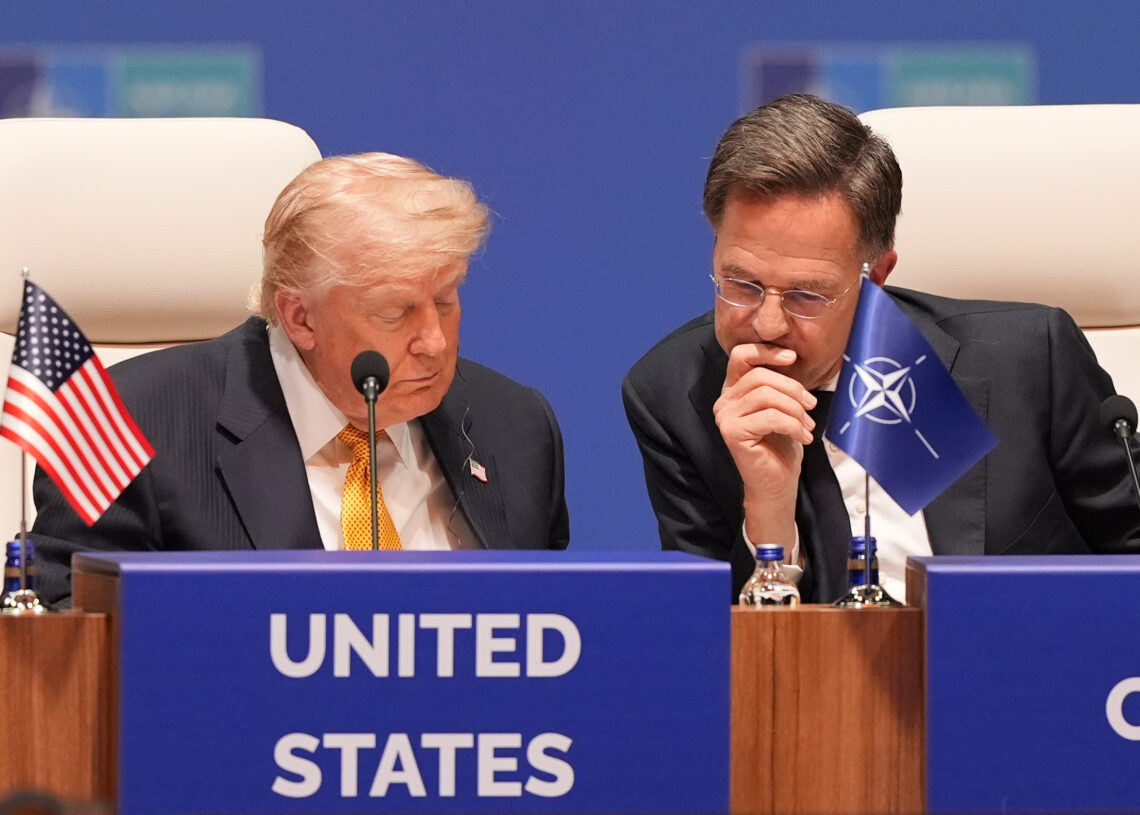
On Wednesday, sitting alongside Rutte before the more positive closed-door meeting, Trump appeared to dispel hopes that this was an offhand remark and said he planned to use the annual meeting, which gathers leaders of NATO’s 32 nations, to “relay my problems.”
“Greenland is a big problem for us,” he added. “Greenland is very important for the U.S. but it’s not important for Denmark.”
Laying out his grievances with fellow NATO member states, Trump also took aim at the hesitation of European allies to get embroiled in the U.S.-Israeli war against Iran.
“I’m not happy with NATO,” Trump said repeatedly during a meeting with Rutte on Wednesday.
European leaders have sought to distance themselves from the war, which is unpopular across much of the continent, although some nations, including Germany and Britain, lent their bases and airspace to the U.S. bombing campaign.
Diplomats expected Trump to use the summit in the Turkish capital to lament Europe’s criticism of his war with Iran war or again complain that military spending by NATO nations is too low. But his comments on Greenland on Wednesday caught some off guard.
Frederiksen in recent months has said that she didn’t believe the ordeal was truly over, after Rutte assuaged Trump with promises of increasing the NATO and U.S. military presence in the Arctic.
Leaders in Denmark and Greenland have staunchly rejected Trump’s ambitions to seize the territory.
Arriving at the summit on Wednesday, Frederiksen said her country’s “position is as clear as it has been all through: Greenland is of course not for sale.”
“We are a sovereign state,” she told reporters, “and we need everybody to respect our territorial integrity.”
Asked if Denmark would defend its territory from friend or foe alike, Frederiksen said, “Of course we will defend the kingdom of Denmark.”
The Danish leader also noted that NATO was meant to ensure allies help defend each other from outside threats.
“One of the reasons we built NATO many many years ago is if anything happens to one of us then everybody should stand up,” she said, referring to the alliance’s mutual defense clause. “I mean, Article 5 is our insurance … and the same goes for Greenland if anything happens in our direction.”
Some European officials say Trump’s public skepticism about defending U.S. allies has spurred a reckoning over Article 5, which promises that an attack against one should be considered an attack on all.
Instead, the 77-year-old alliance was left navigating the prospect that its biggest military power could try to annex land from another ally, potentially by force.
Sitting next to Trump on Wednesday, Rutte again sought to de-escalate, reminding the president that the two had “made a deal” on Greenland, and pledging to “make sure that deal is step-by-step being implemented.”
The NATO chief maintained that there is a “good process in place” in negotiations between U.S., Danish and Greenlandic officials.
Technical talks began after Rutte defused the crisis in January, but officials say that so far they have yielded few concrete results.
Talks have previously broached increasing the presence of U.S. troops or bases in Greenland, offering the U.S. greater access to investment in mineral extraction and boosting military operations in the Arctic, including for a multilayered air defense system called Golden Dome.
NATO officials also pledged to boost the alliance’s footprint in the Arctic to address Trump’s contention that the icy expanse, home to about 56,000 mostly Inuit people, is not well protected from Russia or China.
The president on Wednesday claimed that the U.S. “took Greenland” during World War II and then “stupidly gave it back.” The U.S. set up a military presence in Greenland to defend the country after Denmark was invaded by Nazi Germany, but never annexed it at the time.
Trump reserved the worst of his ire for Spain, the only country that has not agreed to NATO’s pledge for each member state to increase spending on its military to 5 percent of GDP — a figure pushed by the White House and agreed at last year’s summit.
Spanish Prime Minister Pedro Sánchez has also angered Trump by leading public opposition to the U.S. war with Iran. Spain is chief among the European nations that blocked U.S. access to their bases or airspace for attacks against Iran.
Trump threatened Wednesday to cease trade relations with Spain. That would be tricky to enforce given Europe’s single market, and the fact that the European Union governs trade for all its member states.
“Cut off all trade with Spain, please, including visits,” Trump said during the meeting with Rutte, though it was unclear to whom he was issuing the instruction. “I don’t want to do any more trade with them. Immediately. Don’t even talk to them. They’re hopeless. They’re bad people.”
Trump did not smile as he walked out with other NATO leaders for a group photograph, sandwiched between Rutte and outgoing British Prime Minister Keir Starmer, whose recent resignation Trump gloated over.
Rutte, who has gone to great lengths with his flattery to keep Trump onside, heaped fresh praise on Trump Wednesday for pressuring European nations to raise military spending. “Grab the win, it’s there. You did this,” Rutte told the president.
European leaders say they are not simply appeasing Trump, but rearming to prepare for a potential confrontation with Russia as trust in the U.S. wavers.
Still, NATO officials came to the summit flashing big numbers that could appeal to Trump, signing weapons deals and highlighting the hundreds of billions of dollars that European nations have recently diverted to defense and security.
For all Rutte’s efforts, the president lauded the NATO chief but repeated his long-standing complaint that Europeans have relied too heavily on U.S. security guarantees rather than their own militaries.
Trump did have some good words for the presidents and prime ministers gathered in Ankara despite the recent sparring with a few of them.
“I like, I think, all of these leaders,” he said. “I think they didn’t treat the United States fairly for many years, but that’s okay. But they’re sane, rational, good people, most of them.”
Michael Birnbaum contributed to this report.
The post After Greenland bluster, Trump surprises NATO allies with praise appeared first on Washington Post.