
This rock star is ready for its extreme close-up.
Chinese researchers have captured the first-ever close-up images of the rare “mini-moon” that’s tracing circles around the Earth.
Dubbed 2016 HO3 or Kamoʻoalewa, this interstellar rolling stone is not actually one of our lunar satellites – it’s too distant for that — but rather an asteroid that’s circumnavigating the sun, Science Alert reported.
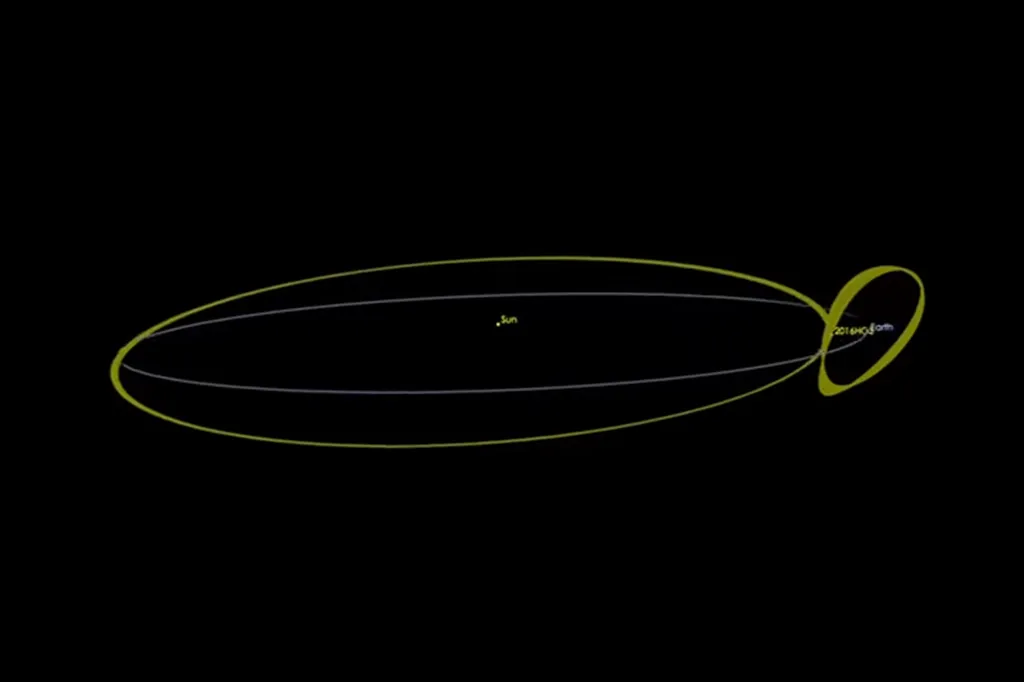
However, as this space rock comes in relative close proximity to our home planet via our elliptical orbit every 45 years, astronomers consider it a “quasi-satellite” – just one of seven known to orbit Earth. However, it is the closest at around 25.8 million miles away.
First discovered around ten years ago by the Pan–STARRS 1 asteroid survey telescope in Hawaii, Kamoʻoalewa was caught on camera for the first time earlier this July by the Tianwen-2 probe sent by the China National Space Administration (CNSA) mission.
Accompanying photos show the jagged asteroid Tianwen-2 — which measures between 138 and 328 feet across — hurtling through the vacuum of space.
“After a 400–day, one billion–kilometer (621 million–mile) journey, the Tianwen–2 probe recently made a successful encounter with asteroid 2016 HO3, reaching a distance of 20 kilometers (12.4 miles) from the asteroid to begin scientific exploration,” the CNSA noted in a statement.“During its approach to the asteroid, the probe acquired image data.”
This marks the an important milestone in the mission of the spacecraft, which launched from the Xichang Satellite Launch Center as part of CNSA’s first asteroid sample–return mission.
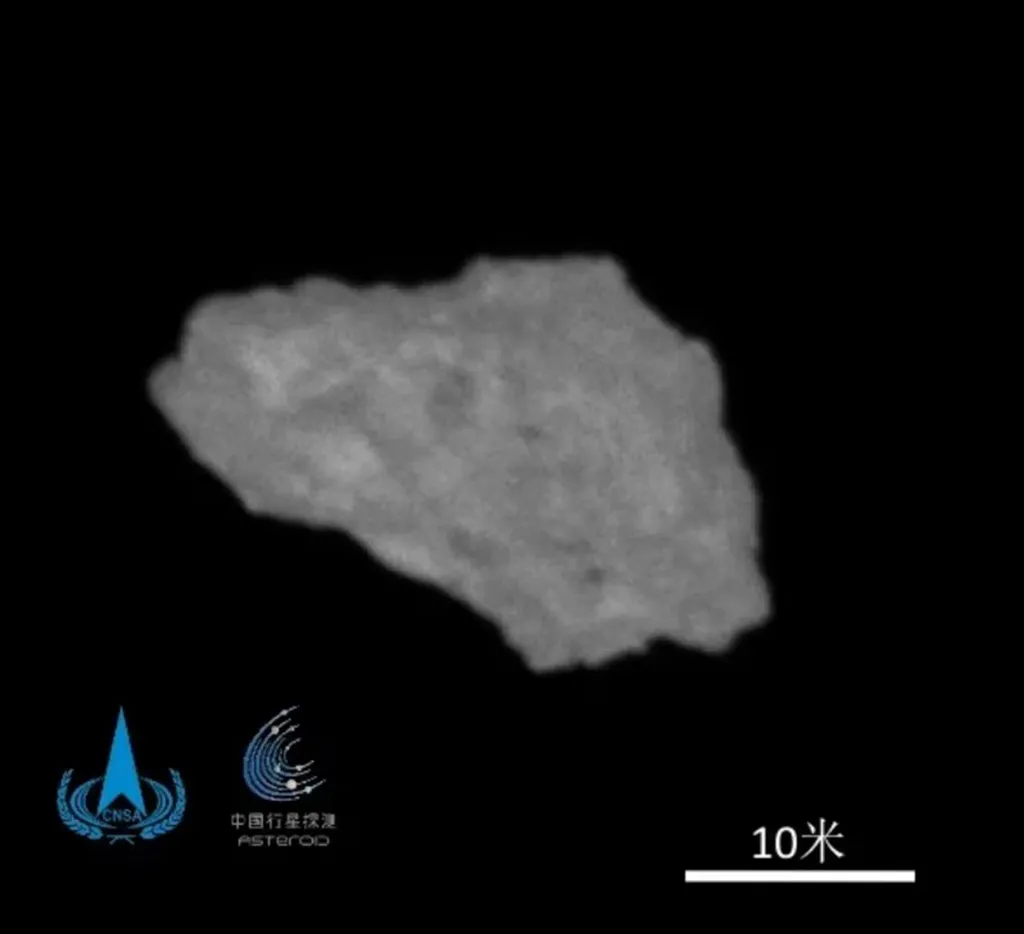
Tianwen-2 didn’t make its first optical detection of Kamoʻoalewa on June 6. Thirteen days later, it had come within 1,242 miles of our second moon.
It wasn’t until earlier this month that the probe was close enough to capture the aforementioned images. The recon craft will begin scientific exploration with the goal of conducting in-orbit observations on this one-of-a-kind quasi-satellite and collecting samples to return to Earth later this year via re-entry capsule, per a January article in Space Science Reviews.
“Among the known near-Earth asteroids, 2016 HO3 is an exceptionally rare Earth co-orbital object,” physicist Rongqiao Zhang, of the Lunar Exploration and Space Engineering Center in Beijing, and his colleagues explained.
They noted that “as an Earth quasi-satellite, its orbital period is close enough to provide “favorable conditions for tracking, control, and communication.”
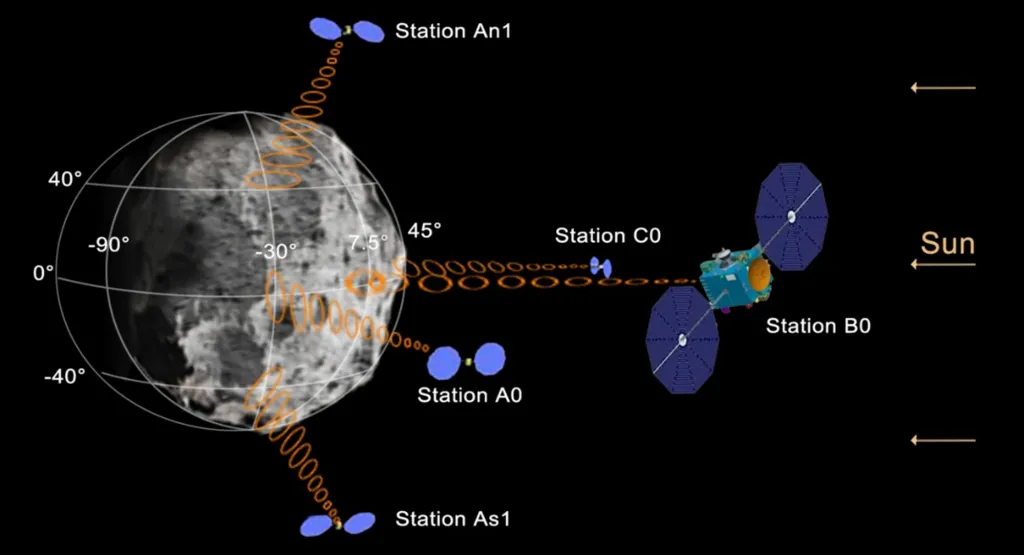
They hope this mission will shed light on Kamoʻoalewa’s composition — whether it’s a pile of rubble or a monolith — how its orbit evolved, and if it harbors water, among other characteristics.
Perhaps most intriguing is the possibility that this intergalactic gravelstone is indeed a bit of Moon — a theory that arose based on telescope observations.
Unfortunately, conducting recon won’t be easy. The scrawny size of the diminutive mini-moon, which is potentially the smallest asteroid ever visited by human spacecraft, makes it difficult to sample compared to larger targets, the South China Morning Post reported.
This challenge is compounded by the fact that 2016 HO3 is spinning at a rate of one revolution every 28 minutes, boasts an uneven gravitational field and complex terrain that affords few flat areas for analysis.
Experts fear that the Tianwen-2 could bounce off this moving target or even lose the sample during contact operations.
To mitigate risk, the team has outfitted the Tianwen-2 with hovering and anchoring capabilities that will allow it to collect samples effectively despite 2016 HO3’s inhospitable terrain.
“Tianwen-2’s mission is far more complex than previous deep-space explorations and represents a completely new path for humanity’s exploration of the universe,” the CNSA wrote.
However, the team believes the mission will be worthwhile as analyzing 2016 HO3 could potentially answer “fundamental questions about the origins of Earth’s quasi-satellites and the dynamical evolution of their orbits.”
The post First look at Earth’s second moon — revealed in satellite images for the first time ever appeared first on New York Post.