Times Insider explains who we are and what we do and delivers behind-the-scenes insights into how our journalism comes together.
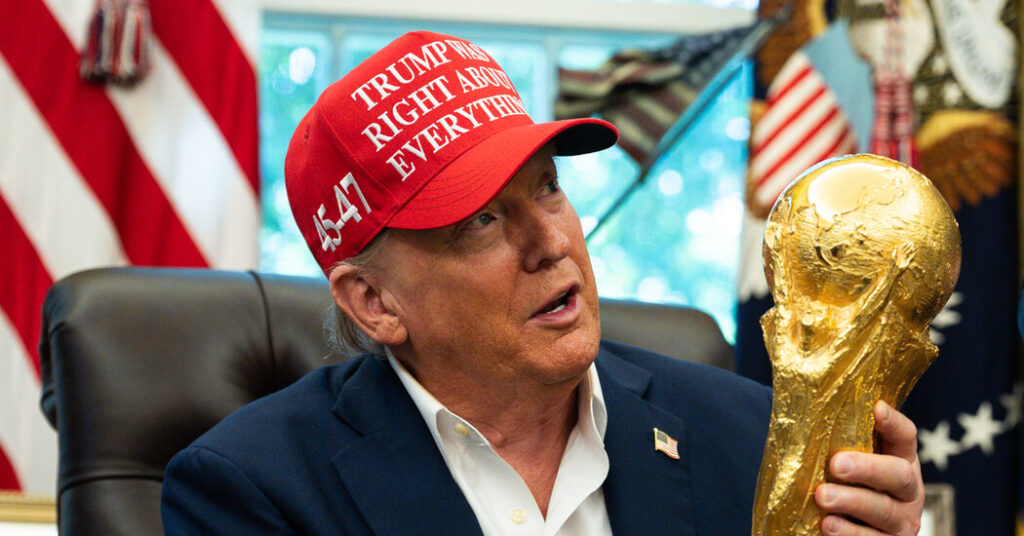
On Sunday afternoon, The New York Times broke exclusive details about President Trump’s personal call to the president of FIFA and request that he review the suspension of Folarin Balogun, a striker for the U.S. men’s soccer team who had been given a red card and deemed ineligible for Monday’s game against Belgium. On Sunday, FIFA reversed the suspension — and Balogun was cleared to play. Tyler Pager, who covers the White House, and Tariq Panja, who reports on sports, teamed up to chase down details of a conversation between the president of the United States and the president of the international soccer federation, Gianni Infantino. I asked them to break down their reporting; their responses have been edited for length and clarity.
You guys reported that President Trump had called Gianni Infantino, FIFA’s president, and asked him to review the suspension. How did you hear the news of the reversal of the red card punishment, and what were your next steps?
TYLER PAGER: I was on a plane to Istanbul when the news broke that Balogun was reinstated. I was traveling to Turkey ahead of the NATO summit, which Trump is attending later this week. But as soon as I saw the news, I started texting sources from the plane. (I am grateful for Turkish Airlines Wi-Fi!)
We know that Trump and Infantino have a close relationship and have talked frequently over the last year, so I figured Trump may have been involved. I sent a bunch of messages that went unread, but after one source confirmed that Trump and Infantino had spoken by phone, I knew we had a story. But one source wasn’t enough, so I reached out to Tariq, and we worked together to firm up the reporting and write the story, which published before I landed in Istanbul.
TARIQ PANJA: Having covered the curious Infantino-Trump relations over the years, it seemed highly likely that the two men would have spoken in some way about the issue. The news came at an awkward time for me as I was scouring Mexico City to find a media bus to the Azteca Stadium for what was going to be one of the biggest games in Mexican history, a World Cup knockout match between Mexico and England.
Once there, we were stuck in a line for almost 90 minutes and my phone battery was close to dying, which meant I was briefly umbilically connected with a kind reporter from The Times of London who let me share his power bank. Not the easiest place to do this type of work. But we managed to connect with contacts over messages and a few phone calls to get details for what will go down as one of the most extraordinary events in the World Cup’s 96-year history.
This is the first time in over 60 years that FIFA has allowed a player to appear in a World Cup game when that player would have otherwise been suspended. Walk us through FIFA red card rules — and why this moment is so extraordinary.
PAGER: It is very unusual for the U.S. president to try to reverse an outcome in an international sporting competition. I can’t recall any incident like this happening before.
PANJA: The rules on red cards are quite clear, and those who follow the sport are aware of them. A red card means an automatic suspension for the next game. Only in the most extreme cases, like a mistaken identity, is a ban supposed to be lifted. This was not one of those cases, even though to many football officials, coaches, fans and even politicians, the red card was a harsh one. But FIFA had already been called out for appearing to favor a star when it lifted a two-game World Cup ban that Cristiano Ronaldo was supposed to serve for a red card he received before the tournament.
The White House confirmed that Trump and Infantino had spoken and that “the correct and proper outcome was achieved” after what the White House described as an independent review. It declined to provide additional details of the conversation, but people familiar with the call clued you in. What happens next?
Trump Administration: Live Updates
Updated
- Trump defends asking FIFA to review a U.S. soccer star’s suspension.
- Trump rings the stock market opening bell to celebrate new children’s accounts.
- Efforts to help smokers quit have stalled under Trump.
PAGER: We did not publish the story until we had multiple sources confirming the details. When I reached out to the White House for comment, they initially referred me to the president’s post on Truth Social, in which he celebrated the decision but made no mention of his communication with Infantino.
PANJA: We cross-reference what they are saying with other sources and confirm those details with what may already exist in the public domain.
Tyler, you report on Trump and the White House. Tariq, your beat is all things sports and how they collide with geopolitics. What was it like joining forces?
PANJA: Tyler is a force of nature. It was great to see him go full throttle on this.
PAGER: Tariq is the expert on FIFA, and it was such a treat to team up with him. After a source told me that Trump and Infantino spoke, I shared my reporting with my colleagues on the White House beat to see if any of them had heard similarly. Zolan Kanno-Youngs recommended I reach out to Tariq. His depth of knowledge and sourcing on the FIFA beat helped bring it all together.
Besides the game: What will you be watching tonight?
PANJA: I’ll be watching to see when Infantino reaches for his phone!
PAGER: I am in Ankara, Turkey, and kickoff is at 3 a.m., so I’m hoping to try to catch at least some of the game. I am interested to see if any of this spills over into the NATO summit, where Trump will gather with many world leaders, including Prime Minister Bart De Wever of Belgium.
The post Trump’s Call With FIFA: How We Nailed Down the News appeared first on New York Times.