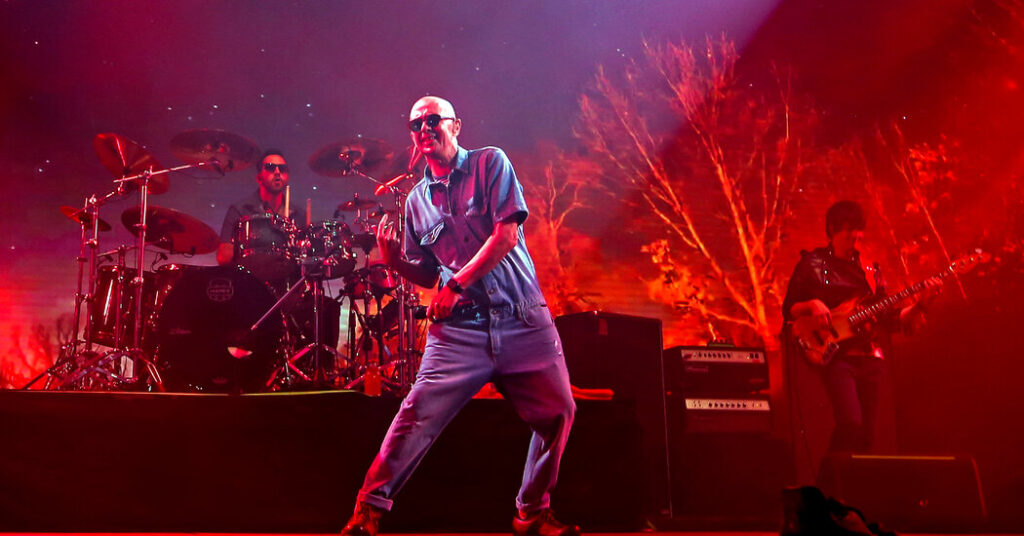
Indio Solari, an Argentine rock star whose cryptic lyrics and plangent voice drew a fervent national following to his allusive anthems on his country’s unfulfilled aspirations, died on June 5 at his home in Ituzaingo, west of Buenos Aires. He was 77.
His death was announced by his family on social media. In 2016, he said he had been diagnosed with Parkinson’s disease, and Argentine media reported he died of a stroke.
Though he was largely unknown outside Argentina — his band never toured internationally or signed with a major record label — inside the country, Mr. Solari was more than merely a popular singer. He was an icon of both the masses and the counterculture whose songs “shaped a whole generation of Argentines,” the music historian Marcelo Fernández Bitar wrote after his death. The line of mourners waiting to enter the chapel on the outskirts of Buenos Aires where his body was kept stretched for miles.
Mr. Solari’s band, Patricio Rey y Sus Redonditos de Ricota, became an “almost religious phenomenon,” Javier Lorca of the Spanish newspaper El País wrote in an obituary. (The playfully nonsensical name was derived from the group’s custom of distributing ricotta-cheese-filled pastries at its early concerts in the clubs of La Plata in the late 1970s.)
The soaring, Springsteen-like songs Mr. Solari wrote turned stadiums into swaying, chanting mosh pits of hundreds of thousands during the band’s heyday in the late 1980s and early 1990s. The concerts attracted such enormous crowds that they began to be held in remote towns to avoid confrontations with the police.
Mr. Solari’s fandom transcended class lines, but he had an especially devoted following among working-class youth who adored the songs’ tight, classic-rock guitar riffs, braying saxophone solos and elements of tango.
Key to his appeal was his Bob Dylan-like attention to lyrics, which he filled with fictional characters and esoteric metaphors. With a shaved head and often wearing round sunglasses, Mr. Solari sometimes compared himself to Mr. Dylan, and said in a 2012 interview that he had also been influenced by Beat poets like Allen Ginsberg and Jack Kerouac.
Phrases from songs like the powerful rocking anthem “Ji, Ji, Ji,” his biggest hit; “Un Ángel Para tu Soledad” (“An Angel for your Loneliness”); and “Encuentro Con un Ángel Amateur” (“Encounter with an Amateur Angel”) were worn as tattoos, printed on T-shirts and shouted at his concerts: “Every prisoner is a political prisoner.” “Violence is lying.” “Luxury is vulgarity.” “You dream of the bonfire where you are always the firewood.”
In an Argentina that had emerged shattered from seven years (1976-83) of brutal military dictatorship, only to find the regime replaced with dispiriting materialism as democracy returned, Mr. Solari’s words and persona “resonated deeply with an audience that found in his lyrics a guide to keep going,” Sebastián Ramos wrote in Rolling Stone after his death.
Those lyrics were often riddles, open — like Mr. Solari’s deliberately reticent public persona — to all sorts of interpretations. “More than once I heard myself say / That in resistance lies all the noble valor of life,” he sang in “Encuentro Con un Ángel Amateur.” It’s a phrase of ambiguous revolt.
“I make music not so people understand the nonsense I say, but so they can imagine,” Mr. Solari said in a 2024 interview.
Mr. Solari was open about being an admirer of the populist demagogue Juan Perón, and about his contempt for Argentina’s current far-right president, the Trump ally Javier Milei. “I don’t know if he’s a complete lunatic,” Mr. Solari said in 2024, “or a lunatic who’s a figurehead for certain interests.” (Mr. Milei’s government refused to allow Mr. Solari’s wake to be held in the Palace of the Argentine National Congress in Buenos Aires.)
But his lyrics were not overtly political. “All the tensions that are diluted in a political conversation take away the mystery,” he told Rolling Stone. “You detach yourself from tensions that you must apply to what you do.”
The sociologist Pablo Alabarces wrote after his death that Mr. Solari “proved that popular art could be made with poetry so hermetic that either no one understood it, or everyone understood it as they saw fit.”
Carlos Alberto Solari was born in Paraná, Argentina, on Jan. 17, 1949, the younger of two sons of José Solari, a post office employee, and Celina Choy.
The family moved to La Plata when Mr. Solari was a child, and his father became the local post office branch manager. Mr. Solari later recalled reading voraciously as a boy, but he was an indifferent student, studying briefly at La Plata’s School of Fine Arts. He became known as El Indio (The Indian) because that was the nickname of the well-known 1960s Argentine soccer player Jorge Solari, with whom he shared a last name.
In the mid-1970s, a few years after his brief military service, Mr. Solari had a decisive encounter with Eduardo Beilinson, known as Skay, a guitarist in La Plata. They began making short films together, supplying the music themselves.
The two men formed the nucleus of Patricio Rey y Sus Redonditos de Ricota, which began in 1976 as a “somewhat chaotic variety show,” as a recent article in Periodismo de Izquierda put it, in a rented theater. La Plata, a provincial city, was then, unlike Buenos Aires, a ferment of rock band activity.
In the mid-1980s the band recorded two albums that established their reputation as counterculture rockers: “Gulp!” (1985) and “Oktubre” (1986). The dictatorship, with its forced “disappearances,” was over, but Mr. Solari was intent on pointing out the deadening continuities in the capitalist excesses that followed: “No more kidnappings, no,” he sang, “not even of your mind.”
The band went on to record seven more albums before splitting up in 2001. Three years later, Mr. Solari started another band, Los Fundamentalistas del Aire Acondicionado (The Air-Conditioning Fundamentalists), with whom he made five albums. His last public concert was in March 2017, not long after his Parkinson’s diagnosis, and was attended by over 300,000 fans.
He is survived by his wife, Virginia Mones Ruiz, and his son, Bruno.
Mr. Solari didn’t apologize for cultivating aloofness. “The enigmatic, mysterious and explosive nature of the work,” he told Rolling Stone, “is better protected if one doesn’t compete with it.”
The post Indio Solari, Argentine Rocker Who Packed Stadiums, Dies at 77 appeared first on New York Times.