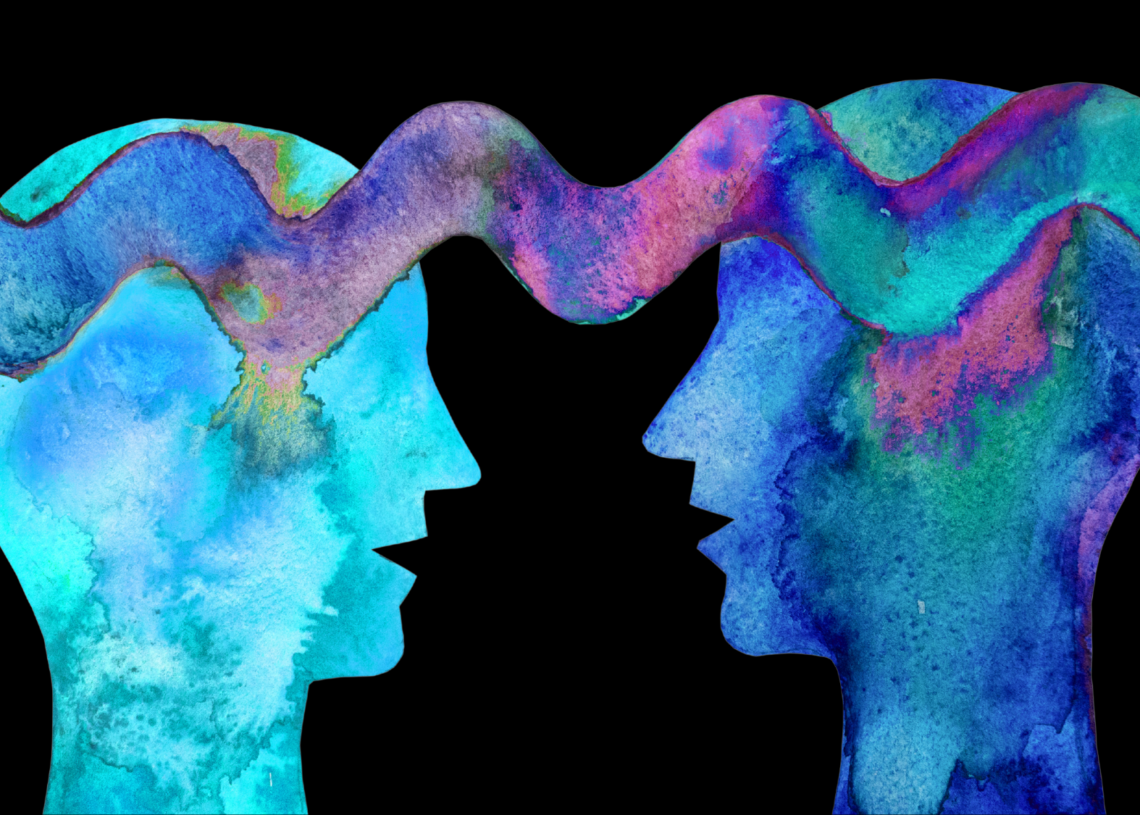
If you’ve ever been riding a wave of creativity that feels like your brain and someone else’s have been Bluetooth-synced and are now finishing each other’s sentences, both instinctively knowing where the song/screenplay/woodworking project or whatever you’re building should go, then you’ve experienced what scientists call brain synchrony.
As described by a team of researchers publishing their findings as a press release on Eureka Alert, originally published in Trends in Cognitive Sciences, it’s a real phenomenon that’s been observed in laboratories and real-world settings. Now, researchers say it isn’t just measurable, but it can actually be strengthened.
Researchers reviewed a decade of studies involving thousands of people, from regular everyday students to professional artists. Using portable EEG headsets, researchers found that when people are genuinely engaged with one another, their brainwave activity begins to align. Even more interesting, when participants received real-time feedback showing how synchronized they were, that alignment often became even stronger.
Being ‘on the Same Wavelength’ Is Actually a Pretty Accurate Description
The research suggests that being “on the same wavelength” is much closer to reality than the figure of speech lets on. Students whose brain activity was synchronized during class reported enjoying being around their classmates and the teacher’s lessons a lot more than usual. Back in 2019, the phenomenon was observed in professional musicians, as the now mega-huge Bad Bunny had his brain waves observed while recording a song with fellow Puerto Rican rapper Residente. The researchers were reportedly able to watch their brain waves align in real time as they collaborated.
Meanwhile, study participants who described themselves as lonely showed less natural synchrony with others.
The researchers think this feedback could eventually become a tool to be deployed in therapeutic settings, schools, and in any walk of life that requires teambuilding. As Discover Magazine reports, a new federally funded, larger version of the study will test whether strengthening synchrony between therapists and patients can improve treatment outcomes.
Turns out that in the era where the term “vibes” has risen to prominence, it turns out that actual, literal vibes are a real, observable neurological phenomenon, and all the term is doing is catching up to something that we’ve been experiencing for thousands of years.
The post Researchers Discovered Your Brain Really Can Sync Up With Someone Else’s. Here’s How It Works. appeared first on VICE.