Subscribe here: Apple Podcasts | Spotify | YouTube
Elon Musk isn’t just the world’s richest man—he’s one of the most influential people alive. His companies have transformed industries, his wealth has shattered records, and his politics now shape governments and public debate. But how did he become this powerful? And is his dominance really inevitable?
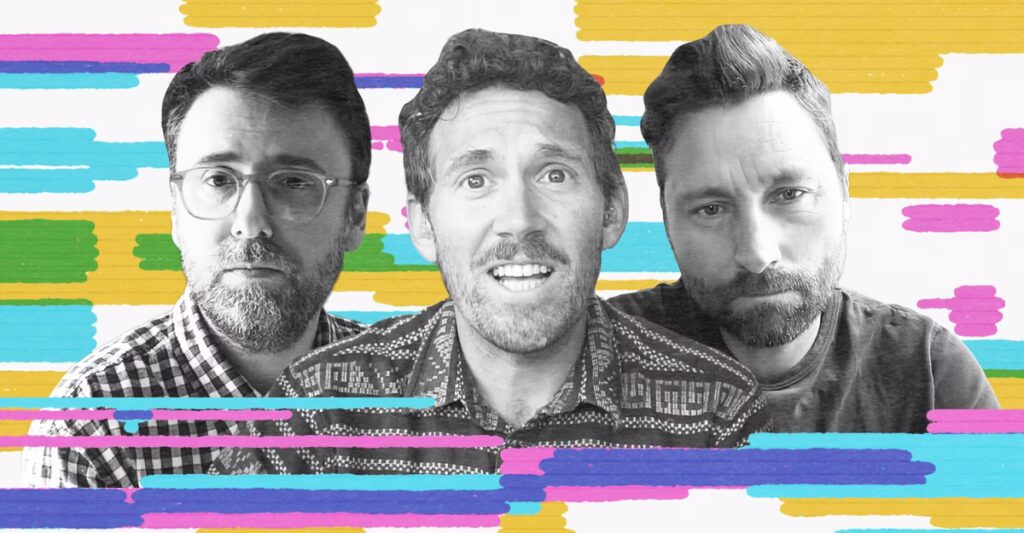
This week on Galaxy Brain, Charlie Warzel talks with the historian Quinn Slobodian and the technology writer Ben Tarnoff, the authors of Muskism: A Guide for the Perplexed, about the ideas driving Musk’s rise. They unpack the mythology of the billionaire genius, the ideology behind his politics, and whether the world’s most powerful CEO is stronger—or more vulnerable—than he appears.
The following is a transcript of the episode:
Ben Tarnoff: A lot of folks ask us, “Well, what about Musk and science fiction?” And if you read the SpaceX prospectus that they had to file, it reads really like a work of science fiction—but one that he’s managed to operationalize toward a very concrete material end. Which is unlocking this extraordinary amount of money that he can use to continue to finance his projects.
Charlie Warzel: That SpaceX prospectus is this pretty unbelievable document. It is very future forward. The desire to mine asteroids, to promote space tourism, to “extend the light of consciousness to the stars.” This is very different than what SpaceX is actually doing on the ground.
[Music]
Warzel: I’m Charlie Warzel, and this is Galaxy Brain, a show where today we are going to talk about the richest man in the world.
So what do we do about Elon Musk? This is a question that I spend a lot of time thinking about.
In recent years, Musk has become an omnipresent force in the global economy, in our culture, and especially in our politics. His money and his campaigning were likely factors in Donald Trump’s win in 2024. He then helped spearhead the DOGE takeover of the federal government: assisting in cancelling thousands of grants, cutting over 270,000 federal jobs, and dismantling agencies like USAID.
But Musk is first and foremost an industrialist. Tesla, his car company, helped create the modern EV market. SpaceX, his rocket company, has made genuine progress in aerospace, and their rocket-launching prowess has allowed Musk to create Starlink, the satellite company.
And most recently he helped take SpaceX public at an astronomical valuation, briefly becoming the world’s first trillionaire on paper. But his wealth now has no precedent. In fact, it is difficult to even comprehend it. At one point last month, Musk lost more money in SpaceX stock than Bill Gates’s entire net worth.
If you spend enough time thinking about all of this—Musk’s money and his politics—it can be easy to see Musk as something like inevitable.
But is that actually right?
Recently, Musk has spent his days on his social-media platform—the same one he’s turned into an algorithmic cesspool of conspiracy and racist dogwhistling—arguing with congressman Ro Khanna and others over the impact of his USAID cuts. Specifically, he’s fighting allegations that those cuts could lead to the deaths of millions of people in places like sub-Saharan Africa.
So he is at once unpopular, embattled. But also, he is pushing through it all like he always does, continuing to spin the story that has helped him amass his billions: that he is the industrial genius of the 21st century. The Henry Ford for our times.
So what do we do about Elon Musk? How do we think about him? How do we think about his money? How do we think about his power? How do we situate him in history, but also among his peers in Silicon Valley? Who, if anyone, can stop this guy—rein him in politically or economically? Is Musk too big to fail, or is he actually, surprisingly vulnerable?
To answer these questions, we need to reckon with Musk’s bigger project—the beliefs that govern every single thing that he does, from building rockets to posting “Great Replacement” conspiracy rhetoric. Because Musk is not just a person; he’s an ideology. And grasping Muskism is crucial for understanding not just the man, but the world that made him.
Now thankfully, Quinn Slobodian and Ben Tarnoff have written just that book. Slobodian is a professor of international history at Boston University. And Tarnoff is a long-time technology writer and critic. Their book, titled Muskism, is an attempt to explain the richest man in the world. What he believes, the techniques he’s used both good and bad, and what Muskism seeks to accomplish. Is Elon Musk a genius? A fraud? Or is he something else entirely? Quinn and Ben join me now to talk about it all.
[Music]
Warzel: Quinn, Ben, welcome to Galaxy Brain.
Quinn Slobodian: Happy to be here.
Tarnoff: Thanks so much for having us, Charlie.
Warzel: So the book is called Muskism. First question is: Why did you guys choose to write a book about Elon Musk? This is a guy who is absolutely everywhere. He is possibly the best attention seeker we’ve got outside of Donald Trump—which is to say, it’s easy to be exhausted by this guy. Why did you guys choose to write this book and willingly devote a giant portion of your life to this guy that everyone’s already pretty tired of?
Tarnoff: I think we kind of stumbled backward into the subject. I mean, the point of origin really for us—thinking about Musk independently before we teamed up on this project—is that we both did a review of Walter Isaacson’s biography that came out a few years ago. And we both kind of, on our own, arrived at some similar thoughts about Musk in the course of reading and reviewing the Isaacson biography: namely that we’re very interested in Musk as an industrialist, how Musk organizes production, how he organizes the working day. We started to think about Musk more as an avatar of a particular kind of capitalism rather than the focus on his personal life or his biography, his relationships and so forth. And that’s I think how it really started, right, Quinn? That’s kind of the origin point.
Slobodian: Yeah. And I think in both of our reviews we independently made the Ford comparison. And more specifically the Fordism comparison. So we both started asking ourselves, you know, that what we know about Fordism as a social system might be or might not be relatable to a version of Muskism. The thought experiment that Ben raised at some point early in the process, which I keep on going back to, is: If there were like progressive social scientists or critics in the 1920s sitting around, you know, in their apartments in Berlin thinking about Henry Ford, would one of them just say to the other, “What do you think about Henry Ford?” And the other people just say, like, “He’s an idiot.” No; rather, they’d be like: “How is this man achieving the power he has? How is he reformatting and rewriting social rules and conventions and contracts?” And actually if you don’t do that work, you’re never gonna be able to oppose and ultimately hopefully defeat these people.
Warzel: Let’s just talk about Muskism. Like, what is Muskism? Describe the thesis of the book for me.
Tarnoff: So the one-line definition of Muskism that we provide in the book is that Musk is not primarily in the business of selling cars, rockets, or satellites, so much as he’s selling the notion that both individuals and nation-states can, in an increasingly unstable world, fortify their self-reliance by plugging into his infrastructures. But of course, in doing so, they deepen their dependency on those very infrastructures.
Warzel: How do you situate Musk historically? Like, how does he compare to the robber barons of old? Or how does he compare, how is his brand much different than, let’s say, Ford?
Slobodian: Well, I think that, you know, we were entering this debate amongst many kinds of competing frames for what’s happening in Silicon Valley. And some of the other categories people have posed often reach even deeper back into the past, right? And we wanted to, I think, both draw attention to the fact that capitalists have always made their money in some way by working in a sometimes fraught, but ultimately mutually productive, relationship to the government.
So the the idea of libertarianism in the strong sense—the way it’s often attributed to Silicon Valley thinkers, that they want to, you know, start afresh on a decommissioned oil rig out in the the Pacific, or, you know, live in a blank-slate society in Honduras or whatever—is of course true in some cases, but really misses the bigger story. And the bigger story is, as it always is with a leading fraction of capital, is like: How are you getting the government on your side? The first half of our book is called “Foundation,” and you could see it as an attempt for us to say, how, in kind of traditional ways, did Musk curry favor with the government? Figure out ways that he could roll out, you know, consumer-facing technologies that were backstopped either directly or indirectly by the government? Whether that’s just piggybacking on the R&D funding that created the internet in the first place, or the GPS constellations that were required for Zip2, his first city directory. Or federal deposit insurance. Eventually, the demands of the war on terror.
So there’s many ways in which he is a kind of classic modern industrialist, in that he finds advantage with changes in policy and changes in technology that he can make use of. Where he gets unique, I think—or where he becomes harder to compare to Lee Iacocca or even in some ways to Steve Jobs or Bill Gates—is the degree of his focus on frontier technologies that will fuse man to machine in ways that haven’t actually happened yet. So that second half of our book is called “Cyborg.” And that’s where it really gets into, like, Okay, we are in a different territory now. Once he’s no longer even seeing the worker-boss factory relationship as the lens through which he views money-making, but has started to see—and in fact, always saw—the computer as the control unit of reality. And that the way to make money, control politics, is to seize the mainframe. That then enters us into, you know—especially by the end of the book—the world of generative AI that there are very few comparisons to, I would say.
Warzel: How do you orient him among the current oligarch class? The current tech elite? Because it seems even in Silicon Valley that he is without peer in a lot of different ways. How do you situate him right now among his Silicon Valley peers?
Tarnoff: It’s interesting to think about Musk in relation to Silicon Valley, because he’s always been both of and not of the Valley. He’s not cleanly a Valley figure in the way that, say, [Peter] Thiel or [Mark] Zuckerberg are. He makes his first fortune in the Valley through the dot-com boom, but then he takes his winnings in the early 2000s and moves to Southern California and starts a rocket company outside of Los Angeles. And I think that is a real indicator of how he, on the one hand, is formed by the cultural milieu of the Valley; that style of thinking. But he really distinguishes himself from his peers, because in the 2000s—while all of his friends back in the Bay Area are building the platforms of the Web 2.0 era—he’s become a rocket-and-car industrialist, right? He’s always been fascinated with the hard physics of infrastructure. And we position him as someone who at various junctures has made moves that were, that appear in retrospect to be quite prescient.
So now it’s become somewhat of a platitude to say that Silicon Valley is infrastructural, that in the generative-AI era there’s a turn back to hard tech. But Musk got there first. I mean, he was doing infrastructure before it was cool. And it’s, you know, it’s interesting when you think about xAI. I mean, what are they actually good at, Musk’s AI company? As we know, they’re laggard when it comes to kind of frontier development. Grok is generally seen to be lagging behind the other top models. But what Musk is good at is putting data centers up really quickly.
This is actually what he does, is he builds things fast. And that, I think reputationally, has often actually sustained his favorability. You know, that he was the guy who built stuff, in contrast to the Zuckerbergs of the world. But it also positions him, I think, quite well for the new hard-tech era of Silicon Valley.
Warzel: I had somebody explain to me the other day that all the Silicon Valley guys are slowly moving down the line to just becoming, like, HVAC salesmen, you know? Because it’s the infrastructure stuff. But it speaks to that. I wanna talk a little bit about his worldview, the early ideas. Talk to me a little bit about the idea of the mech: what it is, how it influenced him early on. This fusing of man and machine that becomes so integral in his personality.
Slobodian: Yeah, I mean we get it to that in the first chapter, which is called “Fortress Futurism,” and is devoted to the South Africa of Musk’s childhood and youth. And there’s a challenge in writing about Musk and South Africa, because of basically a paucity of sources. And I’m a historian by training, so you prefer to have archival sources if you have them. But if you don’t, then you can say, Okay, what’s the context? What was happening in that country?
And everyone knows that apartheid was happening in that country, and it was an enforced model of white supremacy and race separation. But it was also, as we point out, a country that was doing the best it could to import high-tech technology to fortify itself against its external and internal enemies. So we point to the licensing of IBM mainframes that were used to sort the population and allocate them according to labor needs, the development of nuclear technology so that South Africa had an operating bomb by the early 1980s. But thirdly, building out their own car/auto sector by licensing the right to build, you know, Fords, Datsuns, and so on.
All of this is happening within a short drive of where Musk is growing up in the Pretoria suburbs. What does that aggregate to? Well, we point then, as well, to something we do have a kind of an archival trace for. Which is what was on TV when Musk was, you know, coming of age. And one thing you can find is that regularly screening were two TV shows which we know had an influence on him later. One was Transformers.
[Clip from Transformers]
Slobodian: Which is an alien race of transformable—
Warzel: Heard of it, yeah.
Slobodian: The premise is crazy, right? They’re aliens that somehow also transform into Earth-style vehicles, but anyway. And the other is Robotech, which was this American-Japanese co-production, less well known as Transformers. And the premise of Robotech is there is alien technology on Earth that allows for humans to fight back against the incoming aliens by fusing with the technology itself to become mechs. To become humanoid robots that gain extra capacity by the prosthetic, you know, mechanics that they are absorbed into.
And it becomes doubly interesting to us because one, it sets this scene of like a high-tech fortified enclave, which in some ways South Africa was. Which you can argue is the whole Musk business model now. I will sell you the tech to make your own fortified enclave, whether it’s a nation or a household. And second, it literally creates this image of man-machine fusion, which at least since Neuralink and OpenAI, 2015, 2017, he has been accelerating and ever more interested in. Up to Optimus, of course: the humanoid robot named after the semi-truck protagonist of Transformers.
Warzel: You all write, have this great line: “If South Africa was the nursery of Muskism, Silicon Valley would be its primary school.” What do you feel Musk gleaned from that primary-school element of Silicon Valley?
Tarnoff: So Silicon Valley is a place where Musk arrives quite young and at a quite opportune time in 1995, just as the dot-com boom is kicking off. You know, I think so much of Musk’s approach to building businesses is drawn from that period. But I would say perhaps what Musk is best at—because I think when someone has been very successful, and not just once, but over and over, you always have to ask, “Well, what is their special capacity?” What are they best at?
I think you could take the case of Steve Jobs. He wasn’t the programmer; he wasn’t even necessarily really the designer. He was, if you like, the kind of visionary. When you look at Musk, what comparable quality really distinguishes him from his peers? And what we look at is that from the very beginning, from the 1990s, he’s very good at securing investor confidence in his ventures. He’s very good at telling fantastical stories about the future that nonetheless have a kernel of plausibility such that investors are willing to part with their money to help Musk build that future. And in particular, he develops a technique that we describe as financial fabulism that he draws on.
Warzel: Going right where I was gonna go, yeah.
Tarnoff: Yeah, and, you know, I think a lot of folks ask us, “Well, what about Musk and science fiction?” Because this is a reference that he makes all the time. He’ll talk about [Isaac] Asimov, [Robert] Heinlein, Douglas Adams as figures who have inspired him. And we are, I think, more curious about Musk, not necessarily as a science-fiction reader, but as a science-fiction narrator of a sort. Someone who is actually drawing on the tropes and the techniques of science fiction toward a different end, toward actually accessing capital markets.
And if you read the SpaceX prospectus that they had to file, it reads really like a work of science fiction—but one that he’s managed to operationalize toward a very concrete material end. Which is unlocking this extraordinary amount of money that he can use to continue to finance his projects.
Warzel: So for the listeners, that SpaceX prospectus is this pretty unbelievable document. It is very future forward. SpaceX’s core business, you know—launching the rockets and the satellites—is not really reflected as much as all of the potential stuff, right? These assumed triumphs and ambitions, the desire to mine asteroids, to promote space tourism, to “extend the light of consciousness to the stars.” This is very different than what SpaceX is actually doing on the ground.
Slobodian: Yeah; I mean, I think it’s worth saying something first just to underline what you’re saying about what an interesting document that is. Sort of from a genre point of view, right? I mean, it’s kind of captured in the name of it, which is the prospectus. So it’s not describing what exists; it’s describing what might exist in a proleptic kind of imagined future. And at some point it says, you know, These are forward-looking projections. None of these should be taken as ironclad promises. They are based on technology that doesn’t even exist.
And I guess the way that we answer it, and we want to take the question seriously, we do not write this book as a, like, “Musk is just a liar” or “Musk is the king of the bullshit artists”—except insofar as all everyone raising money in Silicon Valley is in some sense a liar and a bullshit artist. It’s intrinsic to the form.
But there are a few things that he’s pulled off, and it’s not a long list, but it’s a serious list that we can reiterate them, right? I mean, he basically created the consumer-EV market, right? There was no mass-market EV until the Tesla. He brought the cost of putting mass into orbit down by over 90 percent over two decades at SpaceX, right? He’s doing Falcon 9 launches with partially reusable rocketry, at a pace that’s well over 10 times what anyone is even touching or even projected at being able to reach. So he makes possible the idea of a space economy, of the idea of in-orbit manufacturing, asteroid mining. Those things were pure science fiction before. They’re now mostly science fiction. And that difference is actually quite a serious one. Having done that fraction then buys you a lot of runway, I think, from the investor.
Warzel: To delve in on that more—or maybe take it from another side of it—I wanna ask you both to evaluate Musk’s acumen. Because there are those who talk about the self-mythology. You know: He’s the next Edison, the next Tesla. The next whatever. The genius inventor of our age. There’s also a lot of people who, you know, will just say: This guy’s extremely lucky. And then you have the last few years, where you have, you know, DOGE [the Department of Government Efficiency], which is just pure chaos; didn’t reduce the deficit.
Also the purchase of Twitter, which I think the history of has been slightly retconned. Where, you know, Musk decides to purchase it out of spite because of an argument that he’s having with people at Twitter. Then he tries to back out; a judge forces him to do it. It’s kind of this humiliating process that he then spins into, Okay, let’s turn this into a political weapon. But there wasn’t a grand strategy there, right? There’s this idea that he sometimes has this vision for whatever. But a lot of the day-to-day reality feels like it’s bumbling through. How should we be thinking of his actual skill set, to the degree that you all believe there is one?
Tarnoff: Well, I think the Twitter acquisition is a great place to begin, Charlie. Because, as you point out, this was a case of Musk bumbling through, as you put it, that now turns out to have been, I think we could say, a somewhat inspired move. That he’s transformed it into a tool for his own political purposes: as a kind of soapbox, a a megaphone for his own ideologies, as well as a testing ground of sorts for his AI ambitions. And arguably, even as an effort to transform what social media is, in a more synthetic direction. That now, rather than interacting with human beings, we’re interacting with AI companions of various kinds. I think that example is a good illustration of Musk’s genius. I think we would probably use that word just as I would be inclined to apply the same word to someone like Donald Trump. And he, like Musk, does not appear to be a particularly premeditated figure. As an improviser, seems to work as much by intuition. Nonetheless, we could say that he has innovated a new style of politics that’s been immensely consequential. That our political environment is unimaginable without the effect that Trump has had on it.
I think we would say the same for the political economic environment of Musk. I think folks get into these very polarized discussions, because those who like Musk want to claim him as a genius, and those who are critical of him want to attribute his successes to luck. Quinn and I are quite critical of Musk. I think our own political commitments are very, very obvious. We don’t try to hide them, but we really insist upon a point that Quinn made at the outset—which is that for those of us on the left who are concerned about the kind of world that someone like Musk is constructing, it’s really incumbent on us to achieve a degree of analytic clarity about what precisely is going on. And I think trying to make moral points here, to say, Well, because it’s luck, he doesn’t deserve his fortune. I think that that muddles things a bit. It doesn’t necessarily mean in our view that he deserves to be a trillionaire, but there is a degree of agency there that needs to be accounted for.
Slobodian: I think, if I can just add to that, does it make Musk or Trump a genius that they manage to—through some means or another—organize attention in the way they do? From their often totally unregulated, you know, production of, like, text? It’s almost more like thinking about how an athlete can operate than it is about how, you know, an Einstein or someone at a chalkboard can come to a theory and then figure it out in the abstract.
There’s a dynamic interaction between the technology, the audience, and the actor that allows for this thing to arise. And that’s where Musk somehow is just able to be this movable lightning rod that can do financial alchemy, but then also this attention alchemy.
Warzel: I think it all really dances around, or hinges on, or whatever words you want to use, the idea of shamelessness. Because that is sort of what makes these guys able to pivot in that way that you could ascribe as genius—to make use of whatever thing it is, right? X as a business: He alienated a lot of advertisers, took on a lot of debt. He spins it into xAI, his AI company, right? Okay, so now X is going to be used to, yeah, train Grok or whatever. But it’s all part of the same thing, right? Then he spins xAI into SpaceX and says SpaceX is really, in terms of total adjustable market, a majority-AI company. AI being the thing that everyone is very excited to value and has these huge future projections. There’s a shamelessness at the root of that pivot, right? And I think that the shamelessness is the tool that allows both of those men to elevate in that capacity.
Slobodian: Yeah. I think you could also see it as a kind of vulnerability. Or a kind of, what is interpreted by his fans as authenticity, right? I mean, it’s this appearance of non-mediation that you’re getting the real him, in the case of Trump, and the real him in the case of Musk.
The peculiarity of Musk’s interaction with social media, for us, was such a thing to focus on. Like, no other CEOs are just posting at anon accounts and, like, retweeting them and replying to them and posting just a wide array of things. And those things, they could be seen as almost like childlike. It’s like a childlike lack of self-reflection, which also comes through in his dreams of taking a rocket ship to Mars. I mean, people seem to be charmed by this impression, of a lack of calling himself to the normal account that the corporate leadership classes would tell you you had to, right?
In fact, I was reading accounts of Harvard Business School corporate-leadership seminars, and they’re just in shambles now, right? Because the very things that they are teaching would-be CEOs and executives to never do, the richest man in the world is serially doing. Like, one after the other. How do you teach people not to do that if it seems like you are so profligately rewarded? And the social-media platform is the only way to understand how all of those normal gatekeepers have been swept aside.
Warzel: How has Musk used X, in your mind, to shape the world more in his image over the last couple of years? And how do you think it will continue to shape social media?
Tarnoff: Well, I think the obvious one is politically. And, as you pointed out, Charlie, I don’t think this was necessarily a point of view that he had at least fully developed at the outset. But we know that the acquisition of Twitter coincided with his rising concern with what he described as the “woke mind virus.” 2022 is really when he starts using that phrase most consistently. And what he means by it is quite literal: the notion that the kind of progressive politics that he increasingly objected to in the early 2020s—and therefore a new kind of politics—could be engineered by seizing control of crucial nodes of the network and reprogramming them. Changing the kind of information that circulates in them.
That I think is a very good way to describe the transformation of Twitter into X, particularly in 2023 onwards. That it becomes a megaphone. Not only for him—you know, instructing his own engineers to amplify the reach of his posts—but for for his allies, and in particular for far-right political operatives around the world. That X under Musk’s tenure becomes a kind of nationalist international. A way for political parties of the far right to make connections with one another, to exchange memes, to find commonalities.
More recently, I think the story has become even stranger with the growing integration of Grok. That now, when you visit X, many of the interactions that people will be having are not with human beings, but with Grok. And Grok, of course, is explicitly a so-called anti-woke AI model and chatbot. There was some great reporting from Business Insider that we cite in the book that looked at the post-training pipeline of Grok, where human workers are providing reinforcement feedback to Grok and pushing it in more right-wing directions. There’s also Grokopedia, which is a Grok-authored right-wing Wikipedia clone.
So this is, I think, consistent with using X as a tool of political education, if you like. But now the direction of travel is to automate that process of propaganda. The way we’ve thought about it is that, you know, if it’s three in the morning, and you want to learn about the Great Replacement theory or the idea of white genocide, Grok will be awake. Grok is happy to have that conversation with you.
Warzel: It doesn’t even have to be if you want to learn about Great Replacement theory or something like that, right? I find the @Grok “Is This True?” convention to be just such a fascinating new vector for information. The fact that that is happening from normal people—not you know, edgelord, 4chan white nationalists who are on Twitter—but just people who are like, Hey man. I’m here for NBA Twitter, and I’m, you know, asking a question because I’m not sure if this thing that I’m seeing is actually real. That ability to tap into that is extremely powerful, I think.
Slobodian: In some ways, it’s the most interesting part of what’s going on and is emergent right now, I think. I mean, first of all is: It gives some incentive to the kind of “flood the zone” strategy that Musk has embraced for years, right? Because if you’re flooding the zone just to kind of colonize the discourse space, okay. But if you’re flooding the zone to literally, you know, pad the training data such that it’s more likely that what you’re saying will then get fed back to a Grok user, or a querier, then it actually has more of a function than just, you know, the Bannon style of just creating a fog of uncertainty, or trying to populate enough confusion that no rational thought can take place. So you’re actually, you know, piecemeal kind of bringing the chatbot’s training data over to your side.
There is also the thing that we write about in the Atlantic piece we published concurrent with the SpaceX IPO announcement, which is the possibility that if indeed what he promises in the SpaceX prospectus is realized—namely if Starlink becomes much closer to something like a global telecommunications provider—then it’s not very hard to imagine him building into, say, Starlink mobile a kind of zero-rating service so that you can use his apps without, let’s say, hitting your data caps. So if as long as you’re asking Grok, as long as you’re using X, as long as you’re using the money feature, which by the way is being rolled out these days on X, then maybe you would be able to have unlimited bandwidth. So if that happens, then he’s able to capture a way. You know, the channels that people might otherwise use to AI overview, from Google or Anthropic or ChatGPT.
But a third thing that I wanted to raise is: Although, as Ben said, and he’s absolutely right, we talk about in the book, Grok was intended as an anti-woke, maximally “truth seeking”—meaning against the woke perversions of his competitors—chatbot, it’s actually hard to make an anti-woke chatbot. And Musk says it himself that it’s surprisingly hard to split the difference between “woke libtard” and “mecha Hitler.”
Why? Because actually, by nature, LLMs are not polarization machines. They’re actually center-finding machines. They aggregate toward the middle of the bell curve, not the long tails on right or left. So interestingly enough, insofar as I dip in to see what’s going on on X, you actually find more often than not—Ro Khanna just did this himself—if you ask Grok about something Musk said, it’s just as likely that Grok says that he’s wrong as it says that he’s right. Because it’s hard to get the weights right to balance for someone who’s ultimately trying to produce a distorted version of reality.
Warzel: I wanna talk about Ro Khanna, actually. It’s a great segue. Lately, Musk has been on X trying to defend the DOGE tenure. He’s been fighting very publicly with Ro Khanna about figures that were published in The Lancet: that the cuts that Musk oversaw at USAID “could result in more than 14 million additional deaths by 2030, including 4.5 million deaths among children younger than five years.” Do you think that DOGE’s legacy is going to haunt Musk? That this is cracking the myth of Musk that is so foundational to the Edison, Tesla, you know, identity?
Tarnoff: I think the reputational costs of DOGE at the time were pretty severe for him, particularly for the Tesla brand. But I think it will persist. And how I read some of the exchange with Ro Khanna is that Musk is increasingly thinking about, consciously or not, how he might position himself for a Democratic administration. That I think the midterms will probably go against the Republicans, to what extent we’ll see, but there’s a decent chance that the next occupant of the White House is a Democrat.
And if you know about how Musk makes money, if you zoom out and look at the whole arc of his career, it is—as Quinn has pointed out—always in interaction with the state. He’s always very good at instrumentalizing the state as a source of power and profit. He needs an active government partner, particularly with SpaceX. SpaceX is now really the focus of his empire, and it’s all about the state. I mean, not just the state as a customer, but the state as a regulator.
If you read the SpaceX perspectives, the key risks are mostly regulatory. You know, he’s very exposed to the possibility of a regulatory incursion. So I think he is doing some image management, trying to deflate that story. In anticipation of getting hauled before Congress, getting his contracts canceled, the possibility the Democrats could really go after him once they return to power.
Warzel: Is it good image management? Because Musk right now is on X, and he’s kind of being extremely defensive. Saying, like: I couldn’t find a child anywhere who—like, show me the children. This would be the biggest story in the world. Mind you, it is a very big story in the world. And there’s been reporting, including reporting that I and my colleague Hana Kiros have done on this. He seems like he’s Streisand-effecting himself here. He’s, you know, basically keeping the story in the forefront. Is he losing a step in that sense?
Slobodian: I think he is. No, I think he’s flailing on this front. I mean, what’s interesting is how rarely he actually rises to take the bait, I would say, of his critics. He’s actually very good from a tactical point of view of just creating his storyline parallel to whatever his critics are trying to say. In this case, as you say, I think because he’s directly trying to refute it. He’s talking himself into corners, right?
I mean, now he’s saying, I did USAID cuts because of the Wuhan Institute of Virology. I think it’s notable that the Musk book that really broke through actually this season as to a larger readership was the one called Into the Wood Chipper, about someone who was inside USAID seeing it getting shredded.
And it’s led me to ask: Why that has resonated with people? And I think that for especially kind of a liberal, Democratic-voting American readership, it actually still is very important for them to think of America as a positive force in the world. And something about Musk’s attack on that, I think a lot of humanitarian, maybe even also Christian inflected people, feel that. And it’s also, you know, obviously accumulated to such a level that Musk is no longer able to just mute it or try to change the narrative effectively.
Warzel: SpaceX IPO’d a few weeks ago. And it feels like the entire process of this IPO—the myths that he has spun, the financial fabulism, the endless posts, the trolling, all of it—encapsulates Muskism so well. And so I’m curious: If you all were on deadline for Muskism, if everything was pushed back a year, how would you be writing about the SpaceX IPO?
Tarnoff: Yeah; it’s a fun thought experiment, actually. I mean, I think you’re right that SpaceX embodies so many of the themes of Muskism. Partly because now it is truly a conglomerate that incorporates lines of business that don’t seem to have a lot to do with one another at first. So it is an AI company, a social-media company, an orbital-launch company, a satellite-internet company, prospectively a moon-factory company, and so forth. He often describes it as a “vertically integrated innovation engine.”
And I think that that also gives us a good opening for our argument, because for so much of our book we’re tracing Musk’s own fascination with the idea of vertical integration, which he arrives at quite early in the 2000s at SpaceX and Tesla. He is practicing vertical integration, trying to reduce reliance on external suppliers, building this enclave style of industrialism that—as Quinn mentioned earlier—we really attribute as an influence of apartheid South Africa.
But I think it really speaks to how Musk was, you know, deglobalizing before it was cool. And I think SpaceX really takes that to an nth degree; that it is, on the one hand, the most global company one can imagine. Because it’s up in space, operates in a hundred countries around the world. But it’s also simultaneously very much a creature of our deglobalized, deglobalizing times. It is a provisioner to militaries around the world that are feeling embattled and threatened in a new era of conflict. It really, you know, has long been a military contractor, but has achieved new visibility through the Ukrainian conflict, where drones rely on Starlink for navigation and guidance. So I think SpaceX is a real beneficiary of a world that is fragmenting, that is remilitarizing.
Slobodian: Adding onto that. I mean, I think though the very zenith of Muskism that we’ve witnessed now—with the biggest IPO in history, briefly over two-trillion-dollar valuation, launching him as a trillionaire—would suggest a kind of triumphant climax in a way, right? If there is a kind of grim, steel-manning of Musk that we perform in the book, then one could see it as the natural conclusion of that. But I would actually, if given the chance to add an epilogue with attention to this, write it in the inverse. Because actually, I have found this IPO as more revelatory of Musk’s many vulnerabilities as it is of his kind of omnipotence.
Ben mentioned before the risk factors that are spelled out in the SpaceX IPO, right? Not only the incredible key-person risk of everything hinging on Musk himself, which has raised many eyebrows across corporate-governance circles. But the many ways that his wish-casting is gonna hit a wall very quickly if he actually tries to realize it. So you recall that the 1 million satellites in orbit in the prospectus is spoken of as a kind of a fait accompli. It’s nowhere close to a fait accompli, right? That still would need to go through the FCC. They haven’t approved it. The American Trump FCC has not approved the 1million-satellite request. Let alone the International Telecommunications Union—to which they have to go next, to ensure that broadband and that space in orbit remains open—which will certainly say no.
So when you actually start to look at the ways that his collusion with Trump—his reputational, now really conflation with Trump—has accelerated across the last year and become. Now he’s become synonymous, right? You can’t think of Musk outside the MAGA orbit. I think that actually is the biggest damage he has inflicted on himself, for his own future-accumulation model. Because too many countries now that previously might have welcomed in Starlink, built a gigafactory—you know, laid out the red carpet—are now like: Whoa, am I also letting in a particular extreme faction of American politics when I do that? And do I want that? Is it worth it? What are the risks associated with it? So I actually think he’s creakier in his power than ever.
Warzel: How should people view Musk right now? Like, how do you view him? And how do you, what do you want readers to take away from what kind of person this guy is?
Slobodian: For me, I think a lot of it goes back to the question we were debating earlier, which is the question of agency. Like, how much of this is Musk doing stuff, inventing stuff, innovating stuff? And how much of it is him as a kind of antenna or a receiver for things happening, which he’s then able to sort of channel and then rebroadcast?
My feelings about him have, you know, deepened intensely toward real loathing. I mean, I think that his own actions over the last year and a half, since we started this book, have gone from depth to depth in terms of his inhumanity and his embrace of this theory we call suicidal empathy—so the belief that to feel emotional bonds with one’s fellow humans around the world is the central exploit and character flaw that we must suppress at all costs.
I mean, that goes basically against for me—not just for me, but for like, you know, the golden rule that has passed through most major world religions. Like the core of what humanity ought to be. And given the fact that he’s grown ever more wealthy and powerful, even as he has fallen deeper and deeper into these often quite sadistic pathways, then how much does that actually just tell us about where we are at collectively as a society? Of how much receptivity there is, how much signal he’s able to receive in that vein, that he then sees it as productive to resend out. So it’s made me also much more concerned, I think, about the state of the world. To think that one person could productively channel those vile instincts and be, you know, increasingly rewarded as he does so.
Tarnoff: Yeah, I think my feelings are quite similar to Quinn’s. I think I would only probably add that in the course of doing this book I came to appreciate how useful Musk can be as a teaching tool. How much he can show us about the kind of world we’re living in, and how we got here. And I think that sort of process of inquiry and reflection are quite useful for politics.
I mean, that sounds perhaps too cerebral, or I’m being self protective, or I’m diminishing the toxicity of someone like Musk. I don’t mean to appear that way. I really do feel that if we’re going to figure out how to begin to build the kind of political interventions that would not just reduce the power of a Musk, but to make Muskism—as we’re trying to broadly define it—inconceivable, impossible to practice, impossible to replicate, then there is a lot of intellectual work to be done toward that end.
Warzel: Quinn, Ben, thank you so much for coming on Galaxy Brain and talking more about this guy, man.
Slobodian: It almost never ends. Well, thanks for all your work, Charlie. It’s been a great help to us as well.
Tarnoff: Yeah; thank you, Charlie.
[Music]
Warzel: That’s it for us here. Thank you again to my guests, Quinn Slobodian and Ben Tarnoff. If you liked what you saw here, new episodes of Galaxy Brain drop every Friday. You can subscribe on The Atlantic’s YouTube channel, or on Apple or Spotify or wherever it is you get your podcasts. And if you want to support this work and the work of my fellow colleagues, you can subscribe to the publication at TheAtlantic.com/Listener. That’s TheAtlantic.com/Listener. Thanks so much, and I’ll see you on the internet.
This episode of Galaxy Brain was produced by Renee Klahr and engineered by Miguel Carrascal. Our theme is by Rob Smierciak. Hadley Robinson is our senior supervising producer. Claudine Ebeid is the executive producer of Atlantic audio, and Andrea Valdez is our managing editor.
The post How Elon Musk Became More Powerful Than Ever appeared first on The Atlantic.