Clare McHugh is the author of the historical novel “The Romanov Brides.”
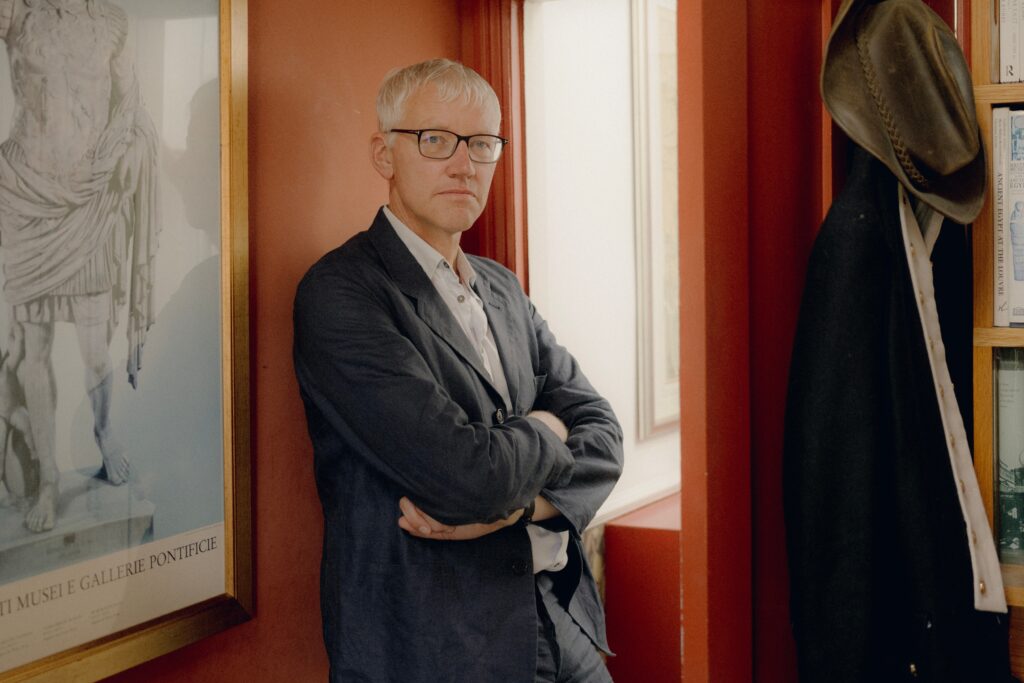
BROAD CHALKE, England — On this bright morning in high summer, Tom Holland barrels down narrow lanes bordered by tangled bushes, yellow grass and ancient deep-green hedgerows. The historian has agreed to chat about America at 250, but first he’s driving me to his childhood home in a village eight miles southwest of the cathedral city of Salisbury. Holland, 58, is participating in the large history festival held annually here, founded 15 years ago by his brother, James, a historian of World War II.
When we arrive, the first question stumps him. How old is this marvelous long, low, thatched-roof cottage in which he grew up? Holland wrinkles his forehead, unsure, but his 94-year-old mother, Jan, sitting nearby, lends a hand. “Seventeenth century?” she ventures, smiling.
It’s a bucolic spot. The Queen Anne-style residence next door has a bountiful garden that could have doubled for the one in “The Tale of Peter Rabbit,” with fruit trees, trellised plants and low vegetable beds divided by straight pebble paths. “Funny thing — how often our cricket balls would go flying over the fence,” Holland recalls, “and then we’d need to go hunt for them in there.”
James, two years his junior, was the ball-retrieving companion. He was also the first Holland brother to have a podcast, “We Have Ways of Making You Talk,” launched in 2019. Tom’s decision to follow the next year with “The Rest Is History,” which he hosts with Dominic Sandbrook, has made him an international celebrity.
Taking the past seriously while avoiding pious PC finger-wagging — or “woke tosh,” as they dub it — Holland and Sandbrook mix erudition with spirited banter and have spun audio gold. “The Rest Is History” regularly makes the Apple list of most popular podcasts, garnering more than 27 million streams and downloads per month, reaching a fan base that skews male and remarkably young. More than 60 percent of the show’s listeners are under 44. Surprising, too, is that this very British production — on which a pair of middle-aged Englishmen entertain themselves doing impressions of Winston Churchill and Margaret Thatcher — captivates so many Americans. The United States is the show’s biggest market, accounting for more than a third of all plays.
Over tea and biscuits, Holland describes how he became entranced by the past. His first obsession was with dinosaurs, and then, after reading Robert Graves’s novel “I, Claudius” at age 11, ancient civilization. A boyish zeal for fact-foraging remains alive in Holland’s podcasting style, married to an instinct for brisk narrative pace, honed over his many years writing books. “Rubicon: The Triumph and Tragedy of the Roman Republic” in 2003 was his breakout title. “Dominion: How the Christian Revolution Remade the World” climbed the bestseller lists on both sides of the Atlantic in 2019.
Among the 900-plus episodes of “The Rest Is History,” a fair number concern American topics, and the occasion of the U.S. semiquincentennial has prompted the duo to play to their strength: examining personalities. Episodes on George Washington and Benjamin Franklin have been released this week; Thomas Jefferson and Alexander Hamilton shows will appear next.
“It’s very unfashionable, I think, to attribute the success of the revolution to the remarkable qualities of the Founding Fathers,” Holland says, then pausing a beat. “So what? Their quality was recognized at the time, even by their enemies. And it’s rare for people who have been defeated to acknowledge the stature of those who have defeated them.”
Holland notes how stupefied King George III was to learn that Washington had given up the presidency and, like Cincinnatus, returned to his plow. But America’s founders consciously emulated the Romans, he explains, because as members of the transatlantic British elite they were steeped in classical history. “There are multiple lessons that can be applied from classical history — that’s the joy of it,” Holland says. “If you are in rebellion against a king, you can look back at the palmy days when the Romans expelled a monarch and established a republic.” They knew how that project ended, of course, “so there’s an immense emphasis in the early decades of the American republic on the virtues of the early Romans as they are properly understood.”
Holland’s favorite image of the first president is Horatio Greenough’s 12-ton marble statue of Washington in Roman dress, commissioned in 1832 to mark the centennial of his birth. It once stood in the Capitol Rotunda and now lives in the National Museum of American History. “For me, that is the emblem of Washington — an 18th-century gentleman cosplaying in a toga.”
But an ever-present consciousness of the Roman Republic’s fall also accounts for the suspicion harbored by the rivalrous Hamilton and Jefferson that the other was a potential power-grabbing Caesar. It also informed the enduring fear — unreasonable, in Holland’s mind — of a collapse of American democracy, which still haunts many Americans to this (Trumpian) day.
Asked to name his favorite Founding Father, Holland fulsomely praises Franklin for lining up the French on the colonists’ side — “the great diplomatic achievement in the whole of American history” — before admitting that no colonial leader surpasses Jefferson, author of the Declaration of Independence. “The genius of the Declaration is that it draws on what are clearly Christian ideas of the inherent dignity of mankind — life, liberty and the pursuit of happiness,” he says. “But there is no overt Christian framing of it, which is brilliant, because it allows all kinds of people to buy in.”
What of the current antipathy for Jefferson, owner of 600 slaves, a man who sired children with his late wife’s enslaved half sister, Sally Hemings? Holland responds passionately: “Jefferson knew in his marrow that slavery was a moral abomination. He knew this because he had read the New Testament, because he was steeped in the liberalism of the English Enlightenment, because for him the ideal of liberty was the most vivid ideal he had.”
And yet the historian admits “it’s such a mystery” that Jefferson lived in conflict with his own values. “My solution is he basically wants to be Cicero; he wants to retire to enjoy otium cum dignitate, as the Romans call it, leisure with dignity, but he needs the slaves for that. All the Virginian aristocracy is going bust at that time. If he frees his slaves, he will lose Monticello, and Monticello is the great love of his life.”
Touching on the tension between the podcast’s hosts — a willingness to disagree that often enlivens “The Rest Is History” — Holland acknowledges that Sandbrook has no patience for his adulatory view of the third president. “Jefferson is everything Dominic most hates. He hates hypocrisy, he hates slave owners, he hates the French Revolution.”
But Holland’s affinity for Jefferson is also demonstrative of his constant striving to see people from the past in their full complexity. “I respect Jefferson’s many qualities — he’s unbelievably clever, talented, an amazing politician.” And yet in Holland’s view, he’s a “tragic figure because all those qualities served only to immure him within what he understood to be a terrible moral crime.”
Holland likewise spares a thought for the big baddie in the story of America’s beginning. “The way George III has been framed is insane. A man less qualified to be a tyrant would be hard to think: He’s a genial buffer who goes mad. It’s a classic example of how the myths are summoned up in defense of the cause. It’s necessary for the founders to cast George III as being Tarquin the Proud or Nero, but he’s like neither.”
Yet history is ever vulnerable to distortion. In the academy today, the past is viewed obsessively through the anti-colonial, oppressor-versus-oppressed lenses. “We’re going through a massive purity spiral,” Holland says. “One of those periodic great moral awakenings that America has experienced, and Britain as well, since the 18th century.” Holland, who is often at pains to remind Americans not to view history in continental isolation, continues: “This is part of the moral character of the Anglo-American Atlantic world that existed before the U.S., which is why Britain and America share it.”
“It’s an anxiety about sin,” he adds. “And what I don’t like about it is that although it’s obviously based on Christian notions of sin and repentance, there isn’t actually much opportunity for repentance.”
So is “The Rest Is History” a kind of woke-countering reeducation project? Holland shakes his head. “I don’t think the purpose of history is to teach you moral lessons. I think the purpose of history ultimately is to broaden your sense of what it is to be human.” Still, unhooking the study of history from moralizing is one secret to the show’s success. On that, Holland agrees: “It’s not that we are amoral; we have our own morality, but we try not to let it intrude,” he says. “We try to be respectful of the moral opinions and judgments of actors at different periods and different times. And when they go against their own moral codes, we identify that.”
What of Donald Trump, a man widely considered morally challenged? “He is the most consequential president since FDR,” Holland says. “Instinctively, he understands how to use the upheaval in the media landscape. He’s obviously not an intellectual, but he has an amazing feral intelligence, which would count for nothing were it not for the fact that clearly a substantial part of the American electorate felt their views were not being articulated, not being respected, not being placed on the national agenda.”
“I think Trump does have authoritarian tendencies,” Holland continues. “There is an element of Commodus about him,” a reference to the Roman emperor whose reign, starting in the year 180, is commonly thought to mark the end of the Pax Romana, a golden age of tranquility and prosperity. “But Trump is also — red in tooth and claw — an expression of American democracy. And I really don’t think that America becoming a fascist dictatorship is remotely plausible.”
Speaking of that “upheaval in the media landscape,” hasn’t Holland, like Trump, benefited from it? He concedes the point. “In ‘Dominion,’ I wrote about the impact of the printing press on the emergence of Protestantism,” he says. “And I never thought that I would benefit from a kind of technological revolution. But that’s exactly what we’ve done. We’ve caught the crest of this great technological wave that means that we can do history in a way that simply wouldn’t have been possible 20 years ago.”
George Orwell once placed “sheer egotism,” atop the list of reasons why people write, and Holland’s bounding confidence in conversation speaks to that. But it’s impossible to sit across from him and not sense also a deeply feeling nature. “I would happily spend years on Jefferson,” he confesses after a brief return to his ardent defense of the third president. “Which I don’t have — I don’t have the time.”
Indeed, after diving into the past for more than an hour, Holland resurfaces in the present, with the hunted look of the overcommitted 21st-century man. It’s evident as he searches for his misplaced car keys, remembers an upcoming meeting, kisses his mother goodbye with a promise to return, that too many people want a piece of Tom Holland. Plus, he blew his book deadline six months ago.
“I was meant to have handed it in at Christmas,” he says mournfully of the manuscript titled “All You Need Is Love,” an exploration of how the 1960s were the most consequential decade in the history of Christianity since the 1520s. “I’ve only written 12,000 words so far.”
This weekend will be taken up hosting with Sandbrook the first-ever “The Rest Is History” festival at Hampton Court Palace. (Yes, the Hollands are now a family with two history festivals to their name.) A live audience of 5,000 people is slated to be in attendance on July 4, when Holland will be onstage in conversation with historian Mary Beard discussing “What makes Romans unique?”
George Washington and his friends might have a few thoughts.
The post Tom Holland sees echoes of Rome in the American experiment appeared first on Washington Post.