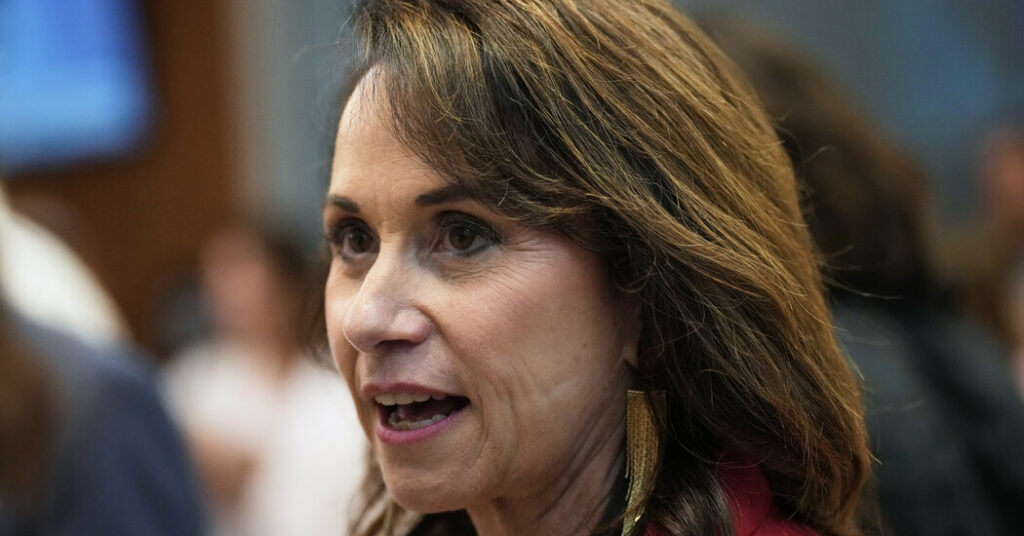
The Louisiana Supreme Court on Friday paused the prosecution of the state’s Republican attorney general just hours after a grand jury in New Orleans indicted her over letters she had sent city officials threatening that they could be removed from office.
Attorney General Liz Murrill made an emergency filing asking the court to intervene after the grand jury handed up a 16-count indictment on Thursday that charged her with malfeasance in office and intimidation and retaliation against a public official.
The court, whose justices are elected and the majority of whom are Republican, issued a stay early Friday morning.
In the order, the justices wrote that Ms. Murrill “makes a compelling argument” regarding possible flaws in the grand jury process and in its interpretation of the laws she was accused of breaking. “The indictment appears to turn the law on its head and flows from what appears to be extraordinary procedural defects and improprieties,” the order said.
In a statement on Friday morning, Ms. Murrill renewed her condemnation of the charges as a political attack and thanked the court for stepping in. But she said that the matter was not resolved and that she would be filing motions asking for the charges to be dismissed.
“I hope this political witch hunt is not a harbinger of things to come, but I fear that it is,” Ms. Murrill said. “Neither the grand jury investigation law nor the public intimidation law was intended to be used as a political weapon by a rogue, biased, vindictive special prosecutor, judge and grand jury.”
The charges are the latest move in a long and convoluted conflict between left-leaning New Orleans and Louisiana’s conservative state leaders who have sought to exert their power over the city, most recently with sweeping changes to its judicial system. The overhaul included merging the separate elected offices of the criminal and civil court clerks into a single role.
The reconfiguration of the clerk’s office, in particular, struck a nerve in New Orleans because the city had recently elected Calvin Duncan, an acclaimed jailhouse lawyer and criminal justice advocate who had been exonerated after 28 years in prison on a murder conviction. State officials rushed to enact the changes before Mr. Duncan could take office in May.
State lawmakers said the merger eliminated the criminal clerk’s office, shifting its responsibilities and funding to the civil court clerk. But New Orleans officials argued that the state had, in fact, created an entirely new office: the clerk of courts. In May, the City Council appointed a retired judge to the post and called a special election, all while the sitting civil court clerk continued to serve.
Ms. Murrill responded by sending letters in May to eight elected officials, including Mayor Helena Moreno; Jason Williams, the district attorney for New Orleans; Judge Calvin Johnson, the interim clerk appointed by the city; and five City Council members who had voted in favor of appointing Judge Johnson.
In the letters, Ms. Murrill asserted that the city’s actions “trigger serious consequences under Louisiana’s usurper statutes, including the possible forfeiture of your own office.” She said the officials had “put your own offices in jeopardy” and that Gov. Jeff Landry had the power to appoint replacements.
Ms. Moreno claimed that Ms. Murrill’s letters constituted a threat to the officials for daring to challenge the state and accused her of breaking the law.
The grand jury initiated its own investigation into Ms. Murrill, prosecutors said. A judge appointed a retired judge to step in as a special prosecutor after Mr. Williams, the district attorney, recused himself.
Local news outlets described a frenzied scene at the criminal courthouse in New Orleans on Thursday, as journalists were blocked from witnessing what legal experts said should have been open proceedings. At least one journalist and a legal advocate were handcuffed, the outlets reported.
The Supreme Court, in its order, cited that commotion and potential conflicts of interest involving the special prosecutor named in the case. The prosecutor, Laurie White, had previously been a lawyer for Mr. Duncan, and the attorney general’s office has represented Ms. White in a lawsuit accusing her of sexually harassing and retaliating against a court employee while she was on the bench. (Ms. White has long denied the accusations.)
Efforts to reach Ms. White on Friday have been unsuccessful.
In a news conference on Friday, Ms. White acknowledged the frustration in New Orleans over the actions of state officials and said that those actions could have informed the grand jury’s thinking in pursuing the investigation.
She sounded exasperated as she described her own involvement in the case.
“I didn’t even know what I was being appointed for,” Ms. White told reporters.
The post Louisiana Supreme Court Pauses Case Against State Attorney General appeared first on New York Times.