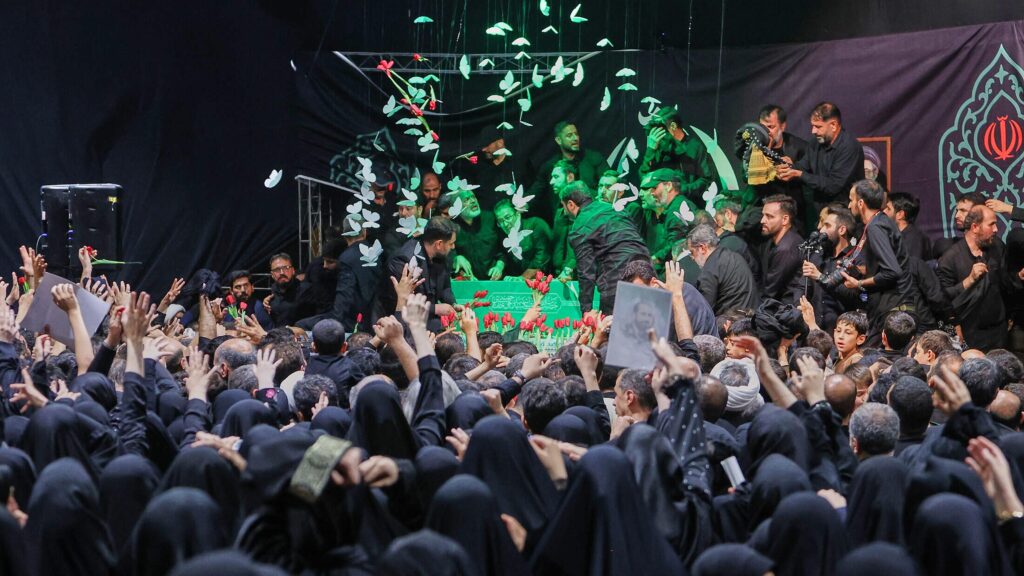
Iran is preparing for a week of mourning, beginning on Friday, for Ayatollah Ali Khamenei, the country’s slain Supreme Leader.
The mass funeral rites for Khamenei, who was killed by the U.S. and Israel at the start of their war with Iran, will begin in Tehran. The processions will continue next week in Qom, as well as ceremonies in Karbala and Najaf in neighboring Iraq, before the late leader is buried in Mashhad on July 9.
Iran’s rulers have cast the funeral procession as a symbolic rebuke to the U.S.-Israeli war that sought to decapitate the country’s leadership. Officials expect as many as 20 million people to attend, which would make it one of the largest public gatherings in Iran’s history.
“The large public turnout at the funeral procession of the martyred leader and the other martyrs will, in effect, be another referendum for the Islamic Republic,” Qom’s Friday prayer leader, Ayatollah Mohammad Saidi, told Iranian state media.
The U.S. and Iran have halted attacks and begun negotiations towards a comprehensive deal around Iran’s nuclear program and the Strait of Hormuz.
But Iran has been substantially weakened by the war. U.S.-Israeli attacks killed thousands of people in Iran, including dozens of the country’s senior leaders, and damaged historic buildings. The U.S. naval blockade, which was lifted on June 18 following the U.S.-Iran memorandum of understanding, crippled an already strained Iranian economy. Moreover, Iran alienated several of its neighbors in the Gulf by launching retaliatory attacks against them and upending regional trade through the blockade of the Strait of Hormuz. Despite this, Tehran appears emboldened, having defied calls by some in the West and Israel for regime change.
Khamenei, who led the Islamic Republic for 37 years out of its 47-year history, is regarded by many supporters as the earthly representative of the Hidden Imam, the 12th imam who, according to Shi’ite belief, disappeared in the ninth century. Since his death, black mourning banners have been draped over Tehran’s streets. Khamenei’s body arrived at the Grand Mosalla mosque in Tehran on Friday, and a red flag from the Imam Reza shrine in his hometown of Mashhad, where he will be buried, has been placed over his coffin.
Khamenei was succeeded by his son Mojtaba, who was wounded in the U.S.-Israeli strikes which killed his father on Feb. 28. He has not been seen since the war began, and according to state media, will not attend the funeral ceremonies over security concerns.
A “referendum” for the country
Iranian leaders have portrayed the mass funeral processions as proof of enduring public support for the theocratic regime after the war.
“As an epic-spirited Iran prepares to bid farewell to this loyal servant of Islam and the Revolution, I call upon all the noble people of our country—regardless of ethnicity, religion, personal preference, or political affiliation—to participate with fervor, resolve, and a historic presence in the funeral and burial ceremony of this martyred leader, thereby once again demonstrating an enduring display of national unity and loyalty to the lofty ideals of the Islamic system,” Iranian President Masoud Pezeshkian wrote in a statement posted to Telegram by Iranian state outlet Tasnim News, translated by The Hill.
“Your massive turnout will serve as a decisive response to the logic of terror and violence, and will not waver our resolve,” the statement adds.
Millions of Shi’ite Muslims are expected to attend the funeral ceremonies, including travelers from Iraq, Lebanon, and Pakistan. An estimated 10 million people turned out for the funeral of Iran’s first Supreme Leader, Ruhollah Khomeini, in 1989. The crush of mourners led to at least eight people being trampled to death, according to the Associated Press.
Iranian media reported that senior officials from around 40 countries are expected to attend the funeral ceremonies, including officials from Russia and China.
Still, the Iranian public remains deeply divided over its support for the regime. In December and January, millions of people took to the streets to protest soaring inflation and the collapsing rial. Many called for the death of Khamenei and denounced decades of repression, only to be met with a deadly government crackdown.
The funeral processions are also unfolding against the backdrop of talks between the U.S. and Iran. On Thursday, Iran warned vessels to use only designated shipping lanes through the Strait of Hormuz or face a “forceful response.” Last week, Iranian attacks on commercial vessels and U.S. strikes on Iran threatened to unravel the newly brokered truce and once again disrupt one of the world’s busiest shipping routes.
The post Iran Holds Funerary Processions for Late Supreme Leader in Symbolic Referendum for Regime appeared first on TIME.