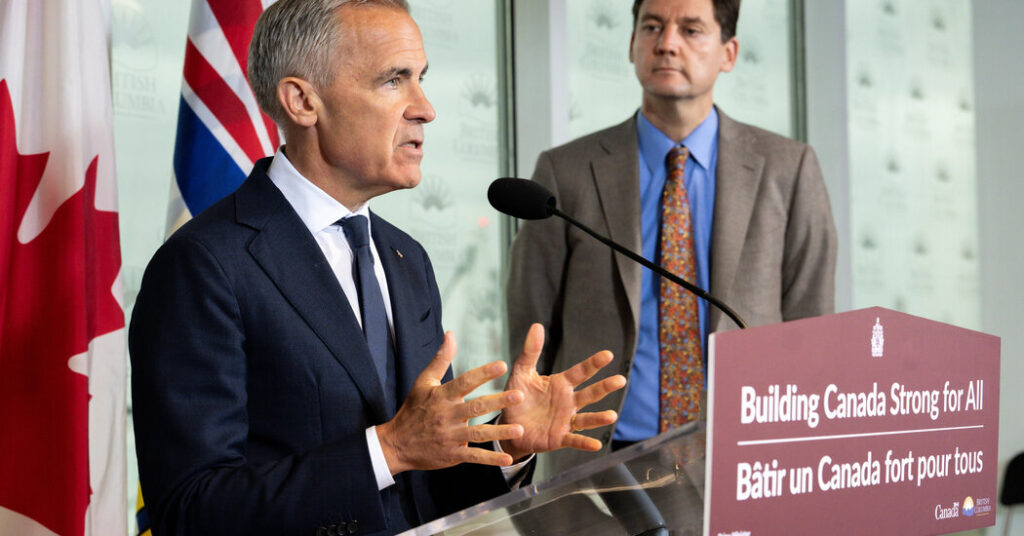
Canada took another step toward breaking its economic dependence on the United States on Thursday, as Prime Minister Mark Carney announced a slew of infrastructure projects in the country’s West to boost exports to Asia.
Key among the proposed projects is a new pipeline that would take oil from the landlocked province of Alberta to the coast of British Columbia, where tankers would transport it to Asian markets. Alberta currently sells nearly all of its oil to the United States.
Other major energy export plans include building up multiple liquefied natural gas terminals along the northern coast of British Columbia to triple the country’s L.N.G. production, and expanding the deep-sea port of Prince Rupert in the same region, which offers faster travel times for vessels heading to Asian destinations.
Mr. Carney also said that the Canadian government would expand the port of Vancouver, which is the main departure point for exports to Asia but has reached its capacity and would need to grow to carry additional goods.
The projects make up a multibillion-dollar strategy to help Canada ship large volumes of energy and other goods to Asian markets amid a breakdown in its economic relationship with the United States under President Trump.
“In a more dangerous and divided world, our strategy is to focus on what we can control, by building our strength at home and diversifying our partnerships abroad,” Mr. Carney said at an event in Vancouver on Thursday, adding that the initiatives amount to 150 billion Canadian dollars ($105 billion) in new investments.
He was expected to head to Calgary in Alberta later on Thursday, to unveil the province’s new oil pipeline proposal.
On Wednesday, the U.S. administration said it would not renew the free-trade agreement it has with Canada and Mexico, putting North American trade, already disrupted by tariffs, in a new state of upheaval.
Since taking office last spring, Mr. Carney has traveled extensively to Asia and Europe, trying to line up export markets for Canada, with the goal of doubling the country’s exports to non-U.S. markets over the next decade.
The ambitious plans laid out on Thursday are politically potent in Canada, both for Mr. Carney and for the provinces of Alberta and British Columbia, whose interests are often conflicting.
Mr. Carney has staked his leadership on generational, nation-building projects that will help Canada survive what he’s called a “rupture” precipitated by the Trump presidency. He is under pressure to start delivering on them as trade talks with the United States drag on.
Support for a major new oil pipeline from Alberta to the West Coast is seen as vital to keeping the province in the country amid a push for secession. Albertan separatists point to a lack of federal government support for more oil projects as evidence that the province cannot succeed within Canada and should break away to realize its potential. A vote to decide on whether to hold a referendum on secession will take place in mid-October.
The projects Mr. Carney announced will keep in place tight restrictions on the movement of tankers off the northern coast of British Columbia, a particularly sensitive issue in the region in part because of strong opposition to the large oil-carrying vessels by coastal Indigenous groups.
The Conservative opposition party has repeatedly called out Mr. Carney for making big announcements but, more than a year in, having little to show for them.
On Thursday Mr. Carney listed a number of big projects but did not elaborate on how much each will cost, who will pay for them, or when they will be ready, although he did commit federal government funding for some of them.
But he did seem to acknowledge that the pace of investment and infrastructure development in Canada was too slow to meet the country’s needs for jobs and growth, a complaint from the private sector, which points to cumbersome government regulations and bureaucracy.
“To seize these opportunities, Canada has to do things differently,” Mr. Carney said. “We need to move faster, build bigger, and work together,” he added.
The post Carney Unveils Western Canada Mega-Projects to Boost Asia Trade appeared first on New York Times.