Well, that’s a fun ride, isn’t it?
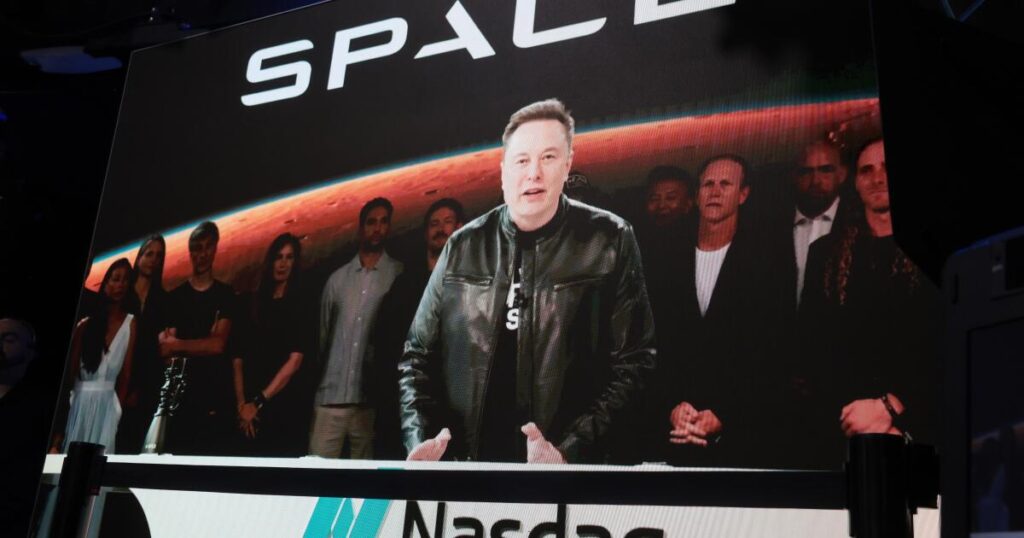
SpaceX, which is controlled by Elon Musk, went public on June 12 at a stratospheric valuation that made Musk the first trillionaire in history.
He retained that status, according to Bloomberg’s billionaires index, for 11 days after the initial public offering, or until the stock price drifted back to Earth and Musk’s fortune fell to as low as $942 billion, by Bloomberg’s reckoning.
On Monday and Tuesday, his fortune crept back to a hair above $1 trillion as SpaceX gained 11.5% and and Tesla, Musk’s other public company, gained 10.8%. These are the core of his net worth, which Bloomberg put at $1.01 trillion Monday and Tuesday.
Yet the tsunami of publicity about Musk’s trillionaireship dodges an important question: Has he ever really been a trillionaire?
The answer, if one examines the basis for the claim, is no. At best, he is a trillionaire on paper, but even that description is dubious.
One reason for the fascination with Musk’s status as a “trillionaire” may be the very human difficulty of grasping such a big number. We can comprehend 1 million, and even that 1 billion is one thousand millions. But a trillion — in other words, one thousand billions?
In his classic book “Innumeracy,” mathematician John Allen Paulos observed that people are inclined to think that 1 trillion and 1 billion are about as close together as 1 billion and 1 million. They’re not. In his book, Paulos tries to illustrate the difference by noting that the passage of 1 million seconds would put us back by about two weeks, the elapsed time of 1 billion seconds would be a little less than 32 years, and 1 trillion seconds was nearly 32,000 years ago — back to the paleolithic era, the dawn of modern humans and tens of thousands of years before the beginning of recorded time.
When it comes to Musk’s fortune, it might help to contemplate some things he could buy if he liquidated all his stock in Tesla and SpaceX to place $1 trillion in his hands: about 8,900 Boeing 737 airplanes, 1,667 Trump ballrooms (at the latest cost estimate of $600 million each) or almost four Jeff Bezoses (at the latter’s estimated fortune of $262 billion). Or he could buy more than 3,400 U.S. elections, based on his documented political contributions of $291 million to Republicans in the 2024 election cycle.
For all that, the description of Musk as a trillionaire rests on the debatable value of SpaceX, which accounts — by Bloomberg’s estimate — for nearly 78% of Musk’s net worth. (I asked SpaceX to comment on Musk’s trillionaire status, but didn’t hear back.)
This isn’t the first time that an estimate of someone’s wealth has stood atop a shaky pillar, and probably won’t be the last. Indeed, the very exercise of ranking people and families by wealth is itself doubtful.
For those whose fortunes rest on private businesses, it’s often based on suspect valuations by insiders.
Even for those whose wealth comes mostly from publicly traded stocks and bonds like Musk, the exercise can be more an art than a science.
That brings us to the valuation of Musk’s SpaceX shares. According to the company’s financial filings, he owns 4.76 billion shares, with exercisable options for an additional 350,000. At Tuesday’s closing price of $170.86, his stake came to about $813.3 billion.
His second-largest holding, 11% of Tesla, was worth about $174 billion at the EV company’s closing price Tuesday. Bloomberg added to its calculation Musk’s stakes in his private companies Neuralink and Boring Co., about $7 billion between them, chump change in Musk’s world. Throw in a few other billions here or there and you’re back over $1 trillion.
But SpaceX stock has been exceedingly volatile. Most IPOs undergo a volatile period that can last for months or even more than a year. The SpaceX IPO had some peculiarities that have made the stock especially volatile, and betoken more volatility ahead.
Come July 7, the shares will be listed as part of the Nasdaq 100 index. That’s a fast-tracked listing compared with most other stocks, which have to “season” for as long as a year by showing sustainable profits and price action before being added to the index.
The listing is sure to trigger buying by mutual funds and exchange traded funds based on the index, because their holdings must reflect the index’s portfolio.
On the other side of the coin, SpaceX will allow some insiders to start cashing out early. The typical IPO locks insiders by prohibiting their sales for at least six months. SpaceX insiders, however, can sell up to 20% of their shares as soon as the second day after the company’s second-quarter earnings report, expected around Aug. 11 —in other words, about two months after the IPO.
If the shares trade for a period prior to the earnings release at 30% over the IPO price, or about $175.50, the insiders can sell up to 30% of their stakes. That could expose the shares to intensifying selling pressure in the days and weeks before the lockups are lifted.
Due in part to these unusual countervailing forces, the trading pattern of SpaceX shares has resembled that of a penny stock on the pink sheets. They peaked on June at $225.64, a gain of more than 50% from the $150 opening trade on IPO day; but on June 22 they fell to $154.60 from $185 on the previous trading day, June 18, a one-day drop of 16.4%.
That raises the question whether it’s proper to count Musk’s unsold SpaceX shares as part of his current net worth. To be fair, investors, from the smallest retail plungers to the biggest institutions, commonly “mark to market” their unsold stock and bond holdings, counting them as part of their net worth at their current prices. That’s fair because those investors can liquidate those holdings if they choose to, or have to.
Musk’s SpaceX shares are different, however. According to the company’s registration statement, he and other top insiders are forbidden to sell, lend them out or borrow against them, among other restrictions, for 366 days after the IPO. Are they really his to count as part of his net worth until the restrictions are lifted? Reasonable analysts may differ.
Musk probably doesn’t need a written order not to touch his shares. He’s like a prisoner in a pen of his own making. SpaceX is such a cult holding that he knows that at the first hint that he was selling or pledging his shares, he would reap the whirlwind. The speed of the rush for the exits would be measured in nanoseconds.
The question at hand is SpaceX’s turbocharged market value, and whether it’s sustainable. It has been widely remarked that the shares’ issue price of $135, much less their peak of $225.64 on June 16, bears no relation to how they would be valued in conventional securities analysis, which is tethered more or less to a company’s capital structure, earnings, cash flow and reasonable expectations for the future.
Rather, it’s based on investors’ faith in Musk and perhaps excitement about the company’s airy goals of building “the systems and technologies necessary to make life multiplanetary, to understand the true nature of the universe, and to extend the light of consciousness to the stars.”
The $135 IPO price valued SpaceX at about 95 times 2025 revenue, an unprecedented multiple. As the veteran short-seller Jim Chanos observed on X, Amazon went public in 1997 at three times revenue, Google in 2004 at seven times revenue, and Meta (then Facebook) in 2012 at 20 times revenue — and promptly declined by 50%. “SpaceX dwarfs these numbers,” Chanos wrote on X.
Another feature of the SpaceX trade deserves notice: Only about 5% of the company’s shares were available for trading, a remarkably thin “float” for an IPO. At the same time, the company reserved some 20% of those shares for sales to small retail investors, a group that tends to be more inclined than institutional investors to buy or sell based not on sober analysis but on emotion.
The thin float and retail investor enticement created an artificial scarcity — if you were a small investor hankering for a piece of SpaceX action the only place to go was an overheated stock market. That was good for insiders, who can sell their shares into a hungry market, but perhaps not so good for those hungry buyers.
“You only set up an IPO like this to enable insiders to dump their stakes,” asserts Will Lockett, a devoted Musk skeptic.
The bottom line is that the SpaceX IPO appeared designed to pump up the stock’s value to the point of what Alan Greenspan might have called “irrational exuberance.” In turn that gave Musk — whether intentionally or coincidentally — bragging rights as a pioneering trillionaire.
He had to give up that mantle within days of the IPO, but now he has it back, narrowly. How long will he hold the trophy? Watch the price of SpaceX to know.
The post Is Elon Musk really a ‘trillionaire’? Only on paper appeared first on Los Angeles Times.