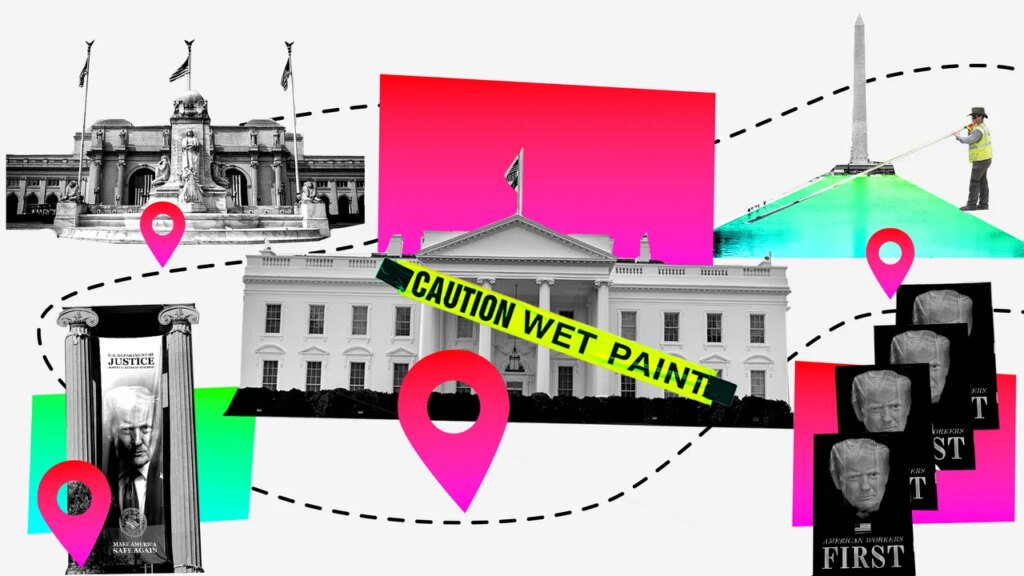
Washington, DC, looks a little different these days. Since his return to office, President Donald Trump has pushed to physically remake the city in his image, adorning buildings with his name and banners with his face, repainting entire monuments, and even changing the White House itself.
As the United States celebrates its 250th anniversary as a country this weekend, tourists might be surprised to find the nation’s capital undergoing immense change and, in many places, under scaffolding from ongoing construction.
On the eve of the Fourth of July, take WIRED’s walking tour through the dizzying effects of Trump’s metropolitan makeover.
Union Station
We start our tour at Union Station, the beaux arts building that serves as the Amtrak hub and gateway to the city for visitors arriving by train.
Stepping outside the grand train hall brings the first evidence of Trump’s efforts to clean up once neglected parts of the District of Columbia: the renovation of Columbus Circle.
While many of Trump’s changes to the city have received heavy critique, the work on Union Station has been broadly welcomed by locals and congressional staff who commute by metro and walk across the traffic circle towards the US Capitol.
After an $11.8 million rehabilitation, the landmark has functional fountains (they were dry for nearly two decades), and its marble sculptures have been cleaned of grime. The homeless encampments on the surrounding grass have been cleared by the National Guard, who have since been redeployed to the reflecting pool (more on that later).
The Department of Justice and Labor’s New Banners
For the next stop, turn right to reach Pennsylvania Avenue while taking in the serenity of the Capitol dome visible above the tree canopy around the Senate Park.
But be warned, for almost immediately, a giant banner featuring Trump’s face will stare down at you onto the street from the side of the Labor Department building.
While most presidents have aspired to a greatness that prompts future generations to celebrate their image, Trump did not want to wait.
The roughly $6,000 banner is the first of several political banners that adorn the exteriors of several executive branch agency buildings and pictures a glowering Trump.
Just five blocks down is the second of the big Trump banners, this time on the side of the Justice Department and featuring the slogan “Make America Safe Again.”
The banners across the city are symbolic of Trump’s efforts to exert total power across the federal government, but the one located outside DOJ is particularly notable, bringing to heel an agency that indicted him twice.
The White House
Continue toward the end of Pennsylvania Avenue to find the White House, which remains half obscured by the ongoing construction of Trump’s ballroom.
For months last year, Trump said the project, which demolished the East Wing, would be paid for by donors. It has since expanded in size and scope, with the president adding a bunker underneath and planning a drone port on the roof.
As a result, the price tag has ballooned, going from an initial estimate of $200 million to $400 million to Trump then asking for $1 billion from Congress until Republicans balked. WIRED previously reported the White House has started using funds previously appropriated last year to the Secret Service.
For all the expanding cost to taxpayers, the construction may be tricky to see, given that Pennsylvania Avenue in front of the White House has turned into temporary staff parking.
And the White House itself may be partially obscured by the giant American flag that Trump erected last year. Also not visible even with binoculars: Trump’s renovation of the colonnade with black granite, which he claimed he would finance but which has instead cost taxpayers about $700,000, according to The Atlantic.
The Reflecting Pool
Walk past the gray Eisenhower Executive Office Building—which Trump wants to paint white—to reach the Lincoln Memorial and the Reflecting Pool.
The pool has always been a must-see for any tourist, but visitors have been flocking to the site more recently to see problems with its makeover.
Trump’s $14.2 million renovation, which painted the pool floor “American flag blue,” has been beset with problems, from algae to tears in the sealant. The algae bloom that turned the pool a cloudy neon-green has since been removed, but that has only made the torn linings more visible.
National Guard members, patrolling near where the paint has peeled off, told WIRED they did not find the pool situation funny. “We could be doing more useful things than stand here,” said one, who spoke on the condition of anonymity.
One word of caution: Guard members have been ordered to detain anyone who even touches the water, for the Park Police to arrest on vandalism charges.
Arc de Trump
Swing around the Lincoln Memorial to look down Memorial Bridge for an unobstructed view of Arlington National Cemetery, likely for the last time.
When built, Trump’s 250-foot triumphal arch—set to be topped with gilt statues, including a 60-foot Lady Liberty—will tower over the end of the bridge.
The arch is expected to obscure the line of sight to Arlington House, the former estate of Confederate General Robert E. Lee, and to represent the biggest change to Washington’s skyline in generations.
Trump officials have countered that the arch would feature an observation deck, offering a new way to look out over the nation’s capital.
But the project, for which the White House is bypassing Congress, has been broadly opposed by the public: 52 percent of Americans are against the arch, compared with 21 percent in favor, according to a Washington Post–ABC News-Ipsos poll.
The Kennedy Center and United States Institute of Peace
Adjacent to the bridge sits the US Institute of Peace, once known jokingly in Washington as the place where a Fox News host had an altercation at a White House correspondents’ party.
These days, the building is more infamous for Trump slapping his name on its side, after DOGE unlawfully shuttered the agency and fired its staff.
Nearby sits the Kennedy Center, which no longer bears Trump’s name after a federal district judge last month ordered its removal.
The performing arts venue was named by Congress as a memorial to President John F. Kennedy in 1964, months after his assassination. A law explicitly prohibits its board of trustees from adding names.
The Trump administration eventually complied with the order, but the removal cannot be seen: A tarp currently covers the spot where Trump’s name once sat. A US district judge recently demanded an update on the tarp’s removal.
The post A Guided Tour of Donald Trump’s Renovated Washington, DC appeared first on Wired.