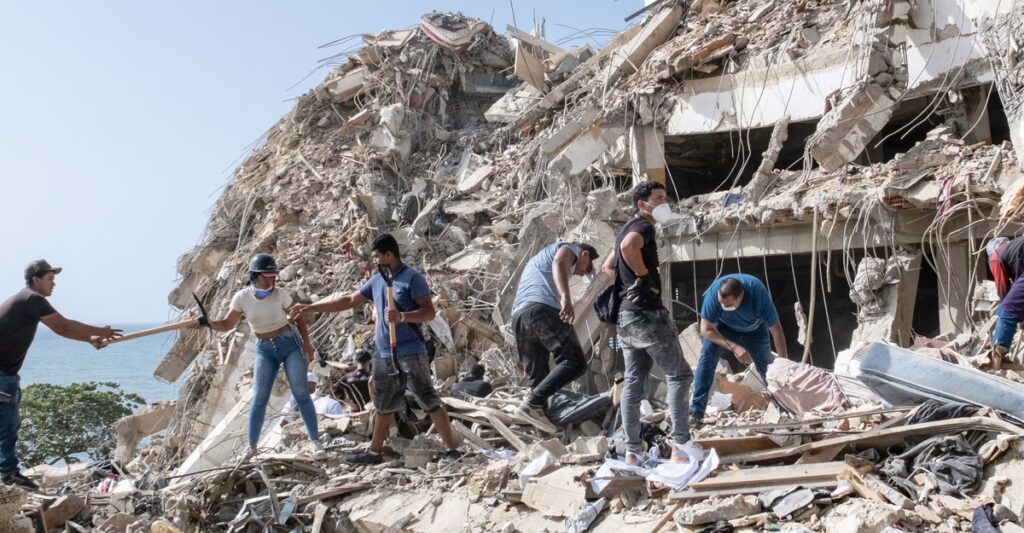
The Conjunto Residencial Belo Horizonte, twin apartment towers in the Venezuelan state of La Guaira, stood 16 stories high and offered sweeping views of the Caribbean Sea. Erick Rosas, a few weeks shy of his college graduation, was living with his family on the third floor, but when the shaking started on Wednesday, he was visiting his uncle, about 15 miles up the coast. It was a national holiday, commemorating a 19th-century battle that led to Venezuela’s independence, and Rosas was in the swimming pool.
In those first terrifying moments of back-to-back earthquakes, more powerful than any the country had experienced in more than a century, Rosas could think of little but escape, he told me. He pulled himself from the water and leapt from the pool deck over a concrete wall that dropped about 10 feet to the street. Apartment buildings behind him, and to his left and right, were falling to the ground. Shirtless, in flip-flops, he set out to find his family. To reach the Belo Horizonte, he walked and caught rides on the backs of motorcycles through dust and smoke, amid the clamor and confusion of the trapped and wounded, past rubble and burning wreckage of once-familiar streets. It took him five hours to get home, only to discover that much of the tower had pancaked and collapsed.
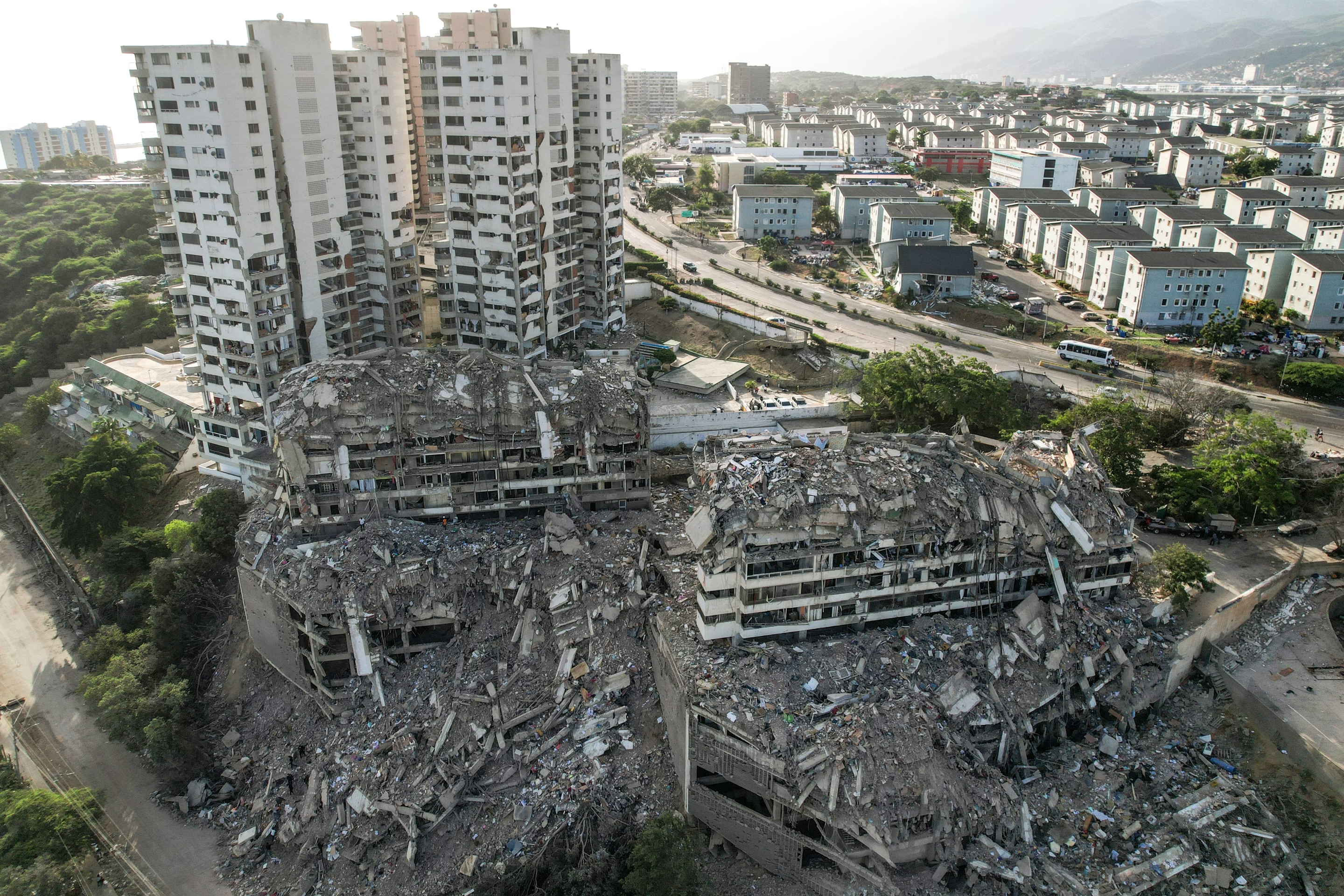
Near the end of the first week of one of Latin America’s worst natural disasters in years, at least 1,700 people have been confirmed dead, some 5,000 are injured, and more are missing. The death toll is sure to climb. The hardest-hit state of La Guaira is teeming with search-and-rescue workers and humanitarian help from dozens of countries, including the United States. The United Nations is coordinating more than 2,000 rescue workers out of a command center in a stadium. American military forces have helped reopen the nearby international airport that serves Caracas. And a Navy warship, the USS Fort Lauderdale, is docked on the coast.
But much of this help came well after the most crucial period, when residents of the Belo Horizonte and the hundreds of other destroyed buildings were urgently attempting to rescue survivors in critical condition. In those first days, the people closest to the disaster felt acutely the absence of any assistance from their own government. “It was just us, the relatives, the neighbors,” Zuleica Perez, a 66-year-old Caracas resident who searched for her family in the rubble of the Belo Horizonte, told me.
Along the Venezuelan coast, and especially in La Guaira, the evening of the earthquakes was primed to be a festive one. The area was hosting the feast of San Juan, an important Afro-Venezuelan celebration, during which the image of Saint John is placed on a public altar. People sing and dance; drumming fills the streets. Perez’s nephew, Christopher Pineda, was at work at a nearby beach club. Pineda’s wife, Maria Eugenia Garcia de Pineda, a high-school math and physics teacher, was home with their two children in their penthouse apartment on the 14th floor of the Belo Horizonte’s Tower A. The World Cup match between Brazil and Scotland was starting, and they were watching the game.
When the shaking subsided, Perez could not reach her nephew, or his wife, by phone. She drove from Caracas to the coast to find out what happened. Hundreds of buildings collapsed that evening; videos from the beach show one nearby building fall as people scream and wail. But Tower A didn’t fall flat; it crumbled into parts and fell to the side. A few lower floors held. By the time Perez arrived, it was dark, and the power was out. The rubble towered over her in a heap of broken concrete and twisted metal. She could find no sign of Maria or her children.
Rosas arrived at the downed towers late that night as well, after his escape from the swimming pool. His mother, he told me, had chosen that apartment tower in large part because she considered it safe. Her prior home had been washed away in the floods in La Guaira in 1999, in which thousands had died. Now more than 10 stories of the building had tumbled down. Their third-floor apartment had been destroyed. But it didn’t fall. Rosas’s family had survived.
He joined the throngs of people in the street trying to help pull out any survivors. “The truth is the neighbors were the ones who were going through the rubble; they were doing this work of rescuing,” he said. “It was an acquaintance, a neighbor, a friend, a relative.”
Similar scenes were playing out up and down the coast. Those first days, residents from Caracas and elsewhere rushed to help as they could, driving in on motorbikes and carrying water, diapers, generators, and tools to help people digging out the wreckage. Many complained that the government lacked heavy machinery to move rubble. By the weekend, government authorities would restrict access to people visiting La Guaira, asking for papers to show permission to be there. This helped bring some order to the search for survivors but also restricted the flow of assistance to people who had suddenly lost their homes and were sleeping outside, Lexys Rendon, the director of the human-rights group Laboratorio de Paz, told me. People in La Guaira had trouble communicating with those outside the area. Daniela Ropero, 38, who was helping mothers find lost children, did not want to leave, in case she couldn’t return, so she slept on floors in strangers’ homes, she told me over the phone. She stood by a truck with a Starlink internet connection, not far from the Belo Horizonte, to make calls. “There’s no running water. There is garbage everywhere now. There’s no public bathrooms. Between that and the smell of corpses—” she said before the connection broke up.
For the first three days, a crucial period to find survivors, the crowd of neighbors and relatives connected to the Belo Horizonte did what they could. In street clothes, many without helmets or masks or tools, they climbed into the rubble, risking their own safety to find those still alive. Videos posted on social media of this effort show people trapped high in the wreckage who showed signs of life but could not be reached. In one video, which Rosas told me captured what remained of his building’s fifth floor, the camera zooms in on a woman lying face down in the space between two collapsed floors and moving slightly. “She’s alive. She’s still alive,” the person filming says.
As the neighbors searched, they taped to a wall a handwritten list, more than 10 pages long, with the names and phone numbers of people who lived in the building. An Instagram account compiled dozens of photographs of residents from the building who were missing or deceased. Rosas told me the crowd managed to extract some people alive, but many more of the people they recovered were dead.
During the 48 hours that Perez and her relatives searched, she talked with others about the same grim mission: the 12th-floor family, two floors below her own apartment, and the husband who had gone out to buy bread minutes before the earthquake. “His wife and his daughter were entombed in there, and he was left out in the street,” Perez said.
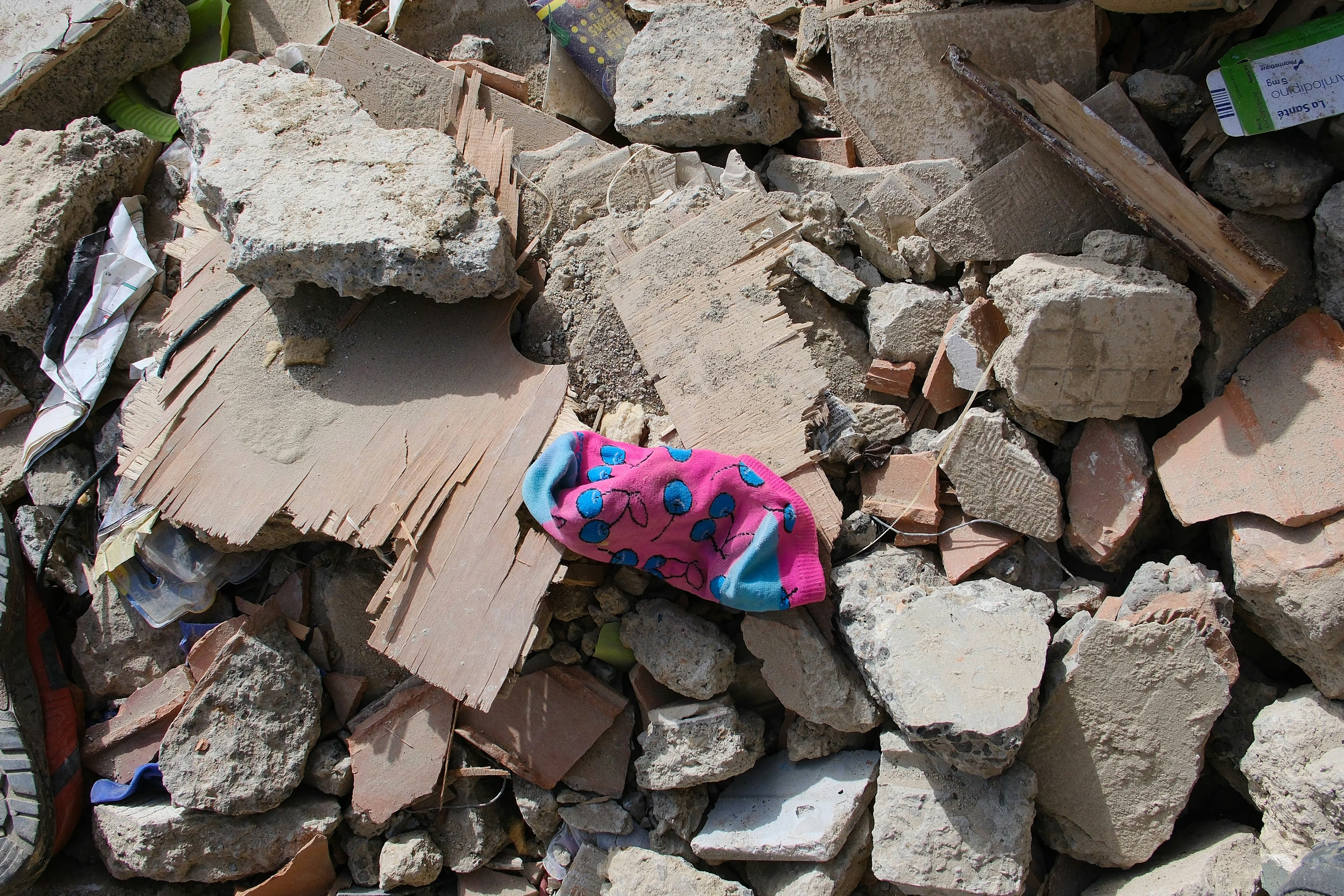
By Friday evening, her nephew had found a pink teddy bear that belonged to his own daughter, Eugenia, beneath slabs of concrete. When they found the girl, she was in her mothers arms; both had died, along with his son, who was in sixth grade. Extracting them took hours of strenuous work. As Perez recounted the ordeal, she was agonized. “They couldn’t pull out the girl,” she told me. “They’re not rescue experts.” It was late at night by the time they loaded all three bodies into a truck and drove through La Guaira to find a hospital.
Across the city, green spaces and parking lots had turned into improvised camps filled with displaced families. Others had taken shelter in stadiums and sports fields. On the streets, bodies were covered with sheets, lime scattered over them to soften the smell.
This country has long been in decline, under the repressive authoritarian rule of Nicolás Maduro, who took over after Hugo Chávez’s death in 2013. Venezuelans have endured food shortages and hunger; rampant inflation; protests by tens of thousands of people, who were beaten back by tear gas, water cannons, and worse. After the Trump administration overthrew Maduro in January, many Venezuelans expressed hope for better days ahead. But even though the economy has shown signs of life under Delcy Rodriguez’s leadership, “Venezuela is still in a profound crisis,” the economist Asdrúbal Oliveros told me. The earthquakes have “overwhelmed the capacity of the state.”
International search-and-rescue teams started arriving in La Guaira on the day Perez’s relatives were pulled from the Belo Horizonte. When Rosas eventually saw them, with their acoustic sensors and specialized tools, he felt as if they were coming not just from another country but another time. “We are taking out bodies with our bare hands, without gloves, and they show up with thermal cameras,” he told me.
These teams spread out amid the wreckage, far and wide beyond the Conjunto Residencial Belo Horizonte, and a new phase of the recovery began.
Mariana Zuñiga contributed reporting from La Guaira.
The post A Search Through the Rubble of Two Towers in Venezuela appeared first on The Atlantic.