The latest attempt by House Speaker Mike Johnson (R-Louisiana) to fulfill President Donald Trump’s demand to advance an elections overhaul bill failed Tuesday and delayed consideration of an annual defense policy bill.
Due to GOP defections, a procedural vote failed 224-198 on the House floor. The vote would have merged the Save America Act and the National Defense Authorization Act upon passage of the latter and sent both bills together to Senate.
Thirteen Republicans joined with Democrats to defeat a measure that would set rules for debate. GOP hard-liners, led by Rep. Anna Paulina Luna (Florida), rebelled against the tactic, arguing it would make it too easy for the Senate to remove provisions of the Save America Act. Senate leaders have said repeatedly that they lack the votes to pass the Save America Act as a stand-alone measure.
House Majority Leader Steve Scalise (R-Louisiana) voted “no” on the rule Tuesday alongside the 13 GOP lawmakers, a move that preserves a chance for the House to reconsider the vote later.
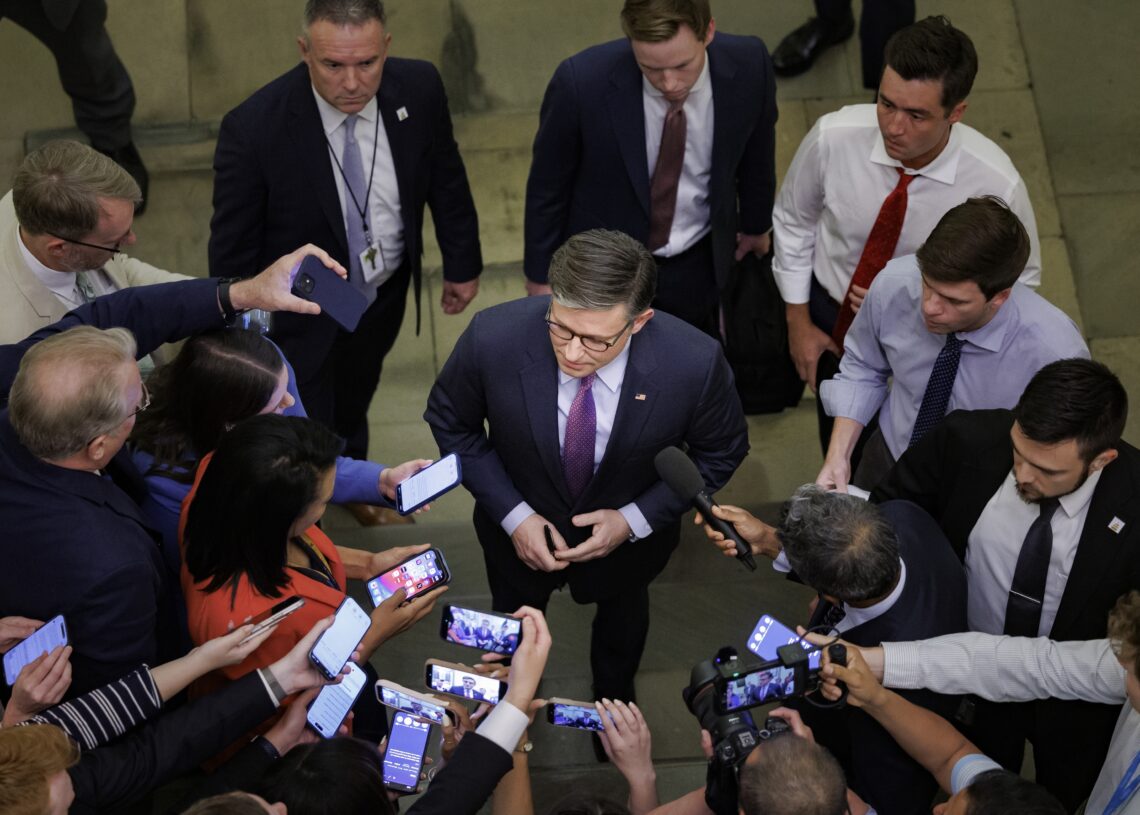
Johnson (R-Louisiana) said Republicans will spend the next day and a half working on getting everyone in the party to a yes.
He said the Republicans who voted against the rule are making “irrational decisions.”
“It makes no sense to punish the House and stop the great progress of the House because of what Senate Democrats are doing or not doing,” he told reporters. “We’ve got to move forward.”
When asked if Trump should talk to the House GOP holdouts, Johnson said he believes the president is “going to be very frustrated” with them.
House Republicans have scrambled to find a way to get another vote on the Save America Act that would impose new voting restrictions, including a requirement to provide documented proof of citizenship and a photo ID at the time of voting, as Trump has demanded.
After Tuesday’s failed vote, Luna said she will vote for the rule if House leaders let her add an amendment to the NDAA that would call for voter ID plus proof of citizenship to be placed into the text of the NDAA — two crucial portions of the Save Act.
Another option House Republicans are considering would use a fast-track process to bypass the filibuster and pass Trump’s sought-after voting restrictions.
Johnson said Monday that Republicans are moving forward with a plan to establish a grant program that would incentivize states to adopt stricter election rules outlined in the Save America Act.
The move would use the reconciliation process, designed to overcome the filibuster, because it can be passed with a simple majority in both chambers, bypassing Democrats.
“If you put it into a grant program or something similar, then it does make it part of reconciling the budget,” Johnson told reporters Monday, after meeting with Trump at the White House. “It does ultimately work that way.”
“The only way to get that to the president’s desk, we’ve been shown many times, is to put it on reconciliation,” Johnson said.
However it’s not clear whether Trump would be on board with voting restrictions administered through a grant program. And many Senate Republicans have expressed doubt about passing more legislation through the fast-track process this year.
On Tuesday, Scalise said Trump is “really excited” about House Republicans’ plans to put components of the Save America Act into a reconciliation bill, but Scalise did not indicate whether the president supports the idea of getting the act done through a grants program.
“He wants to get Save America signed into law, so do I. So you’ve seen us pass it multiple times in different ways, and we’re going to keep trying,” Scalise said. “The Senate is going to have to figure out a way to get it to the president’s desk.”
Trump has been trying to pressure Republicans to pass the act, including refusing to sign a bipartisan bill aimed at helping Americans with housing, which was sent to his desk Monday.
Senate Republican leaders have repeatedly told Trump that the votes are not there to pass his election bill, which would require proof of citizenship to vote in federal elections and restrict mail-in voting, among other provisions. The House passed a version of the bill earlier this year that did not include all the provisions Trump has demanded.
Johnson said he believes that establishing a grant program that incentivizes states to implement the new election restrictions — rather than establishing them outright — should comply with Senate rules and allow them to pass the legislation with Republican votes only.
However, Senate rules would likely prevent much of the Save America Act as written from being included as provisions passed through the process must be budgetary.
At least four Republicans in the Senate have expressed opposition to the Save America Act and previously voted against adding the language to another must-pass measure. It is unclear whether these senators would support the new grant provision.
The post House GOP defections block move to attach Trump-backed elections measure to defense bill appeared first on Washington Post.