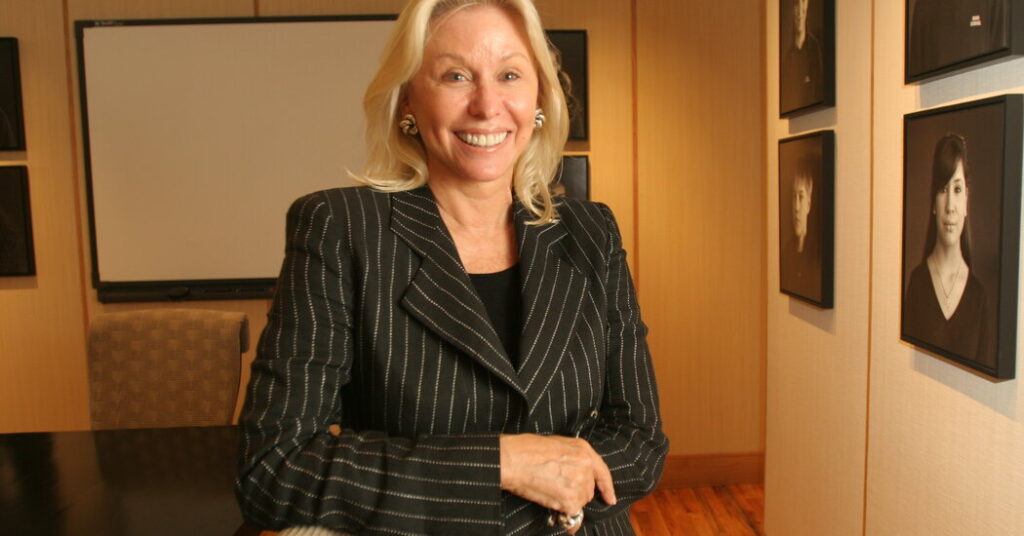
Courtney Sale Ross, whose desire to home-school her daughter eventually inspired her to spend hundreds of millions of dollars creating an idiosyncratic new school in the Hamptons, died on June 1 at her home in Malibu, Calif. She was 78.
The cause was complications of recent strokes, her daughter, Nicole Ross Eloff, said.
Funded with Mrs. Ross’s inheritance from her late husband, the media mogul Steven J. Ross, the Ross School occupies two campuses on Long Island: a lower school, starting at the nursery level, in Bridgehampton, N.Y., and a 62-acre high school in East Hampton. The annual high school tuition is $56,000, and the student body is known for being international, with 21 countries currently represented.
Mrs. Ross’s venture into education began around 1990, when her daughter was in second grade at Spence, the elite private school in Manhattan. A child who had been invited over for a play date demanded a tour of the family apartment, Mrs. Ross told The New York Times.
It was a request, she thought, that epitomized the “money-oriented values” she feared her daughter was learning at school, The Times reported. After discussing it with her husband, Mrs. Ross withdrew her daughter from Spence.
Before long, Nicole and a handful of friends were being guided by Mrs. Ross and a retinue of tutors through site-specific lessons in London, Paris, Berlin and the Galápagos Islands.
There were educational sleepovers at the Rosses’ home on Park Avenue, where the girls could see paintings by Willem de Kooning; one of the country’s best collections of Wiener Werkstätte design; and textiles from the pre-Columbian era. The group also attended Broadway shows and learned etiquette at French restaurants.
Mrs. Ross led it all. “She was our friend,” Alex Fischman, a member of the group, told New York magazine.
The foundation of the endeavor was the wealth accumulated by Mr. Ross, who had turned his first wife’s family funeral business into Time Warner, the media and entertainment conglomerate. He died of prostate cancer in 1992, at 65. The Ross School got its New York State charter the following year.
The construction of the school in the mid-1990s on a sprawling estate in the Hamptons, as well as its unusual curriculum, drew attention from the press.
“There are, in America, few women on their own as wealthy as Courtney Sale Ross, fewer still as elusive, as enigmatic, as controversial,” Vanity Fair observed in 1996.
In 2007, a Ross School board member told New York magazine that Mrs. Ross, long the school’s sole benefactor, had donated $330 million and counting.
The Ross School teaches what it calls a spiral curriculum: a chronological story of civilization beginning in the earliest grades and culminating in high school. New York magazine reported that, as a result, nothing about the United States was taught until 10th grade. The Ross School describes this approach as “a literary narrative of the evolution of human consciousness.”
The school has sometimes been labeled New Age-adjacent. For a while, tai chi was taught every morning. Students, staff and visitors were required to remove their shoes upon entering the school — a practice, Mrs. Ross told The Times in 2000, that brought about “a respect of place,” as well as a moment of pause at the front door that helped “change your state of mind.”
The novelist Jay McInerney sent his twins there and wound up getting lectures from them about organic produce. Other students came from quite different backgrounds. New York reported that Mrs. Ross spent at least $1 million a year on financial aid. A third of the students in the first five graduating classes were the first members of their families to attend college.
News reports sometimes portrayed Mrs. Ross as an imperious leader who demanded loyalty — “as if Donald Trump were a school principal,” one former employee said. But journalists also found that Mrs. Ross was constantly on-site, working to ensure that the school met her lofty goals.
“The school,” she told Vanity Fair, “is my life.”
Courtney Elaine Sale was born on March 12, 1948, in Bryan, Texas, and grew up there. Her mother, Gloria (Stephan) Sale, ran her family’s successful Coca-Cola bottling company. Her father, E.B. Sale, known as Chick, worked there, too.
After earning a bachelor’s degree from Skidmore College in 1970, she spent several years working in art galleries in Dallas and New York City. In later years, she mounted exhibitions and produced documentaries about artists that were often praised by The Times.
In the 1970s, while interviewing for a job at Warner Communications, she met Mr. Ross. They dated for a while before he married the urban planner and socialite Amanda Burden. The marriage did not last long, and soon Mr. Ross asked Ms. Sale to take him back. They married in 1982.
Mrs. Ross’s philanthropic vision for the Ross School led to a charter satellite in New York City that opened in 2006, but the city closed the school in 2010, citing poor performance.
In 2000, Mrs. Ross married Anders Holst, a Swedish businessman. They divorced in 2005. In addition to her daughter, she is survived by two sisters, Stephanie Sale and Lynsey Lonberg, and three grandchildren.
One of the many prominent consultants for the Ross School was Howard Gardner, the renowned Harvard developmental psychologist. Speaking to New York magazine, he questioned aspects of the school’s curriculum, but agreed that Mrs. Ross was a visionary.
“Scholars are more afraid of making mistakes,” he said. “She’s much bolder than that.”
The post Courtney Sale Ross, Founder and Funder of a Quirky School, Dies at 78 appeared first on New York Times.