Judah Gribetz, who as a top aide to Gov. Hugh L. Carey played a key role in helping New York City avoid financial collapse in the 1970s, and who decades later devised a complex plan for distributing more than a billion dollars in restitution to half a million Holocaust survivors in a class-action suit against Swiss banks, died on Friday at his home in the Rockaway Park neighborhood of Queens. He was 97.
His death was confirmed by his son, Sidney Gribetz.
A lawyer by profession, Mr. Gribetz was counsel to Governor Carey during his first term, which began in 1975 as New York City was skidding toward financial disaster. The city had a deficit estimated at $2.6 billion — it would be revised upward, to $5 billion, the next year — and was increasingly unable to borrow to keep itself going as financial institutions grew skeptical of its efforts at budgetary reform. The governor decided he had to step in.
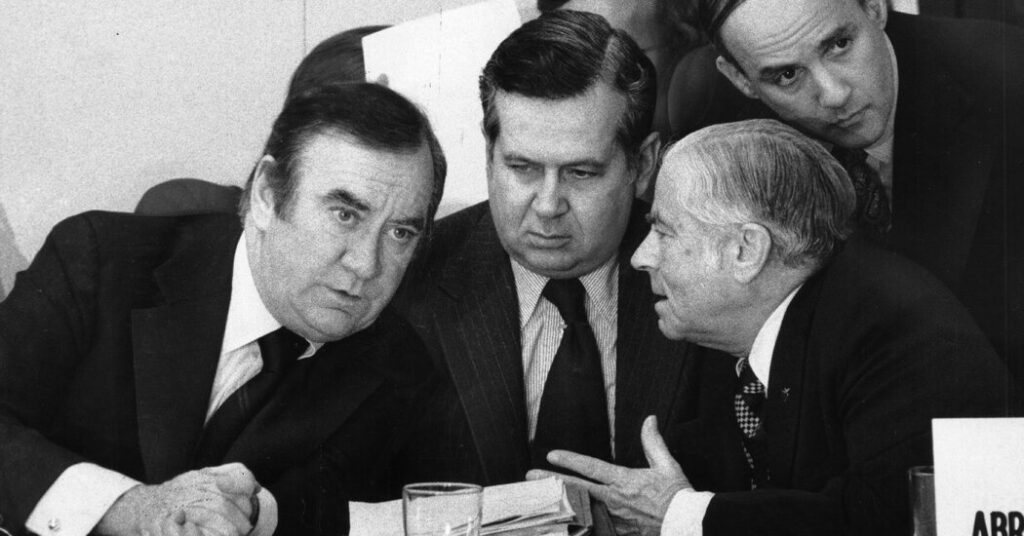
As pressure mounted in the spring and summer of 1975, Mr. Gribetz was one of Mr. Carey’s chief negotiators in talks with the city’s mayor, Abraham D. Beame, and state legislative leaders at a time when the relationship between Mr. Carey and Mr. Beame, both Democrats from Brooklyn, had become badly strained.
At issue were two state bodies that the governor wanted to establish: a Municipal Assistance Corporation, to borrow money for the city, and an Emergency Financial Control Board, to contain the city’s spending.
The proposed organizations were politically sensitive because they would significantly diminish the powers of the city over its own affairs. Both were created; the control board had the governor as chairman and the mayor as one of several members, and it had veto power over the city’s budgets and costly labor contracts. Mr. Gribetz had a leading hand in drafting the necessary legislation.
He had been one of Mr. Beame’s deputy mayors before joining the Carey administration and was credited as an important influence in persuading the mayor to go along with the terms.
“He played a conciliatory and helpful role offstage,” Richard R. Shinn, an insurance industry executive who also had a prominent role in the rescue effort, told The New York Times in 1977, adding, “He was important in bringing those guys together, keeping them each informed and aware of how the other one felt.”
Mr. Gribetz returned to private law practice in 1979. He was active in civic affairs, serving on panels that recommended judicial candidates and as president of the Jewish Community Relations Council of New York. He also wrote a book, “The Timetables of Jewish History: A Chronology of the Most Important People and Events in Jewish History” (1993), with Edward L. Greenstein and Regina Stein.
In 1999, a federal judge in Brooklyn appointed Mr. Gribetz as a special master charged with coming up with a plan for distributing the $1.25 billion that Swiss banks had agreed to pay to settle a class-action lawsuit accusing them of having inflicted further harm on targets of Nazi persecution.
The hundreds of thousands of claimants included people whose money, deposited in the banks to safeguard it from the Nazis, was not returned after World War II; enslaved laborers for German companies that had put their revenues in the banks; and people whose Nazi-looted property was disposed of through Swiss institutions. Besides Jews, others eligible for compensation included members of the Romani community, disabled and gay people, and Jehovah’s Witnesses.
Mr. Gribetz had been given a “Solomonic role,” The Forward said, in having “to adjudicate between the competing needs of different groups of aging Holocaust survivors, from Florida to Ukraine.”
After a year and a half, Mr. Gribetz offered the judge, Edward R. Korman, a 900-page plan that allocated up to $800 million for survivors or their heirs whose claims of unreturned deposits were upheld, with payments to be adjusted for inflation.
Those to be compensated from the remaining $450 million included the former enslaved laborers — at $1,000 each, later raised to $1,450 — and the needy among those whose property had been plundered, who would be aided through various programs.
While many claimants and their supporters urged quick court approval of the plan, others bitterly contested the allocations. But Judge Korman called the plan “carefully reasoned and well supported” and gave his approval.
By 2020, when the last distributions were made, nearly $1.288 billion — an amount larger than the original settlement because of accumulated interest — had been distributed or allocated to more than 458,400 claimants.
Mr. Gribetz recalled in an interview with The Times that working on the plan had been arduous but “very satisfying.”
He added: “We tried to do as transparent and as far-reaching a solution as possible.”
Judah Gribetz was born on April 1, 1929, in Brooklyn, to Abraham and Ida (Heller) Gribetz. In 1938, his father would become the executive director of the Hebrew Free Loan Society, which helped needy immigrants.
Judah attended Boys High School in the Bedford-Stuyvesant neighborhood of Brooklyn. After earning bachelor’s and law degrees from Columbia University and a master’s from New York University, he served in the Navy. Later, he was in private law practice; worked as a New York City assistant corporation counsel, gaining public attention as a vigorous prosecutor of slum landlords; and served as a city buildings commissioner and a regional federal housing administrator.
In 1952, he married Jessica Shapiro. In addition to his son, she survives him, along with two daughters, Marion Gribetz and Sarah Gribetz; a brother, Dr. Irwin Gribetz; four grandchildren; and five great-grandchildren.
At the high point of his influence, during the New York City fiscal crisis, Mr. Gribetz was known for working long hours and also, The Times said, for his “propensity for waxing loud, forceful and dramatic.”
Mr. Beame told the newspaper: “He’s never roared at me, but I’ve heard him make himself known. But everybody who knows him knows that’s just an outward facade: Down deep, he’s very easygoing and pleasant.”
Ash Wu contributed reporting.
The post Judah Gribetz, Key Negotiator in New York City’s Fiscal Crisis, Dies at 97 appeared first on New York Times.