LA GUAIRA, Venezuela — When the ground shook in Venezuela, Alejandro Palombizio was home in Los Palos Grandes, a wealthy Caracas neighborhood. He heard a jarring noise, looked out, and watched the twin towers of an apartment complex fold into a cloud of dust.
Palombizio, 29, carried an elderly neighbor down the stairs, ran back up to get medicine for another and loaned his phone to people trying to reach family. He stayed at it for about 72 hours. “These were my neighbors,” he said. “People I saw every day. I have to be here.”
The coastal town of Naiguatá escaped the worst of last week’s back-to-back earthquakes, so surfing instructor Jesús Elián Sanabria, 25, drove to Caribe and began pulling people from rubble. A young woman begged rescuers not to leave. When they lifted her out, she had lost her legs. Sanabria never learned whether she survived.
The day after the quakes, Sabrina Carranza, 21, was standing outside the wreckage of her government-built housing complex in Caraballeda when more gas canisters exploded. She screamed. Two younger brothers, two younger sisters and a grandmother were trapped somewhere under the concrete.
“Where is the government, the president, the helicopters, the aid?” she wailed. “The police come, take pictures and leave. They are making fun of us.”
‘Our tools are our hands, feet and senses’
The 7.2-magnitude and 7.5-magnitude earthquakes struck some 100 miles west of Caracas within a minute of each other around dinnertime Wednesday, toppling concrete buildings, igniting fires and burying thousands of people alive. Interim president Delcy Rodríguez went on television to declare a state of emergency, urge unity and thank the Trump administration for its support.
But on the ground, people say they’ve received little help. Years of mismanagement by the authoritarian socialist government, exacerbated by U.S. sanctions, have left the government ill-equipped to respond to the emergency. The United States and other countries have sent search teams, rescue equipment and other aid, but the response has been insufficient.
For Venezuelans, years of economic crisis and political repression had reinforced the lesson: The state would not save them. They would have to save each other. Now, in their moment of direst need, ordinary people would lead the rescue and recovery themselves, with a generosity that defied a decade of deprivation.
Their first challenge was both the simplest and the most brutal: There were no tools with which to dig.
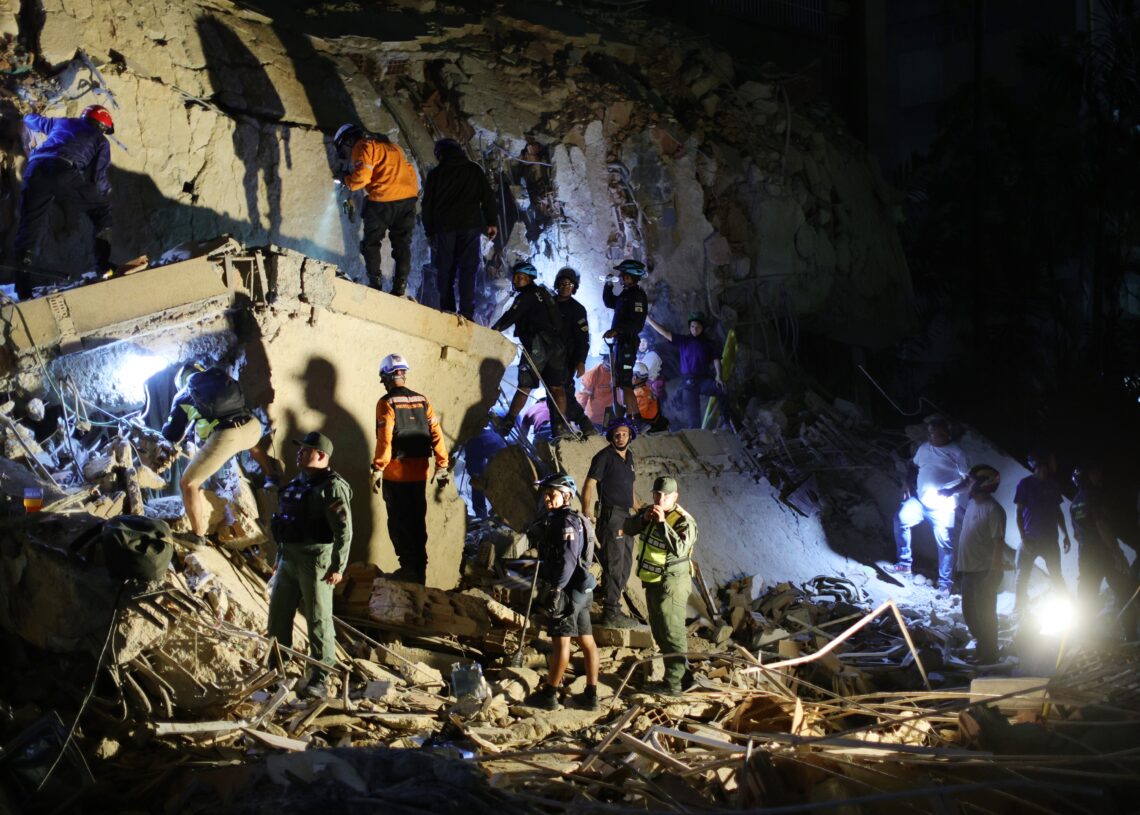
Across the street from Carranza, a dozen men stood around a concrete slab two feet thick. One chipped away at it with a thin metal pick; the rest waited, bare-handed, for their turn.
A maroon tow truck arrived, Portuguese World Cup flags waving from its windows and “From Caracas to La Guaira” scrawled across the windshield. The occupants affixed a cable to a slab and tried to pull it free. Tires screeched, but the block wouldn’t budge. They left to try elsewhere.
Edilio Ramírez, 29, led an orange-shirted church group from Caracas.
“With the available machines, there is almost nothing that can be done,” he said. His team had worked until midnight making 1,310 sandwiches, then driven to La Guaira before dawn with water and medical supplies.
“We waited almost an hour to get a hand grinder, but the diamond discs wear out fast, so we could barely use it,” he said. They planned to return the next morning.
Nelson Barroso, 63, unshaven and red-eyed, held a pick atop a pile of rubble and wept. A sister-in-law and three nephews were trapped underneath. “Our firefighters don’t even have Band-Aids. Our civil defense have no cars or motorcycles to move around,” he said. “Yesterday with our own hands we rescued four people alive, and today we are trying to get our families. But we have no support.”
He straightened up. “But we have to do it,” he said. “The people are united.”
A woman beside him finished the thought: “We are by ourselves.”
Secretary of State Marco Rubio promised $150 million in aid last week through faith-based groups and two U.N. agencies. “It’ll be big; it’ll be fast; and it’ll be effective,” he said. Search-and-rescue teams were dispatched from Fairfax, Virginia, and Los Angeles.
But the first responders were ordinary Venezuelans.
A network organizes itself
Venezuelans at home and abroad rallied on social media to gather data faster than any government institution. One website took reports on the missing; another mapped collapsed buildings; a third matched foreign volunteers with Spanish-language interpreters. One platform, built by a Venezuelan engineering professor in the U.S., helped families trace relatives through hospitals.
The digital response pulled people from around the world toward the rubble. Physician Emma Piñango, 30, drove two and a half hours from Valencia to her cousin’s apartment building in Caraballeda. Her cousin, her cousin’s husband and their two children — ages 3 and 8 — had been on the fifth floor. Amid the rubble, she found what was left of their home: The kids’ toys, the painted walls, the kitchen. But the family was gone.
She sat in lilac scrubs on the garden stairs. “The official response has been pathetic — that’s the word,” she said. “There is a difference between what they are publicly saying they provide and the help that is actually here. We are just family members and civilians with no rescue experience.”
And still, sometimes, it worked. At 3 a.m. Friday, after seven hours of digging with bare hands, rescuers, family members and neighbors pulled a young girl named Fabiana from the wreckage. She could walk. In the dark rose a loud, exhausted cheer.
The supply line
By Friday afternoon the coastal highway had become a supply line, thousands of cars flowing toward La Guaira. Motorcycle delivery workers lined up at improvised collection points, their coolers waiting to be loaded; picks and shovels rode pillion, handles pointing skyward. In the absence of cellphone service, two pickups bore Starlink passwords on their doors; their occupants handed out antennas. Climbers from Caracas distributed ropes, flashlights, helmets and water.
The improvisation strained against the damage. As traffic clotted, a bridge in Caraballeda, already cracked by the quakes, partially gave way. Volunteers in Los Corales called for engine silence to listen for signs of life. Ambulances bearing survivors idled alongside pickups hauling away the dead.
At sunset, doctors in a taxi cruised slowly through the cracked streets of Los Corales holding stethoscopes out the windows, a signal to anyone in need of help.
In Los Palos Grandes, the line at the Farmatodo pharmacy wrapped around the block. People bought gauze, water, Gatorade — some for themselves, most to hand to whoever needed it.
The sea route
Where the roads seized up, people turned to the water.
In the fishing village of Choroní, volunteers assembled food and supplies. Within hours of the quakes, Yalmila Liendo, 53, called friends for donations. Then she began cooking. By morning, 900 arepas were ready for delivery.
That first day, fishermen in six wooden boats made the two-hour run to La Guaira and returned to reload. By the third day, fishermen from neighboring towns had joined. At each place they docked, they asked what was needed most and carried the message back.
On the other side of the world, Sebastián Vaccarella, 30, was in Prague on a motorcycle tour with his father when his phone lit up.
Vaccarella, a graphic designer, had grown up visiting Choroní. He has lived outside Venezuela for 10 years. On hearing of the aid flotilla, he posted a video asking for donations. In less than 24 hours, he took in $5,000, mostly from strangers, along with messages describing the needs in different communities. He organized and shared the information.
People have told him he’s a hero. “I tell them I’m not doing anything,” he said. “I feel ashamed sometimes, because we don’t suffer what Venezuelans [back home] suffer every day. We live with this eternal damage from the last 30 years — my migrant friends feel the same. We are all broken inside.”
Bureaucratic barriers
On Friday evening, Interior Minister Diosdado Cabello announced that access to La Guaira would be restricted. All volunteers — doctors, nurses, machinery operators, ordinary citizens delivering water — would be required to travel first to El Poliedro, a sports arena in western Caracas, to register and obtain QR-coded credentials before proceeding to the disaster zone.
Rodríguez, the interim president, said the center would sort people by expertise. Five hours before it was due to open, hundreds of people had lined up outside. Cars and motorcycles parked around bore the names and photographs of the missing.
Cristian Hernández, 24, and Alexandra Rodríguez, 28, leaned on their backpacks and picks. The couple had traveled to La Guaira by motorcycle on Thursday and Friday. In Tanaguarena, they joined two people in pulling four bodies from the ruins.
They had waited in line for three hours when the soldiers running the center said the computer system was down. “This is absurd when every minute counts,” Hernández said. As the line crawled, the anger grew.
Still, there appeared to be a workaround. One group took a five-hour drive around the Cerro El Ávila mountain ridge and cleared concrete barriers from a national guard checkpoint as soldiers watched.
That night, a fisherman told Liendo the government was attempting to set up a similar cordon at sea. The group decided to defy the order. “We were told we couldn’t pass, and we went anyway,” she said. “And we will keep going. If we can’t enter through one town, we’ll enter through another. It’s a long coastline.”
The next day, she was sending crates of ice so the water would arrive cold.
Some leadership, at last
By Saturday, the Mexican rescue specialists known as the Topos had taken charge in Los Palos Grandes. Volunteers were organized into 13 cuadrillas of 11 people each.
They drilled in the street. “Bomba!” a leader shouted, and the volunteers threw themselves flat on the ground.
By coincidence, Francisco Ortega, 60, a retired naval officer who had specialized in underwater cave rescues, had been planning to visit La Guaira for a coastal folk festival. He arrived Saturday in worn work boots. He spoke to the volunteers. “This is a sensorial experience: a noise or a smell can mean everything,” he advised. “Our tools are our hands, feet and senses. … If we are not completely aware, we might miss something beautiful — like saving a life.”
By Saturday, Sanabria had slept three hours in four days. He had recovered more people dead than alive. When survivors were found, he said, “the families would cry and thank God. … And if they were dead, people would cry and thank God still.”
‘We have only each other’
When Rodríguez visited Los Palos Grandes on Saturday, a muffled booing rose from the crowd — a remarkable act of defiance against a government that just two years ago jailed thousands of people for protesting the results of an election widely viewed as fraudulent.
Sanabria waited with scores of people to enter what remained of the building, not knowing whether a child’s body or a grown man’s would come next. “We are impressive,” he said. “When we want to help each other, we win against anyone. Foreigners call us a plague, termites, scavengers — whatever they call us. When Venezuelans have to go out for other Venezuelans, nothing can stop us.”
In working-class Catia, once a stronghold of government support, authorities had set up medical tents and sanitary facilities for survivors. Soldiers tried to manage the entrance, but hundreds pressed against the perimeter fence for news of loved ones.
Yensy Hernández and Kevin, 24, discussed how they might get aid to people who needed it without going through the government.
Kevin, who managed to get his pregnant wife and their year-old son out of their home before it collapsed, spoke on the condition that his last name be withheld out of concern for reprisals.
“The people above — you know who I’m talking about — if you disagree with them, they’ll shoot you,” he said. “So people help each other. What have we not received? We have everything. Nothing is lacking. We have only each other.”
The post With little official help, Venezuelans in earthquakes rescue themselves appeared first on Washington Post.