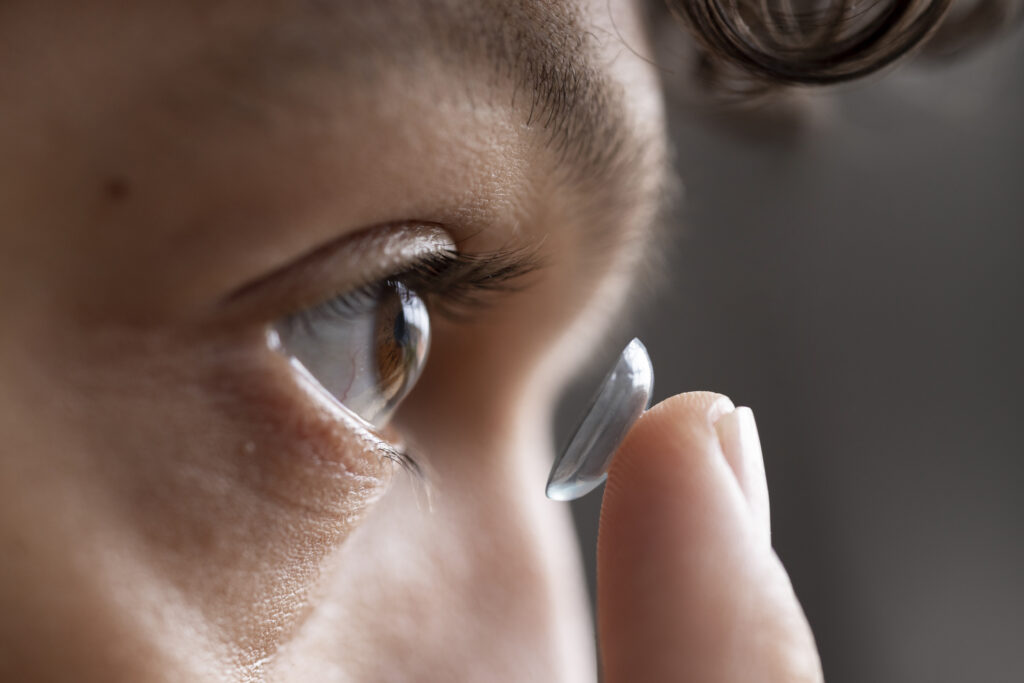
If you’re one of the 45 million people in the United States who use contact lenses, you may not be able to imagine life without them. In a handful of situations, though, experts are adamant that you’ll need to skip wearing contacts if you want to avoid infection and keep your eyes healthy long-term.
There are different types of contact lenses. Varieties made from soft, flexible plastic can be particularly comfortable, while rigid gas-permeable lenses are more durable but less flexible. Some contact lenses are reusable — they should be removed at night, cleaned and then reworn the next morning — while others are single-use, designed to be thrown out after one day. Still other lenses are approved by the Food and Drug Administration for extended use up to 30 days and overnight.
Most contact wearers choose soft, single-use lenses, also called daily disposables, said Loretta Szczotka-Flynn, an optometrist, epidemiologist and director of Contact Lens Service at UH Cleveland Medical Center. Since the lenses are brand-new each morning, daily disposables may offer lower risk of serious problems, according to a 2024 paper she co-authored.
But it’s still possible to develop eye infections from daily disposable lenses, especially if they’re used incorrectly and come in contact with bacteria, viruses or parasites. “Soft lenses, I tell my patients, are like sponges,” Szczotka-Flynn said. “They absorb everything.”
Considering this and other features of contact lenses, eye doctors say it’s safest to avoid these activities when wearing them.
Swimming
Swimming pools, hot tubs, oceans, lakes — water of any kind, including tap water — can lead to problems for contact lens wearers, which is why experts, including groups such as the American Academy of Ophthalmology and the Centers for Disease Control and Prevention, strongly advise against swimming in them.
“There are bad organisms in water, and the lens may become a repository for them,” said Deborah Jacobs, an associate professor of ophthalmology at Massachusetts Eye & Ear and Harvard Medical School.
One particularly worrying organism is Acanthamoeba, a soil- and water-dwelling amoeba responsible for Acanthamoeba keratitis, “one of the worst infections that we know about,” Szczotka-Flynn said. This rare but serious disease can cause vision loss, making the amoeba “the biggest thing we’re worried about” when people swim with contact lenses on, she added.
Rarely, Acanthamoeba might infect someone not wearing contacts, but the vast majority of cases occur in contact lens wearers. That’s because pathogens can stick onto the sponge-like lens and absorb into it, explained Thomas Steinemann, an ophthalmologist at MetroHealth, professor at Case Western Reserve University School of Medicine and spokesperson for the American Academy of Ophthalmology.
The lens holds the organism against the cornea, the delicate outer layer of the eye, he explained, “and that can lead to transmission from the lens onto your cornea.” Once the amoebas take hold, they can be difficult to eradicate, particularly when in a medication-resistant cyst form. The result is vision loss and sometimes the need for surgery or a cornea transplant.
Of course, there are situations in which not wearing contact lenses in water would also be unsafe. For example: “We don’t want anyone not being able to see and being on a Jet Ski,” Szczotka-Flynn said.
If you must wear contact lenses while swimming or playing water sports, look for goggles that seal completely, Jacobs recommended. “And ideally, when you get out of the water, you should, as soon as possible, remove and either dispose of or disinfect those lenses,” depending on whether you use the disposable or reusable kind, she said, since goggles don’t entirely prevent contact with water.
Showering
Showering while wearing contact lenses is common — about 86 percent of soft-lens users reported doing so in a 2017 study. But while you might expect to encounter pathogens in oceans or lakes, infection-causing organisms also appear in the water in our homes. Tap water “is safe to drink, it’s safe to wash in, but it’s not sterile,” Steinemann said.
Acanthamoeba has been found in tap water, along with bacteria and other germs that can cause eye infections if water splashes into contact lenses during a shower or while washing your face. For the same reasons, tap water or homemade saline solution should never be used to clean contact lenses.
Many people tend to get ready in a certain order of steps, Szczotka-Flynn noted, and she encouraged contact lens wearers to create a routine where the lenses are put on after a morning shower, for example, or removed before showering in the evening.
Experts discourage showering in contact lenses due to the risk. But if you absolutely have to do so, Jacobs said, “I would not face into the stream and would keep my eyes closed while rinsing my hair or face.”
Sleeping
The FDA has approved certain extended-wear contact lenses for overnight use, but falling asleep with any type of contact lens on — including those marketed for extended wear, and even just occasionally — is associated with a higher risk of infection. “I never recommend anyone to sleep in their contact lenses,” said Steinemann. “It’s just not safe.”
In a 2018 case series that both Jacobs and Steinemann co-authored, sleeping in contact lenses was found to be a main risk factor among patients who had developed corneal infections. Overall, sleeping in contacts increases a person’s risk of infection by six to eight times, according to the CDC.
Sleeping in contact lenses creates a “recipe for disaster” when it comes to infections, Steinemann said. For one, when eyes are closed, the environment becomes dark, moist and still, enabling any bacteria that may have glommed onto the lens during the day to thrive.
“When your eyes are open, you’re blinking many thousands of times a day, and that blinking acts like a wiper on your windshield,” Szczotka-Flynn said. “You’re wiping the front of the contact lens, and you’re pumping fluid in and around the lens, so it’s an active, moving situation.”
In addition to lack of movement, when you’re sleeping, “your cornea is literally being held captive with a dirty contact lens held in place by your closed eyelids,” Steinemann said.
Plus, because the cornea receives oxygen from the environment — there are no blood vessels in this part of your eye — when you close your eyelids with a contact behind them, the cornea “is in a very unhealthy state,” he added, making it vulnerable to infection. “It’s basically starving for air.” Over time, this can lead to a condition called corneal neovascularization, which can affect your sight.
If you ever experience eye discomfort, discharge or the sensation of a foreign body after wearing contact lenses, regardless of the type or whether you did any of the activities above, remove the lens to see if symptoms improve — and if they don’t, schedule an appointment with your eye doctor. “Any pain, redness or discharge lasting more than 12 hours should probably be seen,” Jacobs said.
While you can still develop an eye infection if you sleep, shower or swim in daily disposable contact lenses, switching to these, if you don’t use them already, may lower your risk in general, experts said. “Those are, in my opinion, the gold standard now for soft-contact-lens wearers,” Steinemann said. “Every day, you’re putting in a brand-new, sterile, fresh contact lens.”
The post 3 contact lens mistakes that eye doctors wish you would stop making appeared first on Washington Post.