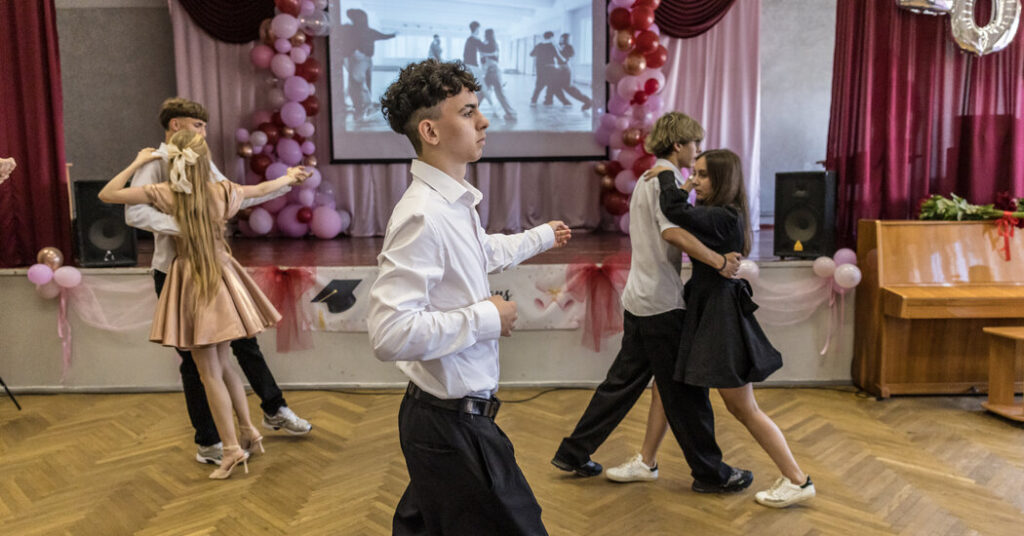
The ninth graders had practiced their waltz hundreds of times. Each step, dip, lift and twirl was drilled into their minds. The song they chose, “Love Story” by the French artist Indila, had been the soundtrack to their winter and spring.
Now it was prom day. It was finally time to perform.
The boys wore black pants and white shirts. The girls wore fancy dresses in an array of colors. The room, sticky in the June heat, was filled with parents, teachers and friends.
The kids shook off their nerves and stepped out in pairs. Artur and Khrystyna. Roman and Oleksandra. Stanislav and Laura. Denys and Mariia. Yehor walked out alone.
The music started. Yehor stayed still. Then he lifted his right palm into the empty space before him. For the next three minutes, he needed to pretend that his date, Masha, was still there.
Goodbye to Old Friends
Prom meant everything to 15-year-old Masha Polska.
The war had already taken so much from her and her classmates. Parents had left for the frontline. Friends had fled abroad. Air raid sirens and attacks kept their hometown, Kyiv, constantly on edge.
But there could still be prom. And Masha, who went by this common nickname for Mariia, wanted the day to be perfect. She started planning it last year.
Masha and her friends would be graduating from the ninth grade at Kyiv’s Lyceum 237 on the same day as prom. The event would mark a goodbye to her friends moving to trade schools. Masha planned to stay at the lyceum through 11th grade but told her friends she wanted to make the ninth grade prom extra special for those who were leaving sooner. This was their last chance to be together, to celebrate their time as students.
With her mom, she chose the restaurant where her class would celebrate after the dance and planned the menu. She started to imagine the perfect dress and how she would style her hair.
But it was the waltz Masha looked forward to the most. Ukrainian proms almost always include a choreographed group waltz that students painstakingly learn for months. Masha, an avid dancer, hoped to be the star.
A Starring Role
Rehearsals started last December in the second-floor gym at school. Masha and nine other students practiced for around an hour every day.
It was cold and dark and Russia was relentlessly bombing Ukraine’s energy grid. Most nights, Russian missiles and drones soared across Ukraine’s skies, targeting power plants like the one in Masha’s neighborhood. Everything was exhausting. Waltz rehearsals gave the students the rare chance in wartime to look forward to something.
Masha had danced since she was 5 years old and was enrolled in classes, including jazz, at a studio near her home. Although an older student was tasked with teaching the students the waltz, Masha, who dreamed of one day working as a professional choreographer, always offered suggestions. She helped choose the song “Love Story,” because she found it especially tender. As the most experienced dancer and the smallest girl in the group, she was chosen to be lifted and spun — the starring role.
Masha’s old friend Yehor Holodryha asked her to be his dance partner. One of his best friends, Stanislav Mogilnikov, asked Masha’s best friend, Laura Cherniavska. There was no romance between the pairs, just a shared desire to make their performance the best it could be.
“I chose Masha because we are very nice dancers and would be the central pair in the group,” Yehor said. He also knew they would have fun together. He liked to tease her with different nicknames, often calling her Mashulia.
For Laura and Masha, the dance rehearsals were a chance to spend even more time together than usual. The girls had been classmates since first grade, but became inseparable best friends only during the war when they were in seventh grade, after Laura had returned home from a lengthy stay in Poland.
The girls walked to school together each day, stopping to buy gummy snacks en route. They designated two playground swings as their special meeting points. They often met there with their friend Vlad Peretiatyi, whom Masha befriended in fifth grade. The three of them loved to play truth or dare and whisper secrets until dark.
The girls were dreading the next semester, when Vlad would leave their school to enroll in a culinary institute. It was in part because of him that Masha wanted their ninth grade prom to be perfect.
When Laura’s dad, Illia Cherniavskyi, was deployed to the frontline, Laura told Masha just how scared she really was. When heat and power outages threatened to spiral Laura into depression, Masha made her laugh. “She was very fun,” Laura recalled. “She was always joking, even when it was not the right time.”
When Masha fell for a boy who lived in Laura’s apartment building, Laura encouraged her romance. When Laura started dating a girl from another class at school, Masha cheered her on. Laura’s new girlfriend was also named Masha, and in Ukraine, there’s a common superstition that a wish will come true if you make it while standing between two people with same name. Laura often stood between the two Mashas. “I wished that this war would end, that prom would come faster and that everyone would be OK,” she said.
The Final Preparations
As spring arrived and prom neared, waltz rehearsals intensified. The teenagers would often practice for hours each day. Laura was annoyed that some boys kept messing up their steps. But Yehor mastered the climactic moment in which he lifted tiny Masha onto his shoulder and spun her around. The students recorded a video of their rehearsal. They watched it and felt proud of how far they had come.
Laura chose a sparkly navy blue gown that sat off her shoulders for the dance. She refused to show Masha photos; she wanted it to be a surprise. Masha was still searching for a dress. She knew she wanted a corset top and a slit skirt.
The first waltz rehearsal in the assembly hall was scheduled for May 14. On May 13, air raid sirens wailed all day as Russian drones swarmed Ukraine’s skies. Masha and Vlad texted around 8:30 p.m. to confirm their plan to head to the mall after school the next day and finally buy her dress. “If you oversleep, I’ll kill you,” Vlad recalled Masha joking. He made the same joke back. Within hours, the drone barrage expanded to include missiles. Ukraine shot down 41, but 15 got through. One soared directly into Masha’s apartment building.
Believing in Miracles
The explosion sounded especially close, but Laura was used to the sounds of war. Dance rehearsal was starting in a few hours. She went back to sleep. Laura did not know that Masha’s seventh-floor apartment had collapsed into a pile of rubble. She did not know that Masha and her mother, father, and grandmother were trapped underneath. She did not know that a teenage friend of Yehor’s ran straight into the chaos to help dig out Masha’s mother, Nataliia, alive.
Laura’s mother saw the horrifying messages roll in on a parents’ group chat. She rushed Laura to the scene. The whole class gathered, waiting for news. The children took turns wrapping their arms around each other and their head teacher.
The kids believed in miracles. They believed Masha could be saved like her mother. “She was trying to live, to live faster, to live as much as possible, to learn as much as possible,” their teacher, Ms. Liudmyla Naumova, said. “This was our Masha.” By early evening, Masha’s father and grandmother had been found dead. Then the rescue workers pulled a smaller body from the rubble. The crowd understood that it was Masha. The students, shocked, stayed together as their parents came to pick them up and take them home. Masha was one of three girls killed in the apartment building that day.
‘You Must Remember’
The school days that followed were a haze of tears and grief so heavy that Masha’s friends thought they might collapse. They helped build a memorial around a tree near the remains of her building, piling up stuffed animals and photos. At her burial, they held up one another as they tossed dirt on her grave. They watched as Masha’s mother, a head wound from the attack still stapled closed, wept on her remaining relatives as she buried her mother, husband and daughter. Each child took a turn touching Masha’s coffin before it was placed in the ground. At the cemetery, Laura and her friends sat piled in the back of her dad’s truck. Mr. Cherniavskyi, home from the eastern front, overheard them discussing how they could not imagine going ahead with spring festivities without Masha. He interrupted and insisted they would find a way. “You must remember,” he told them. The girls stared at him blankly.
But in the days that followed, the teenagers got to work. They resumed waltz rehearsals. Yehor announced that to honor Masha, he would dance alone. Ms. Naumova feared the children’s grief would consume them. She urged Yehor to find a new dance partner. He said he would dance alone or not dance at all. To dance with another person, he said, would be a betrayal.
The Big Day
The students also choreographed a new dance in honor of Masha. They performed it in front of their school on the last day of classes. Masha’s mother was there to watch them. A dragonfly flew by, and the kids all agreed it was Masha. For the next two weeks, they rehearsed the prom waltz again and again. They felt Masha’s absence intensely, but grew used to Yehor miming the act of lifting and spinning her as they all danced along.
On prom day, Laura woke early and brought her dress, shoes, purse, long black gloves and makeup to her aunt’s apartment. She sat in her bathrobe while her aunt curled and pinned her hair into a perfect updo. She did her makeup herself, debating whether her eyeliner was even on each side. Then she changed into the dress that she had wanted Masha to see and headed to school.
Yehor was waiting outside with his friends, chewing sunflower seeds and pacing. Inside, parents took their seats.
Masha’s mother chose a chair toward the back. She smiled and clapped as Masha’s friends received their diplomas. Then the children stood up to perform the waltz.
On a screen behind them, an image appeared of an old TV. The TV flickered for moment and then became a black-and-white video of the children waltzing at rehearsal from before Masha died. On the stage, the students began to moving in unison with the dancing on the screen.
Yehor stepped and knelt and spun and raised his arms into the emptiness where Masha should have been. In the footage playing behind him, she was still the star.
He glanced into the crowd just once to find Masha’s mother. He saw that she was crying and looked away.
The song ended. The room burst into applause. More performances followed. but Masha’s mother sneaked out without fanfare. The rest of the parents lingered afterward, hugging their children, wiping their tears, examining the diplomas.
Yehor wandered downstairs.
“We danced how Masha would have wanted,” he said. And then he joined his friends to walk to lunch.
They ate the meal that Masha’s mother had planned at the Crimean restaurant that Masha herself had chosen. They laughed and danced some more and took photos and reminisced and returned home late at night, exhausted and maybe a little bit tipsy.
They had their prom. It was, almost, just how Masha would have wanted.
The post The Prom Went On in Kyiv, but Masha’s Date Danced Alone appeared first on New York Times.