
The American democratic experiment stands on shaky ground. Not since the Civil War have these proverbially United States been so disunited. As the nation throws itself a grand old 250th birthday bash in Washington, the mood in much of the country is more funereal than festive.
All-out partisan warfare has sown chaos. Republican legislators, taking their lead from a president who sees half the nation as his personal enemy, have put their own party’s interests over the republic’s. Staying in office has become the only thing that matters. The values imparted to me throughout my public school education — equal opportunity, impartial justice, respect for expertise, basic honesty — have been abandoned by a new breed of politician that has turned governance itself into a blood sport.
Where can one turn for reassurance that America’s best years are still ahead? Would you believe me if I said the theater? I’m not toeing the line for my field. I’m merely calling attention to a development that’s been gaining strength since I first reported on it in 2015. A cohort of playwrights, breathtakingly diverse demographically as well as aesthetically, has been rejuvenating American theater.
These writers aren’t on a sociological mission. They’re not trafficking in grievance or appealing to a particular political base. They let their plays do the talking. And they’ve been trying to have a conversation that isn’t hijacked by the most doctrinaire voices in the room.
From an institutional perspective, the American theater is in bad shape. The triple whammy of the COVID-19 closures, inflation and technological disruption has left everyone hurting. The Mark Taper Forum had to suspend programming for more than a year, smaller companies still in operation are producing fewer shows, and producers everywhere are gravitating toward the bankably familiar.
But despite this difficult terrain, it has been a boom time for American playwriting. For more than a decade, I’ve been teaching a course at the California Institute of the Arts called American Drama Now, and each year the selection of plays has become harder to whittle down. I designed the seminar partly around theater offerings in Los Angeles to connect students to recent developments in the field and to consolidate awareness that something special is happening in the American theater.
The current generation of playwrights has revealed itself to be remarkably resilient and independent. It has had no other choice. By the time many of these rising talents were accruing debt in graduate writing programs, the dream of a sustainable career in the nonprofit theater had already gasped its last breath.
When Wendy Wasserstein, Tony Kushner, Craig Lucas and Jon Robin Baitz emerged in the late 1970s and ’80s, it was still imaginable that a chosen few playwrights could make a living via the regional theater circuit, that constellation of companies founded as an alternative to the Broadway model.
That prospect was growing dimmer a few years later when playwrights such as Suzan-Lori Parks and Lynn Nottagecame into prominence. But hope was still alive in the late 1990s and early 2000s. Regional theaters such as Seattle Rep, the Guthrie, the Goodman and Baltimore Center Stage remained committed to their missions while New York nonprofit companies continued to hold the line off-Broadway.
When did the picture change? In 2009, “Outrageous Fortune: The Life and Times of the New American Play” was published by the Theatre Development Fund, and one of the key findings in this study written by Todd London with Ben Pesner and Zannie Giraud Voss is that “there is no way to view playwriting as anything but a profession without an economic base.” A chasm had opened between the network of increasingly corporate-minded nonprofit theaters and the artists this system was built to serve.
The situation has grown bleaker in the last decade and a half as commercial pressures have ramped up and media consolidation and digital shortsightedness have obliterated arts coverage. Yet there’s been an unexpected upside. Theater artists who have come of age in this period have been released from the burden of having to conform to notions of regional theater respectability.
Instead of worrying about the timid taste of subscription audiences, these dramatists have been writing for themselves and their communities, dreaming up plays that don’t have to fit into institutional slots or stay within the staid bounds of traditional proscenium house decorum. The irony is that in not trying to pass muster with more conservative theatergoers (and their fastidious institutional guardians), playwrights have been winning over not just critics but also formerly squeamish artistic directors and perennially nervous Broadway producers.
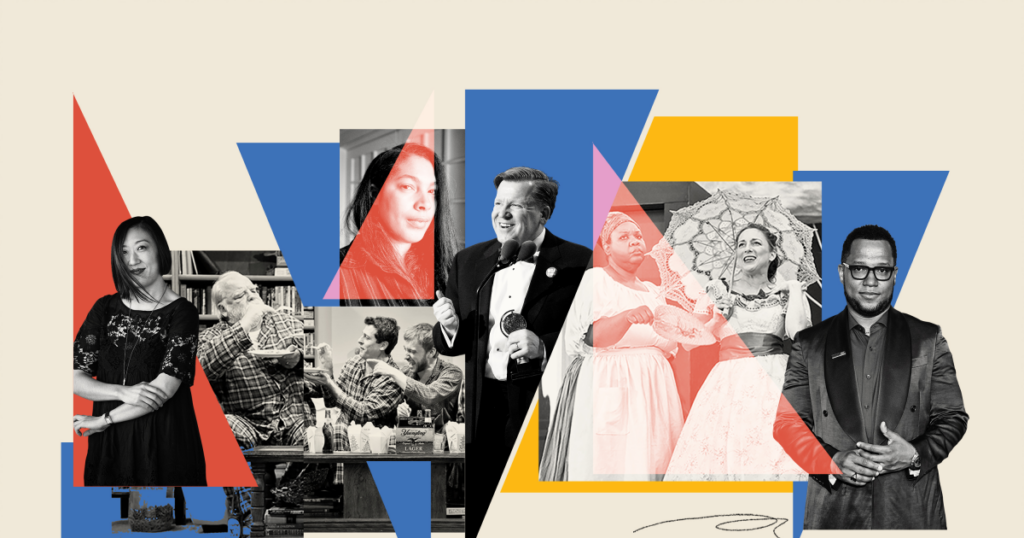
The playwrights who appear regularly on the syllabus in American Drama Now — Young Jean Lee, Tarell Alvin McCraney, Annie Baker, Branden Jacobs-Jenkins, Samuel D. Hunter, Martyna Majok, Jeremy O. Harris, Will Arbery, Jackie Sibblies Drury, Quiara Alegría Hudes, Ayad Akhtar, among them — are of different ages, sensibilities and backgrounds. What they share is an appreciation of the complexities and contradictions in being an American.
The politics of identity for them is a lived experience. And as dramatists, they’re uniquely positioned to appreciate the conflicted loyalties and communal tensions of American life in dramatic rather than dogmatic terms. Whatever agendas they may personally espouse, these writers are too alert to the messiness of history and human nature to be rigidly ideological in their work.
The ongoing war between woke and anti-woke factions is a fatuous melodrama best left to the satirists. The goal of playwrights grappling seriously with what it means to be an American today isn’t to score social media points but to shed light on the fractured reality of our collective experience.
Identity is not a fixed fact but a raucous collision of parts. No single category can contain the Whitmanesque multitudes jockeying for position inside us. Race, religion, ethnicity, gender, age, sexuality, class, disability and geography don’t line up in perfect political harmony, and each social marker tells only a fraction of the whole story. (Money, the great unequalizer, may be the most taboo subject of all.) “We are not only but also,” the sociologist and cultural historian Todd Gitlin wrote in his 1995 book “The Twilight of Common Dreams: Why America Is Wracked by Culture Wars.” We also overlap and often even clash with ourselves.
Discussion around identity can be dangerous. How can anyone be expected to navigate the minefield? Tribalists and traditionalists have controlled the terms of the battle, one by simplifying, the other by denying, the way privilege has shaped our compound selves.
Playwrights know better. They understand the way oppression, which falls disproportionately on the marginalized, has warped all of us. History, whether acknowledged or not, is etched in our souls.
It is a long-held tenet of the theater that the most interesting characters, like the most interesting people, are defined by their schisms and paradoxes. (How else could Hamlet have maintained his centuries-long hold?) Dramatists are more cognizant than ever of the sociopolitical import of these contradictions and they’ve been chronicling the way this historically freighted baggage emerges in the drama of everyday life.
All the world is indeed a stage and all its inhabitants merely stock players, as Jaques lays out in “As You Like It.” Hegel described Shakespeare’s characters as “free artists of their own selves.” The truth where we and our contemporary stage surrogates are concerned is somewhat more constrained. Culture and representation largely determine the range of our performance possibilities.
Jacobs-Jenkins has recognized perhaps more acutely than any of his peers the way dramatic forms have locked us into set scripts about our lives. He tackles genres — adapting a Dion Boucicault melodrama in “An Octoroon,” reexamining the canon of great American family dramas in “Appropriate” — to uncover the stories that have been suppressed in the dominant white middle-class narratives that would prefer not to think of themselves as political.
Lee’s standout identity plays — “Straight White Men,” “The Shipment” and “Songs of the Dragons Flying to Heaven” — reject the illusion of stable, coherent characters propagated by psychological realism. The figures in her uncategorizable works are in experimental flux, trying on masks to see what might prove effective in a given situation. Even “Straight White Men,” which uses the old home-for-the-holidays genre as a springboard, can’t help spinning away from the drama’s droll hyper-naturalism toward something resembling performance art. (Not even straight, white men want to be confined to a box, even a relatively plush one.)
In “Fairview,” Jackie Sibblies Drury theatricalizes the experience of the white gaze, ultimately reversing the comfortable position white theater audiences have traditionally held. Bess Wohl’s “Liberation,”this year’s most decorated play, reanimates the history of the 1970s feminist movement by questioning what it could be leaving out of the picture. “The Balusters,” by David Lindsey-Abaire, brings the current culture wars to the stage with unique sensitivity through the squabbles of a neighborhood association torn between protecting its town’s heritage status and coming to terms with the more pluralistic demands of the 21st century.
“Fairview,” “Liberation,” and “The Balusters” are extremely funny plays that also happen to be deadly serious. If philosophy begins in wonder, trenchant social drama seems to start in laughter.
What do theatergoers want? They don’t just want to look; they also want to be seen. Isn’t that what any of us wants when gazing into the mirror held up to nature, as Hamlet describes the theater? To be granted a more expansive view of ourselves and others?
E pluribus unum, the motto of the United States, is so fundamental that it’s printed on our currency. There’s perhaps no place where the truth of this phrase — out of many, one — is more regularly realized than at the theater, where strangers transform over the course of a show into that mysterious organism we call an audience.
Gitlin ends “The Twilight of Common Dreams” with a plea: “For too long, Americans have busied themselves digging trenches to fortify their cultural borders, lining their trenches with insulation. Enough bunkers! Enough of the perfection of differences! We ought to be building bridges.”
A coalition mindset doesn’t mean denying history or pretending that America has been a level playing field. It’s been anything but in this “melting pot where nothing melted,” to quote the rabbi whose eulogy sets Kushner’s “Angels in America” in motion. But history happens to all of us, not just a select few. And to be an American is to be embroiled in the great democratic experiment that has been defined by division from the beginning. Empathy, the nuclear fusion of playwriting, is expanded when we’re allowed to take in more of our patchwork selves. Today’s dramatists have been extending a generous invitation to their compatriots: We’ll show you our complexity, if you’ll show us yours.
The post American playwrights are embracing the nation’s complexity. Will audiences answer the call? appeared first on Los Angeles Times.