When pointe shoes appear in mainstream culture, dancers tend to cringe.
Pointe shoes, ballet’s emblematic footwear, routinely bewitch fashion editors, advertising executives and pop musicians. Dance outsiders are often eager to use them as shorthand for a certain kind of delicate femininity.
But a pointe shoe is not (just) a symbol; it is a tool of art. To dance on pointe correctly requires years of intensive training. It is essentially impossible to fake. For dancers, substandard pointe work can be painful to watch — not only an aesthetic affront, but an insult to the rigors of their craft.
So when the singer Rosalía opened a Madison Square Garden performance of her Lux tour in June dressed as a ballerina — standing demurely atop a platform, wearing an enormous Degas-esque tutu and, yes, pointe shoes — I held my breath.
And then, once she began moving, came the exhale of relief.
Nobody would confuse Rosalía with a professional ballet dancer. Yet in the Lux show, she approaches ballet with what seems like genuine interest and reverence. (The tour is in California through July 6.)
While singing the piercing “Porcelana” at the Garden, she stepped into a clean partnered arabesque on pointe, her supporting foot impressively arched. A few moments later, as she bourréed toward the back of the stage, taking tiny pinprick steps on the tips of her toes, her arms were convincingly swan-like — fluid yet articulate through the wrists and fingers. Ballet is not a pose; it’s a language, and Rosalía has clearly been studying it.
A similar mix of curiosity and devotion drives her “Lux” album. Rosalía, who began in flamenco, has built a pop music career around unexpected stylistic juxtapositions. On “Lux,” she incorporates elements of opera and sings in 13 different languages. On the “Lux” tour, she presents classical ballet as a physical analogue of classical opera. Her dancing is balletic in the same way her music is operatic: The technique might not be perfect, but the intention is good.
Maybe that’s why Misty Copeland posted the “mind blown” emoji after attending the concert at Madison Square Garden, or why the New York City Ballet star Tiler Peck has commented approvingly on Rosalía’s ballet-forward Instagram photos. When the tour stopped in Houston on June 23, Rosalía invited the Houston Ballet principal Harper Watters onstage for a cameo. “You are such a beautiful ballet dancer,” Watters said to her. “Muchas gracias for showing our art so beautifully and taking such care with it.”
The choreographic trio (La)Horde, which helped create the Lux tour’s movement, said the show’s ballet sequences were Rosalía’s idea. (I talked with Marine Brutti, but the collective — which also includes Jonathan Debrouwer and Arthur Harel — speaks as one.) Though (La)Horde’s members are the directors of the Ballet National de Marseille, “I don’t know that we would have ever advised her to go that way,” they said. “She had a vision of starting the show as a ballerina, and we trusted it. We were like the magician’s assistants.”
Part of the tour’s magic is its easy commingling of ballet and other dance styles. The choreography team is led by (La)Horde and Charm La’Donna, the powerhouse behind Bad Bunny and Kendrick Lamar’s Super Bowl performances. Dimitris Papaioannou, the Greek choreographer known for intriguing visual illusions, and the renowned flamenco dancer José Maya also made contributions.
“She wanted to offer an experience that was like museum-meets-church-meets-club meets-dance theater,” (La)Horde said of Rosalía. “We were all responding to the fluidity of her thinking.”
The Lux tour is presented, with theatrical flourish, in four acts. After the celestial classicism of the opening, the second section begins with a descent into the darker grandeur of the album’s lead single, “Berghain,” named for the famous club in Berlin. Rosalía returns to the stage having traded her pointe shoes for black boots, two hornlike feathers curling above her head.
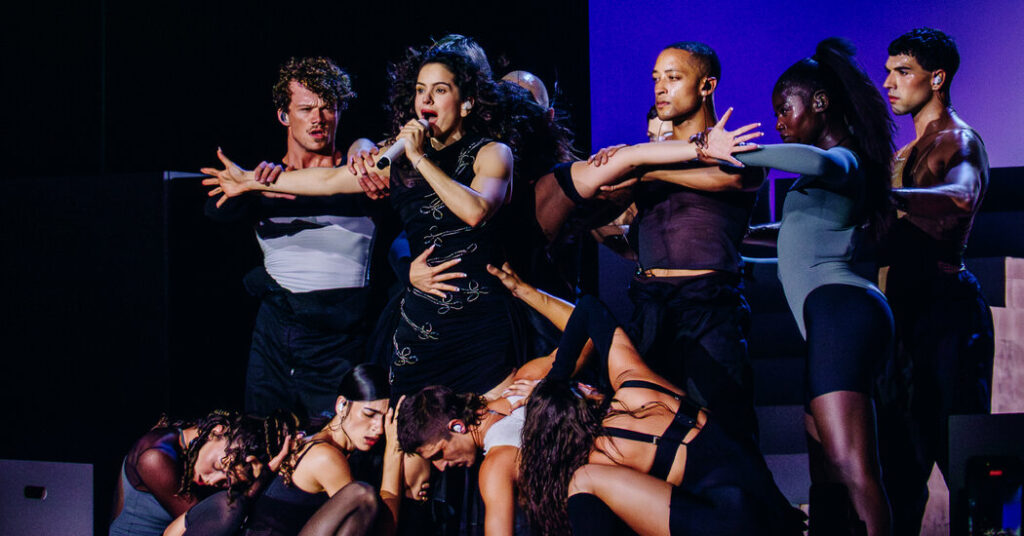
(La)Horde’s fingerprints are most clearly visible here. True to its name, the collective loves to deploy a riotous crowd. In its “Berghain” choreography — some of which derives from Rosalía’s viral Brit Awards performance earlier this year — a primordial ooze of dancer bodies supports the singer, pulsing in response to her every gesture. Orchestral strings propel “Berghain,” but the tour adds a screaming electronic remix to the end of the song. By its conclusion the jewel-box ballerina has gone full club kid, convulsing ecstatically under the strobe lights.
Despite its heaven-and-hell iconography, the show isn’t all epic highs and lows. It also incorporates portions of Rosalía’s 2022 album “Motomami,” a collection of brash, irreverent songs that take a more playful approach to stylistic cross-pollination. As she performed the reggaeton banger “Saoko,” Rosalía dropped easily into pop siren mode, her spine liquid as she rolled through her torso. The song features an improbable jazz break; just as improbably, she twerks along to it, with a camera coming in for a close-up on her hot-pink shorts.
That cheekiness extends into “Lux” territory, too. Papaioannou’s offering to the show is the set piece “La Perla,” which turns the “Lux” waltz — a breezy kiss-off to an ex-lover — into a charming trompe l’oeil spectacle. Against a black backdrop, the white-gloved hands of dancers become Rosalía’s skirt, then a halo, then a veil, evoking the Venus de Milo one moment and Rita Hayworth the next. Unsurprisingly, the number has done numbers on TikTok.
Rosalía, who is from Spain, began her career studying flamenco dance as well as flamenco music, training that is legible throughout the Lux show. (It might explain those impressive swan arms, distant cousins of flamenco’s expressive upper body movements.) In the flamenco-pop song “De Madruga,” her percussive footwork and filigreed twirls of the wrist spurred cries of “olé!” from the crowd. “La Rumba del Perdón,” the “Lux” track that hews closest to classical flamenco, isn’t a dance number here — but as its rhythmic clapping kicked in, Rosalía couldn’t help but snap and stomp along.
That flamenco training also gives her a comfort in her body, a base to build from when trying other dance styles. She is supported in that effort by the show’s cast of pedigreed, fantastically versatile dancers. While performing on pointe, Rosalía is partnered by alums of Ballet National de Marseille and Nederlands Dans Theater. And when she winds and grinds, she does it alongside veterans of high-profile arena tours and music videos. (Sometimes they’re the same people.)
“It does not feel like a group of backup dancers,” (La)Horde said. “It feels like a dance company of its own.”
The final act of the Lux tour returns to the heavens, and to ballet — though less in its choreography than via a collage of visual references. Rosalía and the dancers emerge in white feathered wings that put them somewhere between “Swan Lake” cygnets and Victoria’s Secret angels. At the conclusion of the song “Focu ’Ranni,” the singer ascended a staircase at the back of the stage and fell backward, wing-arms extended, into Swan Queen oblivion. You could imagine her quoting Natalie Portman’s “Black Swan” character upon landing: “It was perfect.”
In the ballet world, a “Black Swan” reference can also be cringey territory. But here — with Rosalía barefoot and spent, her wings slightly bedraggled by her exertions — the moment read as a tribute to effort.
Some artists are attracted to ballet’s inherent impossibility. The labor of chasing the form’s unattainable ideals becomes its own reward. Rosalía, the diligent student of a dozen-odd languages and nearly as many dance styles, appears similarly drawn to impossible tasks. The Lux tour, with all its choreographic ambition, is a celebration of that kind of difficulty — of virtuosity not born, but paid for in sweat.
The post Rosalía, the Shape Shifter: From Jewel-Box Ballerina to Club Kid appeared first on New York Times.