In a mobile exhibit traveling the nation, slavery is a testament to American values at work. Yes, people were denied their freedom, but ultimately slavery was abolished, thanks to the principles laid out in the Declaration of Independence.
Those principles — chiefly the Declaration’s assertion that “all men are created equal” — provide the central message for six “Freedom Trucks,” customized tractor-trailers that each contain a two-room exhibit about the founding of the United States.
At a time of fierce debate over how to teach American history, particularly around issues of race, the Freedom Trucks weigh in squarely on one side of the argument, telling a patriotic, positive story of core American values and exceptionalism. They stand in sharp contrast to liberal efforts in recent years — in classrooms, museums, national parks and media — to lift up discussion of systemic racism and highlight chapters where America has failed to live up to its ideals.
The long fight for women’s suffrage is mentioned only briefly. There’s no discussion of the taking of Native American lives and land. Visitors learn inspiring stories of enslaved people who overcame odds, but not about those who, as was typically the case, endured violent and inhumane conditions.
Federally funded and backed by the White House, the Freedom Trucks have already made more than 80 stops in at least 28 states, with dozens more scheduled, including a visit to D.C. this week that will run through Independence Day. By year’s end, nearly every state is expected to host at least one visit — to a school, state fair, university, campground, community event, national park or other gathering spot.
The exhibit’s content was largely written by Matthew Spalding, who runs Hillsdale College’s Washington program and directed a similar project, the 1776 Commission, at the end of the first Trump administration. The exhibit panels and videos were created by Prager University, a nonprofit that produces conservative educational videos and other material. The White House’s Freedom 250 task force approved the materials.
Spalding said he wanted to focus on the most important element of the American Revolution: it established the principle of human equality. That bold statement, he noted, was cited by the abolitionist Frederick Douglass, by President Abraham Lincoln and by the Rev. Martin Luther King Jr., as each man fought for the rights of Black Americans.
“What do we want to teach people who go through a museum like this? That it’s a country that is so problematic that it’s not worth celebrating?” he said in an interview. “It was the overcoming of slavery. That’s the powerful story here and that’s what is emphasized in these trucks.”
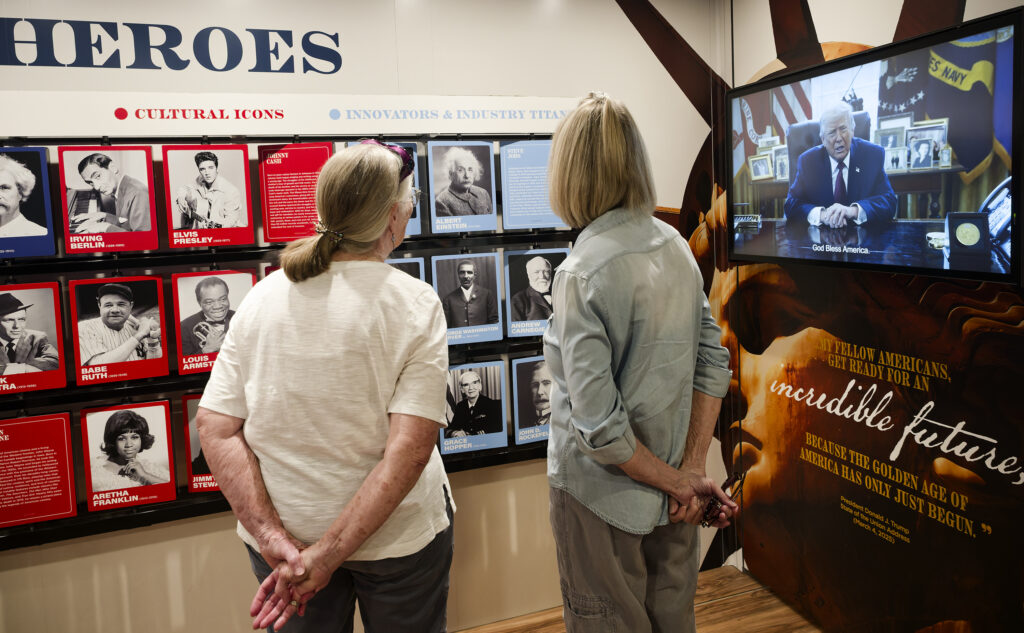
Much of the content in the trucks is noncontroversial. There are panels about various battles during the Revolutionary War, a discussion of Thomas Paine’s call for independence in “Common Sense,” a wall featuring an array of “American heroes” and an interactive civics quiz.
But to critics, other elements feel like a sanitizing of the American story that echoes recent controversies over how history is taught. In March 2025, President Donald Trump signed an executive order aimed at excising “partisan ideology” and descriptions that “disparage” Americans from National Park Service sites. The agency responded by removing exhibits that discuss slavery. Several states have legislation restricting lessons on systemic racism.
Some experts say exhibits like the Freedom Trucks can and should include both the victories and the failures. It’s possible to cast American ideals as powerful and exceptional while also dealing directly with the nation’s shortcomings, said Julie Silverbrook, chief content and learning officer at the National Constitution Center in Philadelphia.
“When we tell the story of America’s founding we don’t have to make a choice between pride and honesty. The most powerful account celebrates both,” she said. “The only way a nation can learn from failures is to fully understand where we didn’t live up to” our ideals.
American values over American failings
The idea for the mobile exhibit was hatched early in the second Trump administration as planning commenced for the semiquincentennial. Organizers were inspired by the Freedom Train that traveled the country in 1976 for America’s bicentennial.
Hillsdale and PragerU donated their services, officials with both institutions said. A $14 million grant from the Institute of Museum and Library Services covered the cost of building the exhibits.
When one of the trucks came to D.C. last month during a Jubilee prayer event on the National Mall, many visitors said they appreciated what they found.
“There’s a lot of ignorance about what the Declaration says,” said Ronda Campbell, 68, of Kentucky. “We’ve kind of erased history. There’s been plenty of mistakes but there’s been more positives than negatives.”
But at least one visitor came expecting to be dismayed — and she was.
“I was looking for how whitewashed our story would be,” said Erika Berg, 68, of the District.
She was upset at how the exhibit cast the country as deeply entwined with religion. When visitors walk into the truck, for instance, they are met with a large portrait of President George Washington, who comes to life to declare “our rights are a gift from God, not a favor from kings or courts.” Berg also was startled that Trump’s voice filled the second room of the exhibit, much like the AI-generated “voice” of Washington in the first room.
And Berg was frustrated that the discussion of freedom for the colonies left out enslaved and Indigenous people. “Whose freedom was hard-won?” she asked out loud, hoping other visitors would hear her.
The scant mention of Native Americans is misleading. A panel quotes the Northwest Ordinance of 1787: “The utmost good faith shall always be observed toward the Indians their lands and property shall never be taken from them without their consent.”
In fact, their lands were taken without consent, which is never noted.
Asked about this, Spalding replied that the Northwest Ordinance was an important document and worth quoting. He said that when people study on their own they will see the conflict between the stated principle and what actually happened. And he noted that in a small space, he had to make choices.
A similar tension underlies the exhibit’s handling of slavery.
“The American Founding is the greatest experiment in liberty the world has yet seen,” one panel says. When the Declaration was signed, it says, “The Founders anticipated that slavery would decline and wither away, and many states began restricting and abolishing slavery.”
Gerald Horne, a history professor at the University of Houston and an expert on America’s founding, noted that slavery massively expanded between 1776 and the eve of the Civil War in 1861 — a point not included in the exhibit. It also does not mention that three of the most prominent Founding Fathers — Washington, Thomas Jefferson and James Madison — were enslavers themselves.
Visitors learn the stories of people such as Phillis Wheatley, the first enslaved person to publish a book. But they do not learn about the untold numbers of enslaved people who were not allowed to read or write.
It adds up to “an attempt to deodorize and sanitize the founding,” Horne said. “It’s inherently one-sided.”
“I understand why these stories are put forward,” he added. “On the 250th anniversary, there are those who think you have to present this uplifting story about the shining city on the hill.”
Conservatives see the exhibit as a counterpoint to more liberal efforts, such as the New York Times’s 1619 Project, which focused sharply on the ways in which the United States has fallen short of its ideals.
“It’s unsurprising that the pendulum swings the other way,” said Jeremy Bailey, professor of humanities at the University of Florida’s Hamilton School. “There is a context here. People who love the country feel like the founders of the country need to be honored.”
The exhibit also highlights the famed abolitionist Frederick Douglass’s famous speech, “What to the slave is the Fourth of July?” It quotes him invoking the Declaration of Independence in making his case for abolishing slavery. But it ignores his harsh critique in that same speech, where Douglass condemns the hypocrisy of celebrating liberty while denying liberty to those enslaved.
For an enslaved person, Douglass said, celebrating the Fourth “is a sham.” He called the American prayers and sermons “mere bombast, fraud, deception, impiety, and hypocrisy — a thin veil to cover up crimes which would disgrace a nation of savages.”
The trucks’ limitations point to the need for more civic education, said Josh Dunn, executive director of Institute of American Civics at the University of Tennessee.
“Regardless of who’s doing it, probably a truck is not going to be able to provide an adequate picture of all the different elements of the American story,” he said.
“When I see Frederick Douglass’s speech being quoted, it’s hard for me not to be excited about that,” he said. “My hope is that people see that and they think, ‘Maybe I should go read all of that speech.’”
The post Trump-backed ‘Freedom Trucks’ tell a sanitized story of the country’s founding appeared first on Washington Post.