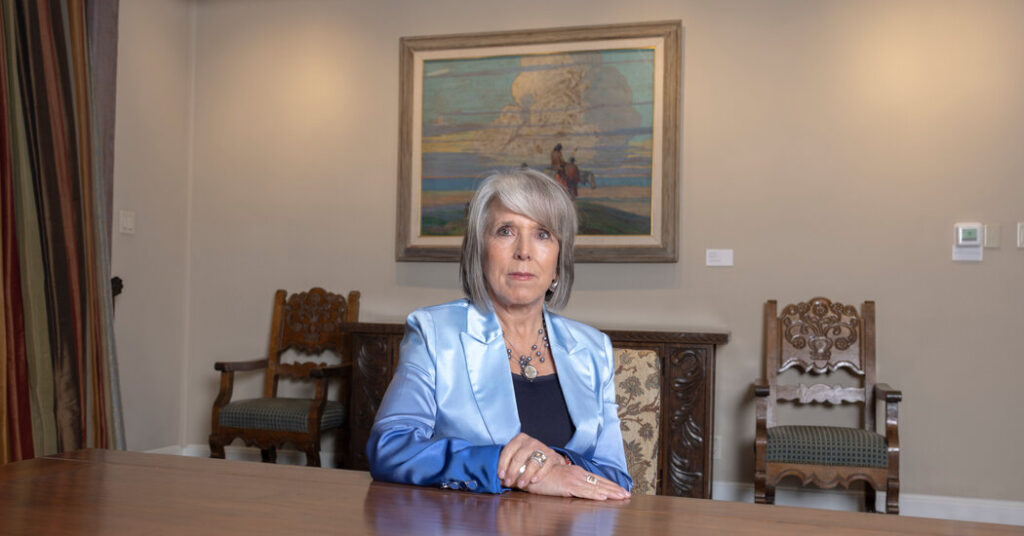
New Mexico’s governor, Michelle Lujan Grisham, called for a criminal investigation of federal agents after two news outlets reported that the U.S. Drug Enforcement Administration intentionally allowed deadly fentanyl pills to flood state streets for years.
Ms. Lujan Grisham, a Democrat, said this week that if the D.E.A. operations violated state laws, New Mexico’s attorney general should “prosecute anyone responsible — regardless of whether they are a federal agent or not.” It was a striking rebuke to a federal law enforcement agency that often partners with local jurisdictions to fight drug trafficking.
Back-to-back articles in The Albuquerque Journal and The Associated Press surfaced a whistle-blower complaint from a D.E.A. special agent, who accused federal officers and prosecutors of permitting the distribution of fentanyl from 2023 to 2025 while they tried to build larger criminal cases against high-level smugglers. President Trump last year labeled the highly addictive opioid a “weapon of mass destruction.”
“There are no words to describe how reckless and dangerous these decisions were,” Ms. Lujan Grisham said. “Make no mistake: The D.E.A. knew people would die if these pills made it into New Mexico communities, and the agency let it happen anyway.”
The D.E.A. initially denied any wrongdoing, calling its tactics “lawful” and “reasonable,” but on Thursday, the agency’s administrator, Terrance C. Cole, asked the Justice Department’s inspector general to carry out an independent review.
Mr. Cole said his request “should not be interpreted as a lack of confidence in the men and women of D.E.A.,” but rather as an attempt to shore up the public’s trust in the agency’s conduct.
The reports shocked and infuriated New Mexico leaders, activists and law enforcement officials, who have long struggled to combat a fentanyl epidemic that has ravaged their state more than most. Even as drug overdose deaths continue to fall nationwide, they spiked by 24 percent in New Mexico last year, the largest jump in the country.
The strategy of “walking” drugs — allowing them to be sold in hopes of infiltrating the supply chain — is longstanding but divisive, and critics of the D.E.A.’s actions have said fentanyl is too fatal to circulate.
“This policy, statistically, had to kill hundreds of people. And nothing is worth that outcome,” said Tim Keller, the mayor of Albuquerque, a city that has been especially hard hit. “It is horrific to think about how immoral this operation was.”
A Justice Department spokeswoman, Natalie Baldassarre, blamed the allegations in the 2023 whistle-blower complaint on the “disastrous open border policies” of former President Joseph R. Biden Jr., but she defended the type of “complex narcotics investigations” that are designed to target wide-ranging criminal organizations.
“The goal is not simply to interrupt a single distribution event, but to dismantle the networks that make those events possible,” Ms. Baldassarre said in a statement.
Trump Administration: Live Updates
Updated
- Trump’s tariff threat was aimed at European countries that plan to tax the revenue of tech firms.
- Trump says Iran attacked a cargo ship, violating the cease-fire.
- John Bolton pleads guilty to mishandling classified information.
Alexander Uballez, who served as U.S. attorney in New Mexico from 2022 until Mr. Trump forced him from office in early 2025, declined to discuss the specifics of the drug probes, which were conducted during his tenure. But, he said in an interview, “going after people on the top” is the most effective way to take on trafficking rings.
“We’ve lived in worlds where we’d arrest anybody for any little thing and that doesn’t make us safer,” Mr. Uballez said.
Monitoring the transportation and delivery of fentanyl without interceding “worked as part of a broader strategy” that also included addiction treatment programs and increasing the availability of opioid overdose reversal medications like Narcan, he argued. Drug deaths in New Mexico declined while he was in office. A case that began under his watch eventually resulted in the largest fentanyl pill seizure in D.E.A. history.
“An investigation will reveal that the tactics employed by my folks were effective in reducing the number of overdoses,” Mr. Uballez said.
The real tragedy, he continued, is the break between federal and local law enforcement since his departure, “and that’s reflected in this dramatic increase” in overdose deaths “since I left office.”
Justice Department fentanyl protocols advise federal agents to “make reasonable efforts to prevent the distribution” of the drug during an investigation. But the department’s Office of Professional Responsibility, which is charged with internal oversight, found in 2024 that the D.E.A.’s actions posed “no substantial and specific danger to public health and safety.”
In a response to that ruling, the whistle-blower, Special Agent David Howell, wrote that the agency’s practices had been self-defeating.
“I do believe in catching the ‘bigger fish,’ just not at the expense of placing the general public in danger,” he wrote. “And to our shame, that is exactly what we did.”
Local law enforcement agreed with Mr. Howell, whose lawyers did not respond to a request for comment. Albuquerque’s executive director of public safety, Raul Bujanda, said he understood the delicate balance officers must often strike.
“But fentanyl is unlike any other narcotic we have faced because the consequences of getting it wrong are measured in lives,” said Mr. Bujanda, a retired F.B.I. agent who helped bring down the notorious trafficker Joaquin Guzman, known as El Chapo.
New Mexico’s attorney general, Raúl Torrez, said his office was “determining the appropriate next steps,” but stopped short of announcing that he had opened a criminal investigation. U.S. Representative Melanie Stansbury, a Democrat whose district includes much of Albuquerque, asked the D.E.A. to provide an in-person briefing on the agency’s investigatory policies.
Mike Vigil, a retired chief of international operations for the D.E.A., said neither he nor his colleagues had “allowed drugs to walk” during his long career at the agency — and that was before fentanyl had been widespread. Gambling with such a deadly substance, he said, was a sign that the investigation had “spiraled tremendously out of control.”
“That is criminal,” Mr. Vigil said.
Caroline Jaramillo-Salazar, whose 34-year-old son died of a fentanyl overdose, was not surprised. She doesn’t trust the authorities much anyway. Ms. Jaramillo-Salazar was planning a march to commemorate those lost to the drug in Española, N.M., when friends messaged her about the news reports.
“They get these people addicted and some of them lose their lives the way my son did,” Ms. Jaramillo-Salazar said. “How dare they?”
Kirsten Noyes contributed research.
The post N.M. Governor Asks for Criminal Investigation of D.E.A. Agents appeared first on New York Times.