Like many American businesses, Tiffany & Company has something special planned next month to commemorate the 250th anniversary of the United States’ independence from Britain.
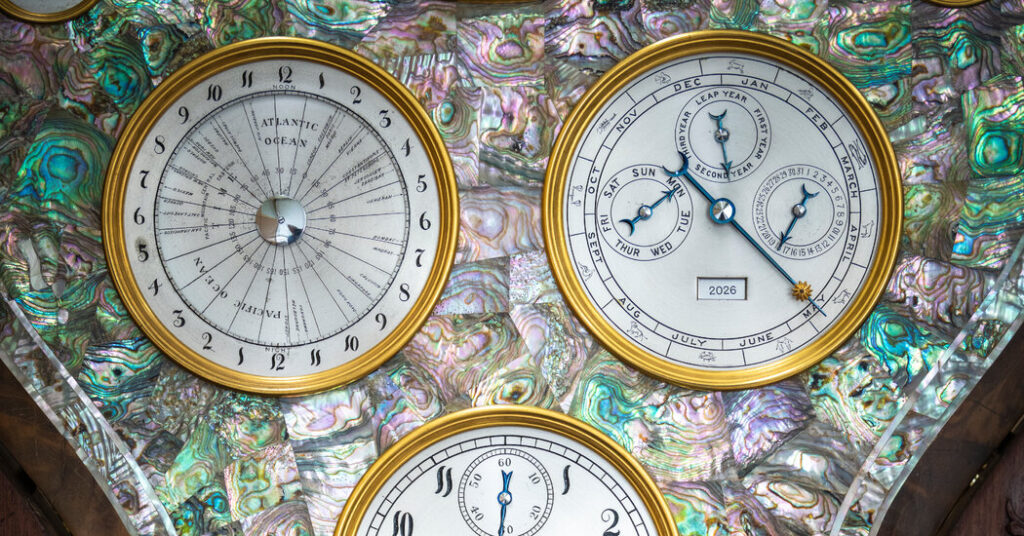
On July 3 at its Fifth Avenue flagship store, the house intends to unveil a newly restored nearly 8-foot clock that it completed in 1893 with an unusual Independence Day connection: One of the clock’s 13 dials tracks the number of years that have passed since 1776.
“It is very, very symbolic for Tiffany, as an American brand, to have that particular detail,” said Nicolas Beau, senior vice president of Tiffany Horlogerie, the jeweler’s watchmaking division.
Last year Tiffany sent a team of three specialists to inspect the timepiece, which was in storage at the Geneva Freeport, a warehouse about five miles southeast of the brand’s watch- and clock-making headquarters in Meyrin, Switzerland.
“Imagine,” Mr. Beau said, “that you open a wooden box, which looks like any wooden box, and suddenly you discover a treasure inside.”
Tiffany decided to buy the clock, even though it clearly wasn’t running properly. (The house declined to identify the seller or to disclose the price.)
“There were a lot of broken, twisted and dented components,” said Baptiste Guye, an expert watchmaker at Tiffany who specializes in archival pieces and later oversaw the restoration. “We realized the amount of work we had to do.”
The 550-pound clock — a type known in the watch world as a long case or grandfather clock — was made of amaranth wood, adorned with ornate marquetry and inlaid with abalone. Its silver-rimmed enamel dials were designed to tell such things as the time in various cities, the moon and sun’s positions in relation to the earth’s Equator and the number of Sundays until Easter. It was first displayed at the 1893 Chicago World’s Fair.
After a special mount was made to hold the clock steady, it was disassembled and work began in October in Meyrin. Mr. Guye said Tiffany was eager to use as many 19th century techniques in the restoration as possible, but an Excel spreadsheet was used to track progress and an ultrasound machine cleaned parts that were especially grimy.
One unexpected discovery: The independence year dial was stuck on 61, the number of years between independence and 1837, the year Tiffany was founded. The brand said it didn’t know if that setting was intentional or mere coincidence, but the dial was updated to start its count at 249, or 2025, when repairs began.
Mr. Beau said about a dozen people were involved with the clock’s seven-month restoration, including a wood expert in Geneva. Last month it was reassembled and tested for accuracy in Meyrin and, in early June, it was flown to New York City, with Mr. Guye as, essentially, its bodyguard.
Before the flight, the clock’s internal weights and balances were packed separately and custom-built stabilizers were placed inside the case — “to avoid shocks, friction, and unnecessary movement,” Mr. Beau said.
The clock, which is to be added to Tiffany’s archives, will be displayed through the end of the year in New York along with some other Tiffany-made items shown at the 1893 fair.
It is, Mr. Beau said, going “back to where it really belongs, not to mention this incredible coincidence of being so close to the anniversary of independence.”
The post Tiffany & Company Marks America’s 250th appeared first on New York Times.