This year New York Times critics have reviewed video games including Resident Evil Requiem, the latest installment in the horror franchise; 007 First Light, a James Bond adventure; and Zero Parades, a spy role-playing game by the creators of Disco Elysium.
Here are a few other games that have stood out:
Mewgenics
Reviewed on the PC.
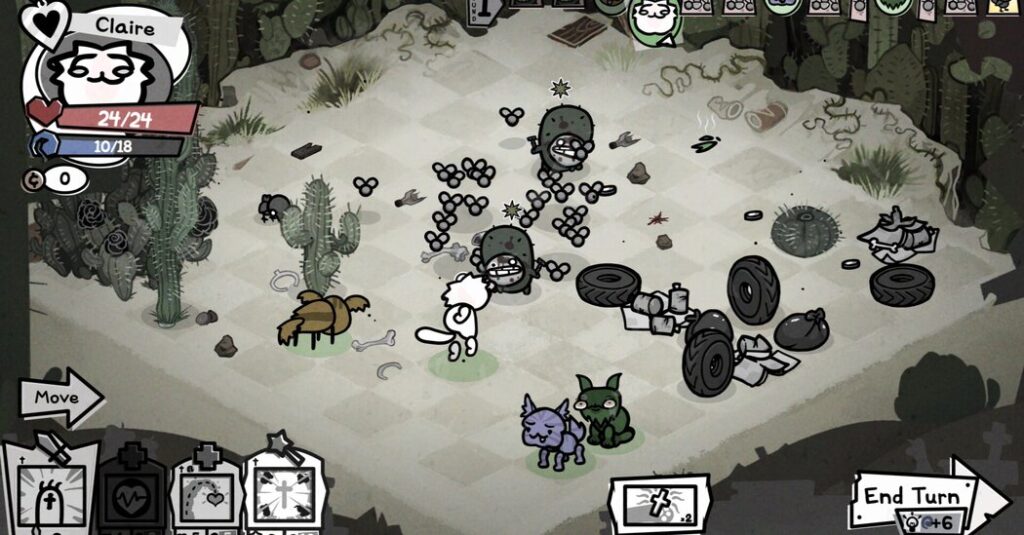
After the death of Laszlo, my family’s lovable, moody, biting cat, I began playing feline-inspired games. None embodies his somewhat feral spirit more than Mewgenics, by a creator of Super Meat Boy and The Binding of Isaac.
This sardonically humorous, sometimes violent strategy game is played on grids of squares. You breed cats (they’re horniest at night), amass power-ups and travel through levels like caves and the moon to battle foes. In the sewers, you can convince a plump shark to fight on your side.
What makes Mewgenics the cat’s meow is that it’s mischievous and odd. Characters like the mad scientist Thomas A. Beanies, with his wild Einstein-like hair, may have lost his marbles, exemplified by his narcissism and a deadly goal. Many characters, with their thick Sharpie outlines, are thoroughly creepy. They’re useful, too. Frank, an itchy, addled architect, lives under your house and builds rooms in exchange for retired cats.
The varied soundtrack, influenced by the Ramones at their punkiest, a growling Tom Waits and the Theremin-loving Danny Elfman, enhances every battle. There is no spoken dialogue, but reading and fighting to this smart music makes the game more imaginative and magical. The impressive depth of Mewgenics includes 281 available achievements, one of which is called Throbbing Gristle, a nod to the industrial music pioneers. Its spell turns foes into meat.
Despite the occasional grammar flubs (It’s “Science made you and me,” not “Science made you and I.”), the narrative is appealing. By the end, you discover a secret reason that Dr. Beanies engaged you to breed cats in the first place.
Although moving from square to square on the grid is time-consuming, Mewgenics rewards those familiar with the feelings of millions of cat owners: frustration, cuteness, beauty and impulsiveness.
— Harold Goldberg
Better Than Dead
Reviewed on the PC.
Better Than Dead, which is in dialogue with the unsettling aesthetic of “bodycam”-style shooters like Unrecorded and Ready or Not, sources its pastiche from low-budget ’80s Hong Kong crime action thrillers, the grungier and grimier and the better.
While its contemporaries set their firefights in empty warehouses and drug dens, Better Than Dead winds players through an intimate underworld with carpeted dim sum joints, kitschy neon-lit strip clubs and bamboo-scaffolded high-rises.
Your character is a sex-trafficking victim who wakes up in a dungeon, staring absently at a filthy wall panel laminated with old photos of a cloudy blue sky. You find a gun, and with it, the means toward freedom and revenge. It’s a simple plot with just enough flavor to cast meaning and depth into the gunfights, which are chaotic and brutal. Your character, no professional, blunders into rooms full of black suited gangsters, squeezing out panicked shots that shatter the eardrums and splatter the walls with blood.
Guns in games are often treated perfunctorily, as tools to click on baddies for points. The gun in Better Than Dead is the unmistakable center of its hazy nightmare, both as your redemption and your curse.
— Yussef Cole
TR-49
Reviewed on the PC. Also available on the Switch.
Call it vacuum-tube futurism.
TR-49 is both puzzle game and audio drama that gestures toward a dystopian reality where the rich can live forever at the expense of everyone else. It also caters to nostalgia for a time when computers were oddly-shaped tools that harnessed rather than scattered attention.
This visually spare but engrossing game places players before a monochromatic circular screen attached to a rectangular four-panel input device that accepts alphanumeric codes. The machine, as this story goes, was designed to help the cryptographers at Bletchley Park crack German war codes. In the wake of World War II, its creators, two married engineers, repurposed it as a “thinking machine” by feeding it books and periodicals that ultimately endowed it with quantum capabilities.
Players are entrusted with figuring out how the machine works and locating a specific document to help end the tyranny of the undying. To do so they must uncover codes that are mentioned, hinted at or alluded to within the machine’s archives. Enter a code and you will see documents whir past in a pleasing way that recalls a microfiche reader.
What one uncovers is a sort of intranet that shows off its creators’ inspirations, interests and concerns. Untangling the interlocking history of an array of people — scientists, novelists, academics, journalists — whose lives or work affected one another is intriguing enough that it makes up for some of TR-49’s more obvious plot twists.
— Christopher Byrd
The post Mewgenics Is a Mischievous Game About Breeding Cats appeared first on New York Times.