That the “Jackass” franchise is perhaps the most successful documentary series of all time is indisputable. Its best-known star, Johnny Knoxville, has the concussions to prove it. Twenty-five years in, as “Jackass: Best and Last” hits theaters, it’s still a little tricky to pin down what exactly the franchise documents.
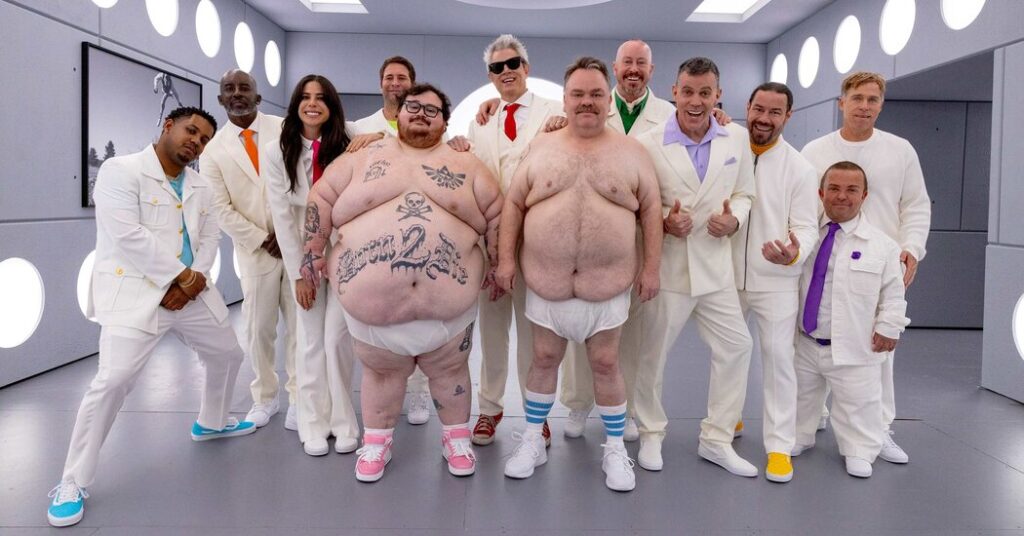
It’s easy to describe what the films literally show — unless you’re holding your hands over your eyes, which would be totally natural. The cameras (operated by long-suffering, iron-stomached crew members) capture a bunch of dudes and one woman doing the stupidest, grossest stunts they can think of, often in various states of undress, and somehow surviving to tell the tale.
If you’re inclined to think documentaries need to be unplanned, then you might still protest that these don’t count, because the stunts are contrived. But an interview is set up, too, and besides, there’s a genuine quality to “Jackass” that rarely exists in today’s tightly controlled documentary environment. Each bone-headed caper provokes moans and gleeful hollers from the guys who are, say, getting knocked in the crotch for the millionth time, and also from their best buddies standing around watching, possibly wearing a hula skirt and some bunny ears.
Yet when I say “Jackass” is a documentary, none of this is really what I mean. What the “Jackass” series reveals was almost certainly not the creators’ intention, and it’s much bigger than some clowns banging themselves over the head with giant hammers and reminding you not to do that at home. Like some other terrific documentary series — the classic “Up” series, for instance, or Robb Moss’s “river films” — the “Jackass” movies track a group of people across young adulthood into middle age, over 25 years. And that can’t help but have meaning.
They’ve been at this delightful nonsense since 2000, when Knoxville, Jeff Tremaine (who directed all the films) and Spike Jonze created a series for MTV. It ran for three seasons, much to the chagrin of many parents and some members of Congress, then entered movie theaters with “Jackass: The Movie” in 2002. (“I assume no responsibility for what happens if you see this film, especially if you have a good time,” A.O. Scott wrote in his review for The Times.) The movie’s success spawned sequels and spinoffs and video games and, no doubt, more than a few trips to the emergency room for viewers.
Since that original TV series, the style hasn’t changed all that much: It’s basically a series of clips of the guys doing dumb stuff with comical titles (“The Bungee Wedgie,” “Human Pretzel,” “Poo Cocktail Supreme”). Men stick toy cars up their butts or give themselves paper cuts in horrible places or prank their friends with snakes or strap themselves to rockets. Every scene fades out to the whole group, including whoever had to endure the pain, collapsing in peals of laughter.
The “Jackass” style is heavily influenced by lo-fi underground skate videos from the 1980s and ’90s, in which skaters in a crew showed off their tricks to music. Here, the crew is Knoxville and a recurring cast of chuckleheads with a high pain tolerance, including Bam Margera, Steve-O, Ryan Dunn, Jason Acuña, Chris Pontius, Preston Lacy, Dave England, Ehren McGhehey and a lot more, especially as time wore on. Instead of kickflips and nosegrinds, they invented ways to torture their bodies with pyrotechnics or sharp objects. If genitals or bodily fluids or fishhooks or bulls were involved, awesome! Bring it on.
I avoided it all until an editor sent me to a “Jackass” marathon in 2022. I’d always assumed these were films about misogynists being mean — frat boys doing fratty things frattily. There’s a little of that in the early “Jackass” years, when the guys are in their 20s, though far less than you’d expect.
But it was a bit of a revelation. I saw men having fun in ways that were — well, you couldn’t exactly call them “healthy” or “nondestructive,” but you might call them wholesome. What mattered wasn’t the stunts, which were uniformly harrowing. (So much poop.) What mattered was what happened between the participants. They were always laughing with each other. They were always helping each other off the ground. They were always hugging.
And while they were doing things that were undeniably stereotypically masculine — many, many of them involve a juvenile fascination with male genitalia — I realized somewhere into “Jackass Number Two” (2006) that they had little in common with the gender-obsessed manosphere. They didn’t talk about women disrespectfully (or much at all, frankly). They weren’t constantly flexing to see who was the manliest man of them all. People were getting slammed in the face, but never for reasons even slightly resembling looksmaxxing. They were just there, after giving very enthusiastic consent, to have a painfully good time.
Over the years, the “Jackass” crew has gone through some offscreen trials. Steve-O has spoken openly about his struggles with addiction and his journey toward sobriety, which started after a 2008 intervention from his “Jackass” castmates. In 2011, along with a crew member, Zachary Hartwell, Dunn died in a car crash while driving under the influence of alcohol. Margera has had a long string of substance abuse problems that spiraled into relationship issues with the “Jackass” cast and in his personal life; he was fired from “Jackass Forever” for breaching a “wellness agreement” related to his substance abuse.
This history only adds to what’s happening onscreen and starts to build out the series arc. As Knoxville has pointed out in interviews, many of the cast come from difficult backgrounds; in one another they’ve found something approximating a chosen family. We’ve watched Steve-O as he’s maintained sobriety and become a vocal animal-rights activist. We’ve observed the group mourn Dunn together. For “Jackass: Best and Last,” billed as the series finale, Margera doesn’t return, but the cast talks about him fondly, and Margera gave permission for archival footage of stunts to be used in the film. We’ve heard them express affection to one another countless times at this point.
Now, those reckless boys from 2000 are in their 50s — their age an inspiration for a few particularly gross stunts in “Best and Last” — and starting to look it, too. Knoxville’s salt-and-pepper hair has lost most of its pepper. Once-tight bodies are getting a little droopy. While it has sometimes seemed as if “Jackass” is a documentary about guys who have seemingly managed to cheat death, “Jackass: Best and Last” reminds us they’re mortal. And when Knoxville is asked if this is really, truly the last installment, he starts to get emotional. “As much as I hate to say it, it is,” he answers, right before he gets zapped in a huge electric chair.
Yet here they all are, still together, and if they’re not still making movies in 20 years, they’ll certainly still be hanging out, doing stupid tricks. That’s because “Jackass” is a documentary about an endangered species: enduring, weirdly healthy, bizarrely supportive male friendships in the 21st century. Somehow this merry band of knuckleheads did something many people never manage to pull off and wish they could.
As if to underline the point, at the end of “Best and Last,” there’s an archival clip, grainy and blurry, with two of the guys post-prank. “I need help,” one says, lying on the floor, a little worse for wear. “Yup,” says the other, and holds out his hand.
The post ‘Jackass: Best and Last’: A Moving Look at Male Friendship and Aging (Really) appeared first on New York Times.