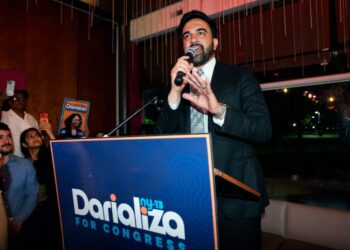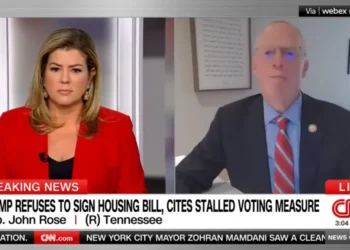
Candidates endorsed by New York City’s democratic-socialist mayor, Zohran Mamdani, swept the city’s primary elections yesterday, provoking alarm in both conservative and centrist circles over the future of the Democratic Party. The right-wing New York Post dubbed the winners, Brad Lander, Claire Valdez, and Darializa Avila Chevalier, the “hateful slate.” The Free Press quoted a supporter of one of the defeated candidates warning that it “doesn’t feel safe to be Jewish anymore,” notwithstanding the fact that one of those winners, Lander, is Jewish and a self-described liberal Zionist. New York Attorney General Letitia James told CNN, “All of us are a little frustrated with the Democratic Party. But you don’t blow it up. That’s what MAGA has done.”
The leftist trend goes beyond New York. In Seattle, the democratic socialist Katie Wilson is five months into her first term as mayor. Another democratic socialist, Janeese Lewis George, won the Democratic primary last week in Washington, D.C., and will likely be the city’s next mayor. In Los Angeles, the democratic socialist Nithya Raman has a good chance of unseating incumbent Mayor Karen Bass.
Overinterpreting election results the day after a contest is easy. Less than a year ago, the victories of Abigail Spanberger and Mikie Sherrill in Virginia’s and New Jersey’s gubernatorial races were being framed as a rebuke to the Democrats’ left-wing. But the boring reality may be that different places have different politics; all of these candidates are suited to their particular contests. Virginia and New Jersey demanded more moderate challengers, whereas New York, especially New York City, has enough left-of-liberal voters—and organizers and volunteers—to sustain more left-wing candidates. What’s happening in Brooklyn doesn’t necessarily tell us what will happen in Texas. This isn’t blowing up the Democratic Party so much as realigning its leaders with the views of their current constituencies.
[Read: The liberal district that could oust a Trump-defying Democrat]
Rather than announcing that the Democratic Party is facing a binary choice, we should think of the democratic socialists, Harold Meyerson writes, as the “urban wing” of the Democratic Party. These candidates won in liberal areas where people are looking for alternatives to the Democrats because the costs of necessities such as housing, food, and child care have risen dramatically—places where the most trumpeted Republican solution is to demonize immigrants, and those they associate with immigrants.
The right-wing podcaster Benny Johnson declared the New York results the “consequences of importing third worlders who hate us and our heritage.” In case you’re wondering who the “us” is here, another right-wing podcaster, Matt Walsh, complained that “third world communists are the enemy. They’ve taken over our greatest American city” and that they “hate white people. They hate our heritage and traditions.” What’s notable is that Johnson and Walsh aren’t talking about illegal immigrants, or about immigrants. They’re complaining about nonwhite people being able to vote.
Democratic voters have been more than willing to support Republican moderates in the past, even in deep-blue states such as Maryland and Massachusetts, but bridging that distance has become harder since the party became Donald Trump’s cult of personality, and since right-wing media figures have been more hostile to the idea of multiracial democracy. It’s hard to win over people in “our greatest city,” or in other cities for that matter, if your fiercest advocates post and podcast constantly about hating the people who live there.
[Read: The Democrats don’t seem willing to follow their own advice]
The Trump administration’s class war against the college educated, and its deployment of federal agents to harass and racially profile people of color, including American citizens, has also created a demand for more strident opposition among these two traditionally Democratic constituencies. Not just opposition to Republicans, but opposition to their power base—the oligarchs who have embraced the administration in exchange for tax cuts and favorable regulations. Democratic socialists seem eager to take on Trump, but many of them can also articulate a clear political narrative of state capture by the ultra-wealthy. Americans who watched their health-care premiums skyrocket while the richest man in the world dictated White House policy and left poor children in Africa to starve before becoming history’s first trillionaire may be looking for something different.
The Democrats’ moderate wing is not going extinct any time soon, however. The modern Democratic Party, by virtue of its class and ethnic diversity, has always been ideologically heterodox. An approach that works for a Zohran Mamdani or a Janeese Lewis George will not necessarily work for a James Talarico in Texas or a Mary Peltola in Alaska. Many people outside of the democratic socialists’ cities and districts will focus on whether the candidates’ stances on Israel and Palestinian rights reflect a shift within the party (and they do) and the fact that they differ from more centrist Democrats (also correct). But whether they succeed as leaders and politicians will depend on much more local concerns—matters such as jobs, public safety, and affordability. Their fates will turn on their ability to deliver for their constituents. This is as true of the democratic socialists as it is of the centrists.
The post Democratic Socialists Aren’t Taking Over America appeared first on The Atlantic.