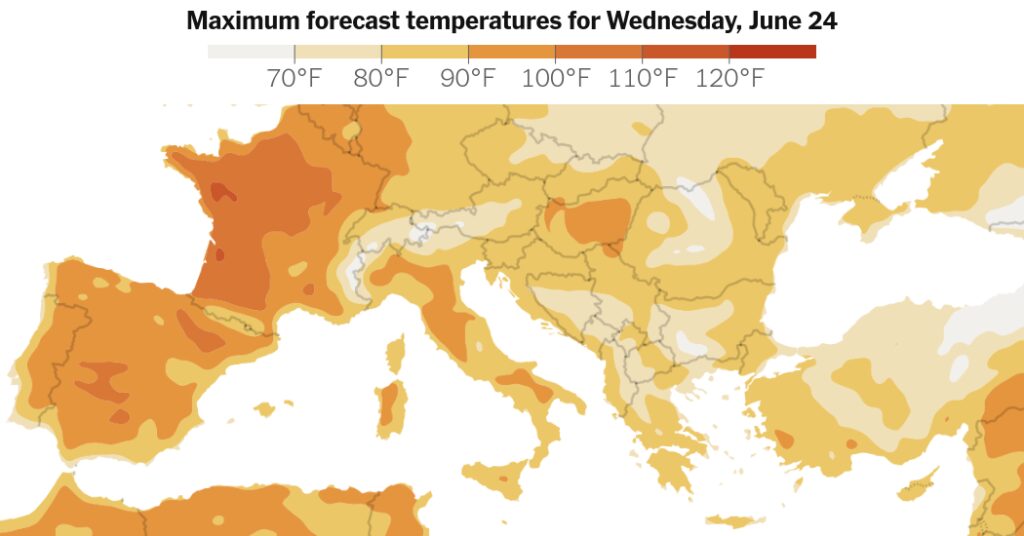
The second severe, and unusually early, heat wave in just two months held Europe in its oppressive grip on Wednesday, straining power grids and testing the resources of countries unaccustomed to extreme heat.
Urgent heat warnings were in effect in more than a dozen countries, including France, which on Tuesday experienced its highest average temperature on record — not just for June, but for any time of year. Power grid failures there have left more than 60,000 homes without electricity. On Wednesday, Britain’s weather service said in a provisional assessment that temperatures in a county outside London had reached 35.7 degrees Celsius, or 96.3 degrees Fahrenheit, which would be the highest temperature ever recorded in the country in June.
As global temperatures rise, Europe has been warming faster than any other continent, and officials have scrambled to react to heat waves that are increasingly intense and happen earlier in the year. Making matters worse, in much of Europe most buildings are not equipped with air-conditioning, and schools are no exception.
“We’ve got a typical London flat that just gets boiling inside,” said Julie Green, 39, who was playing in a North London park on Monday with her infant son, Roman. It was stiflingly hot, but less so in the shade.
The problem, Ms. Green said, is much bigger than just one building — it’s London itself. “The buildings, they’re just not built for hot climates,” she said.
As of Wednesday, Andorra, Austria, Belgium, Bosnia and Herzegovina, Britain, Croatia, France, Germany, Hungary, Italy, Luxembourg, Poland, Serbia, Slovakia, Slovenia, Spain and Switzerland were all under high-level heat warnings.
In France, temperatures were expected to keep reaching “exceptionally high levels” on Wednesday and Thursday, with highs climbing above 40 Celsius, or 104 Fahrenheit, said the French weather agency, Météo-France. On Tuesday, the average temperature across France’s 30 weather stations reached a record 29.8 degrees Celsius, or about 86 degrees Fahrenheit, the agency said.
Some 68,000 French homes were without electricity on Wednesday after power grids failed, the national network, RTE, said on social media. During heat waves, every degree hotter leads to one megawatt more of electricity consumption because of air-conditioning needs, the company said.
Officials in France said on Tuesday that at least 40 people had drowned, many of them teenagers who were swimming in unsupervised areas. Millions of students have been sweltering in classrooms in Britain and France, where few schools have air-conditioning.
While tying a single heat wave to climate change requires extensive analysis, scientists have no doubt that heat waves around the world are becoming hotter, more frequent and longer-lasting. In 2025, almost all of Europe was hotter than normal. Researchers estimate that in recent years, the continent has seen tens of thousands of heat-related deaths annually.
Many homes, schools and businesses across Europe were built for an older, cooler climate. In Britain, many were even built to retain heat, making cooling off amid heat waves especially difficult. Air-conditioning is not a quick fix. In France, installing such systems has become a political flashpoint, while in Britain, high energy prices deter many.
“There’s all sorts of infrastructure which is not built for heat here,” Jacob Baum, a 26-year-old American living temporarily in London, said on Wednesday. The heat is more intense in New York, he said, but London is not equipped to deal with it.
Even in hotter Mediterranean cities, where old-fashioned courtyards, heavy shutters and white-stone facades can keep homes cool, many newer buildings have been constructed using techniques that trap heat.
Forecasters said temperatures were expected to gradually return to more seasonal levels across Western Europe starting on Friday. But countries in Eastern Europe were bracing for a scorching weekend, with temperatures expected to climb into the high 30s Celsius by Sunday.
In Britain, National Rail warned passengers on Wednesday to travel only if necessary. Multiple routes in the south of the country were disrupted, including in and around London.
Elsewhere in Europe:
-
Spain: Highs of up to 41 Celsius, about 106 Fahrenheit, were forecast for Wednesday, especially in the north, the weather service AEMET said. Forecasters said cooler Atlantic air would arrive on Thursday, bringing a drop in temperatures.
-
Italy: The Ministry of Health has issued red heat warnings, the highest level, for more than half of Italian cities for Wednesday and Thursday. Highs of up to 37 Celsius (97 Fahrenheit) were expected in Florence and Milan.
-
Germany: The country’s weather service, the Deutscher Wetterdienst, said the worst of the heat would arrive late in the week. It said temperatures could peak on Saturday at 41 Celsius (close to 106 Fahrenheit), which would surpass Germany’s highest June temperature on record, 39.6 Celsius, set in 2019.
How to cool off
Staying cool and hydrating often are the two most important things to do to avoid feeling sick and discomfort in extreme heat. Here are some other ways to keep cool:
-
Block out the windows in your home — especially those that get afternoon sun — with a blanket or a darker sheet during the day to keep the heat out. At night, keep windows open and run fans to circulate the air.
-
Spritz your skin with a mist of cool or room-temperature water or wipe your forehead with a cool cloth. Cold showers can also help you cool down.
-
If you need to be outdoors, put ice cubes in your water bottle and drink cool liquids. If you plan to exercise, douse your head in cold water. Swimming is also a great way to exercise and keep cool.
-
When exploring or sightseeing, seek out cooler attractions such as museums, cathedrals or even subterranean exhibitions. Some cities have created public spaces to cool down: Barcelona has climate shelters and Paris has drinking fountains, for example. London has a Cool Spaces map to find spots.
-
Watch out for signs of heat stroke. The Centers for Disease Control and Prevention lists some of them as dizziness, a rapid pulse, nausea, headache and fainting. But symptoms can vary.
The post Western Europe, Sweltering Under Record Heat, Braces for More appeared first on New York Times.