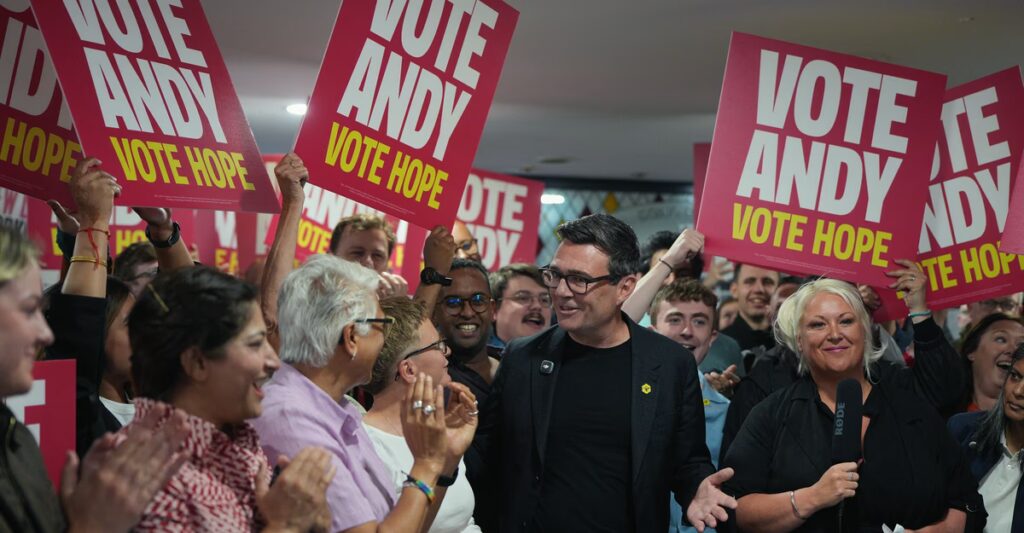
Andy Burnham will soon have a monumental task. If, as expected, he replaces Keir Starmer as Britain’s prime minister, he will not just be taking up an office that has chewed through six occupants in merely 10 years. He will also probably be the British establishment’s last chance to stave off a government controlled by Nigel Farage, the Brexit architect whose nationalist party, Reform UK, is currently leading in the polls. Under British law, the ruling Labour Party can keep its current parliamentary majority without calling an election until 2029. That gives Burnham roughly three years to revive the moribund British economy before frustrated voters turn away from mainstream parties and opt for the radicals instead.
Before Burnham rode to Labour’s rescue late last week by winning a special election for Parliament, he was mayor of Greater Manchester, a place that has grown in defiance of Britain’s economic malaise. Relative to his unpopular Labour colleagues in London, Burnham can credibly argue that he knows better how to conjure up prosperity. “You can’t order growth from the top down,” he told me a few months ago in Manchester. “The U.K., for most of our lives, has been an overly centralized country.”
When we spoke, I was reporting on why Britain had economically stagnated since the global financial crisis almost 20 years ago, and I had come to Manchester because its growth had consistently been double the national average. From 2017 to 2023, cumulative productivity in Greater Manchester increased by 12.6 percent—whereas inner London saw no productivity increase whatsoever. The hope implicit in Burnham’s seemingly sudden rise is that his city’s experience can now be scaled across Britain.
[Helen Lewis: The man who couldn’t do it]
Burnham’s odyssey has actually been longer than Ulysses’s. He had been a well-liked and prominent Labour member of Parliament from 2001 to 2017. But after running twice to be Labour leader in 2010 and 2015, and losing badly both times, Burnham left Westminster in 2017 to lead the Greater Manchester Combined Authority. The authority was an experiment in devolution—allowing greater local control over taxation, transportation, and housing. One of Burnham’s biggest concrete accomplishments has been quotidian: bringing Manchester’s buses together into a coordinated network supervised by municipal government.
This may seem small-bore to Americans or Germans who live in a federalized country, where states have substantial control over their own budgets and can act as laboratories of democracy. But it is revolutionary stuff in England, where power and spending are extremely centralized in the national government. Devolution—which Burnham insisted had ushered in “a level of growth that we’ve not seen here, probably since Victorian times”—is the clearest element of an economic ideology that he has taken to calling “Manchesterism.” He sometimes speaks of this grandly, as “the end of neoliberalism” and “business-friendly socialism” (no oxymoron intended).
The best argument in Burnham’s favor is that he understands that regional inequality—driven by bad transportation networks, too little building, and skills deficits—is a primary cause of Britain’s underwhelming economic growth, and that he seems to know how to reverse it. Burnham’s critics charge that he takes too much credit for Manchester’s rise, which is also due to high costs in London that encourage businesses to expand elsewhere. The BBC and British government agencies also decided years ago to relocate offices to the city, which spurred development. The area also has the good fortune of hosting two of the country’s best-known Premier League teams. Those who wondered whether Manchesterism was a workable system, or merely a good coinage, will have their chance to see.
Before he became prime minister, Starmer talked obsessively about the need for “growth, growth, growth” without revealing his plan to accomplish it. Then it became clear that there was no plan. The transformative potential of a massive majority was quickly eaten up by a series of ill-conceived policy announcements—such as restricting winter-fuel allowances for the elderly and cutting welfare—that were embarrassingly withdrawn in response to entirely predictable criticism. Commentators summarized Labour’s political strategy as “all pain and no gain.” If Burnham is able to design a comprehensive economic plan, he will have an overwhelming parliamentary majority at his back for at least the next three years. The lesson from Starmer’s short tenure is that Burnham must move aggressively, because political capital decays quickly. (The lesson from Liz Truss’s short tenure as prime minister—which ended after mere weeks because of an overly radical budget plan—is to not move so quickly that you trigger a market crash.)
Although Burnham’s path to power has been cleared—he may run unopposed for Labour leader—he has no incentive to make revolutionary proposals until his ascension is complete. For now, he has pledged to color within the lines set by Starmer’s team: the strict fiscal rules laid out by Rachel Reeves, the chancellor of the exchequer, and the strict immigration policies of Shabana Mahmood, the home secretary. He has walked back remarks that Britain had to get out of being “in hock to the bond market” (which the bond market did not appreciate); he has also recanted his past interest in a referendum over rejoining the European Union.
After spending 14 years in the minority, from 2010 until 2024, and then floundering for another two years under Starmer, Labour is desperate to show that it can really govern Britain. The first plans that Burnham unveils will probably be swiftly passed into law.
Farage will be waiting to capitalize on any missteps. If a general election were held today, Reform would win a strong plurality of seats. If an election occurs in a few years’ time, after the implosion of another Labour government, the populist party may fare even better.
[From the July 2026 issue: How Britain became as poor as Mississippi]
Burnham has a genial, dorky-dad affect, but when I asked him about Reform, something pugnacious came over him. “Greater Manchester has become more and more functional as the country has become dysfunctional. But why has the country become more dysfunctional? I will put that directly at Reform’s door—the promises they made running up to the Brexit referendum and since just haven’t been borne out whatsoever,” he said. Brexit was not just bad for growth, Burnham maintained; it also sowed the seeds of the current migration crisis by cutting off access to the EU. Because Britain still needed workers from abroad, the Brexit supporter Boris Johnson liberalized migration laws from elsewhere, attracting an extraordinary surge, which has destabilized British politics to Reform’s great benefit. “I think people can see that that form of politics—a more divisive, polarized politics—does not bring growth at the end of the day. It creates division, it creates argument, it creates discord. Greater Manchester has been built on completely the opposite,” Burnham said.
Is Manchesterism enough to save the Labour Party, change Britain’s economic trajectory, and fend off its rising nationalists? Burnham insisted to me that his party can take the insurgents on and win. “Labour politics has helped build this place into the growth story it is today,” he said of Manchester, “and I’m quite ready to take on anybody who’s going to try and drip poison in and break it apart,” he told me.
Reform’s argument is that the Labour and the Conservatives make up a “uniparty” and have proved themselves unable and unfit to govern, and that only an insurgent and iconoclastic party can sweep away the rules, regulations, and entrenched interests that inhibit growth. Starmer was a vindication for that thesis; a failure by Burnham might be the final proof Reform needs.
The post Andy Burnham Has Three Years to Fix Britain appeared first on The Atlantic.