Bob Blumenfield would like to see Angelenos’ old banana peels and moldy bread stay local.
On Tuesday morning, the City Council member told a small crowd of waste advocates in front of city hall that he was introducing a motion to reduce the city’s greenhouse gas emissions by strengthening local composting infrastructure and decreasing reliance on distant facilities.
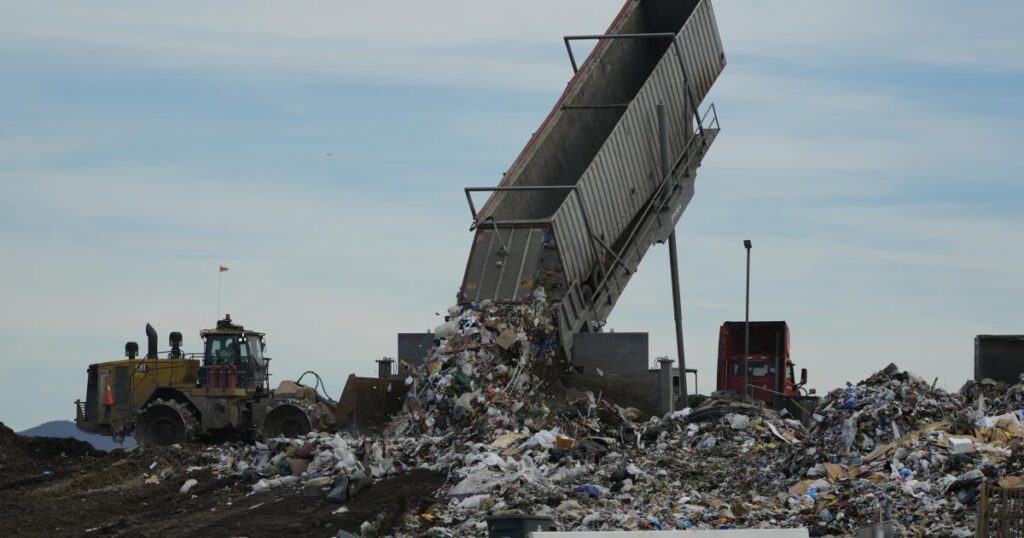
Currently, when city residents separate their food waste and yard clippings, chances are it’s being trucked to faraway processing facilities in Bakersfield or Lancaster.
The motion would help the city meet targets set by California’s Short-Lived Climate Pollutant Reduction Strategy, or Senate Bill 1383, which phases out sending green waste to the landfill, because it is a major source of the powerful climate pollutant methane.
It also would help meet Mayor Bass’ Climate Action Plan, which aims to use at least 50% of locally produced compost and mulch within Los Angeles by 2030. Currently, only 25% to 30% of the city’s material is applied to land locally.
The city produces approximately 350,000 tons of organic material a year, Blumenfield told the crowd, which he said equates to roughly 1.2 to 1.5 million metric tons of carbondioxide.
“That’s a big number, and when you do the math,” he said, that’s roughly the same amount of carbon dioxide released by the entire country of Belize, the entirety of Humboldt County or the equivalent of burning 1.6 billion pounds of coal per year.
As the announcement was underway, in the background a fire burned for a sixth day in a Boyle Heights warehouse,where 85 million pounds of frozen food was thawing and beginning to rot.
Signed into law in 2016, the state’s composting bill mandated a gradual increase in the amount of organic waste that must be diverted away from landfills. It required 50% of all green and food waste be diverted by 2020; by 2025, that number was supposed to hit 75%.
But it hasn’t. Although Los Angeles has pushed to get a residential curbside bin program in place — recall the “Great Green Bin Apocalypse of 2025” — it has struggled to get people to comply.
According to reports for the recycLA program, a commercial and multifamily waste collection franchise program, only about half of households and business are separating their compostable waste.
Alex Helou, assistant general manager of L.A. Sanitation & Environment, provided a much brighter picture of the city’s food waste situation. L.A. is the first major city to provide green bins to 750,000 residential customers, he said. The city has “exceeded expectations” in food recovery, he said, saving 80 million meals that would have been thrown out and redirecting them to people in need.
Helou said Blumenfield’s motion completes the loop by keeping food waste close to home, creating more local composting and reducing greenhouse gas emissions from transporting waste outside of the city. It doesn’t directly affect the city’s compliance with SB 1383, but that isn’t necessary, he said. “We’re meeting that and exceeding that at multiple fronts.”
Blumenfield’s initiative directs the Bureau of Sanitation to develop a plan for expanding local composting across the city. It would also increase the use of locally produced compost and mulch.
For instance, the motion would encourage using the compost on urban farms and at community gardens and city parks. It also would be used to replace artificial grass and turf.
It will support a “citywide transition away from artificial turf and towards nature-based solutions, such as California native plants and natural grass plant fields, and ensure everyone has access to safer, cooler, and sustainable parks, schools, and communities,” said Terry Saucier, a Tarzana resident and member of the Neighborhood Council Sustainability Alliance and the Tarzana Neighborhood Council.
The state’s composting law has proved challenging on several fronts.
The Antelope Valley has become a dumping site for many of the city’s haulers looking to cut transport and facility costs — causing concern among environmentalists and others who say the material is destroying fragile ecosystems.
Complying has been particularly difficult for Los Angeles and much of coastal Southern California, where there are few large composters and low demand for compost. Unlike areas to the north, there is little agricultural demand for compost and mulch.
Experts say dumping in the desert has always been a problem, but the law made it worse by making it more expensive and difficult to deal with.
In addition, composters are struggling with the amount of plastic and other debris that people and businesses put in the food waste bins.
According to a report by Closed Loop Partners, which partners with companies such as Pepsico and McDonald’s, nearly 4% of food waste is contaminated with other materials — most of it plastic. State law requires that finished compost contains no more than 0.5% by dry weight of physical contaminants.
The post Why your food scraps travel more than 100 miles — and how an L.A. council member wants to stop it appeared first on Los Angeles Times.