The naysayers had projected Australia would be rationing fuel just after Easter.
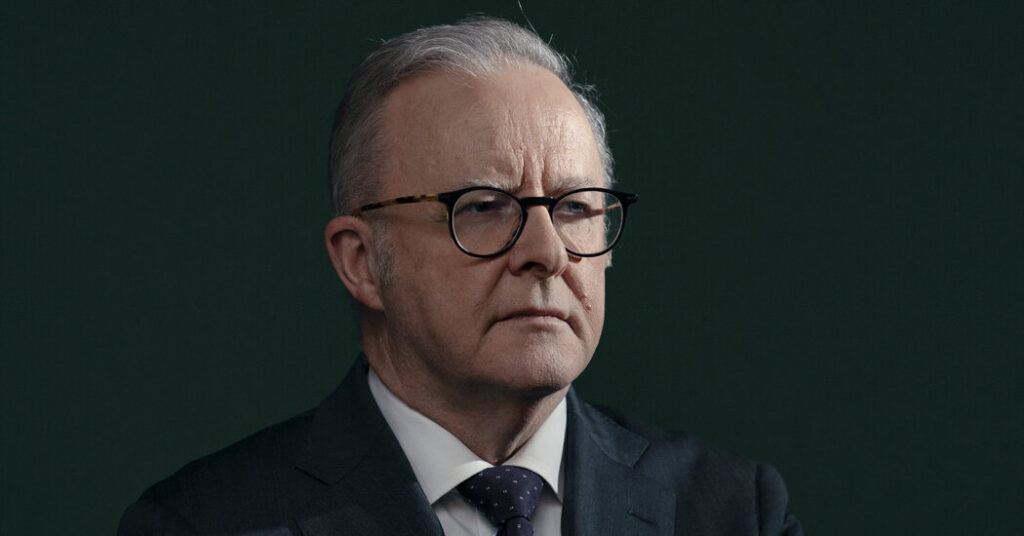
Describing how his government proved them wrong, Prime Minister Anthony Albanese perked up with a hint of pride. Gesturing toward the desk from where he gave a rare national prime time address a couple months ago, in which he tried to calm nerves and ward off panic buying in the wake of the war in Iran, he took a victory lap.
“We have done much better in terms of minimizing the impact on Australians, we’ve done much better than any of the commentators thought was possible,” he said in an interview this month in his office in Parliament House in Canberra, the capital. Now, he said, the country had more in fuel reserves than at the start of the war.
But if Australians are feeling any comfort in their lot relative to the rest of the world, they are not showing it.
Record levels of Australians have said in recent polls that the country is headed in the wrong direction, with economic uncertainty rising. Survey after survey has shown an ascendant far-right populist party, One Nation, beginning to edge out Mr. Albanese’s center-left Labor party.
And almost everyone, it seems, is unhappy with his federal budget — which included bold tax changes to rein in soaring housing prices, but appears to have incensed older citizens and businesses and not given enough of a boost to would-be first-time buyers.
“Everyone wants reform until you do it,” he said, his shoulders sinking a little.
On the global stage, the Trump administration is pressuring Australia to sharply increase its military spending, while Mr. Albanese is facing domestic criticisms that his government is increasing its dependence on an unreliable Washington, with a nuclear submarine pact known as AUKUS.
It is a far cry from a year ago, when Mr. Albanese was re-elected with a sweeping majority for his party, which was seen as a resounding rejection by Australians of the Trumpian politics that were wreaking havoc on the global order.
Since then, the international environment has only grown hairier. And at home, Mr. Albanese was left patching up the gaping societal wounds laid bare by a terrorist attack targeting Jewish Australians at Bondi Beach, the deadliest mass shooting in the country in decades that also fanned anti-immigrant sentiments.
Mr. Albanese, 63, a career politician known more as a political pugilist than an audacious visionary or powerful orator, said he understood the sentiment that has fueled far-right populist movements elsewhere in the world and is now nibbling at his heels. After all, “Albo,” as he’s widely known, entered politics propelled by the challenges of being raised in public housing by a single mother struggling with a disability.
“There’s a lot of frustration there, and they want to tear the house down,” he said, describing the soaring popularity of One Nation and its longtime firebrand leader, Pauline Hanson. He said he knows it is incumbent on him to take risks to try and deliver real change.
“The vibe out there is that governments can’t afford just to be defenders of the status quo,” he said.
‘Crisis Manager’
Mr. Albanese spoke to The New York Times on a Tuesday afternoon, his spirits buoyed by what his staff said had been a successful sparring session in Parliament. He jokingly used profanity while posing for photographs. “It’s OK, I’m Australian,” he said.
He reflected on steering his country through what he has repeatedly called “deeply tumultuous and turbulent global times.”
The United States, Australia’s most important ally, is playing a fundamentally different role in global trade and alliances while China is increasing its influence throughout the Asia Pacific. His government has warned that “deterioration” is no longer an adequate description for the global environment, but that “fracture, rivalry and disorder” will come to define the decade ahead.
It is hardly a natural role for a prime minister who spent his early career as a fiery young activist devoted to welfare issues. Today, he is seen primarily as a pragmatist, who displays in his office a model tunnel boring machine that was gifted to him for his dedication to infrastructure projects.
“He clearly came to power in 2022 as a prime minister who wanted to be a good progressive leader, leading a nation that looks after its people,” said Rory Medcalf, the head of the National Security College at the Australian National University and a former diplomat. “He didn’t come to power wanting or expecting to be a crisis manager or a leader who has to prepare the nation for a darker future.”
More than anything in recent months, he has had his hands full trying to shelter Australians from the economic fallout of America’s war in Iran, one with seismic ramifications that came with no warnings to allies, including Australia. The tumult has only added to the inflation and cost of living issues that at one point had looked like it might cost him re-election.
To the Australian people, the most he’s been able to do is promise to blunt the blows, saying the government will be a “buffer” and a “shock absorber.”
At the same time, with his foreign minister, Penny Wong, he has quietly been building up and reinforcing relationships with other so-called middle powers around the world to lay the latticework that can hold up the global norms and agreements absent the United States. He pointed to the trade deal that Australia signed with the European Union in March, one that had languished for nearly a decade. The leaders of Canada and Japan, Mark Carney and Sanae Takaichi, have each made trips recently to sleepy Canberra.
“You still have the strategic competition between the two great powers, China and the U.S. But also, you have other parts of the world, including Australia, not waiting for that competition to play out,” Mr. Albanese said.
It was because of that groundwork that his government was able to secure the fuel to ease fears of a shortage, he said. He also turned to Beijing, relations with whom he resuscitated from a low point under his predecessor, to secure jet fuel shipments.
“The uncertainty that’s there in global politics and events suits China,” he said. “They want to present an image of certainty going forward whilst at the same time they’re interested in increasing their influence at a minimum, and hegemony in the longer term”
‘Someone to blame’
That uncertainty has fanned discontent and anti-establishment sentiment at home, spurring record levels of support for Ms. Hanson and her One Nation party, which had long been largely irrelevant in Australian politics.
“We’re in a moment where people’s hip pocket is what they feel much more, and somebody like Pauline Hanson is offering an answer, which is, you can blame migrants, diversity quotas in government,” said Daniel Flitton, a veteran political and foreign affairs journalist. “There’s resentment, and the public is more likely to turn on the government in an effort to have someone to blame.”
The massacre at Bondi Beach, where gunmen aligned with the Islamic State targeted Jewish families at a Hanukkah celebration, has furthered interest in One Nation and Ms. Hanson, who has railed against immigration and multiculturalism.
The aftermath of the attack has been trying for Mr. Albanese, who was publicly booed at a Jewish community memorial and later, at a mosque. His decision to invite the Israeli president to Australia was met with large, angry protests that ended in violent clashes between the crowd and the police.
Asked how he intends to move the country forward after the mass shooting at Bondi, he responded obliquely by talking about the two-state solution in the Middle East and global polarization.
“Overwhelmingly, what Australians really want, people who are not partisans, is for conflict to not be brought here,” he said.
Four years into the job, Mr. Albanese is already the longest-serving leader in Australia in two decades. He has two more years until the next federal election to turn the tide of rising support for the far right, and get Australians feeling secure and hopeful enough to continue backing him as prime minister.
By mid-June, he had walked back parts of the tax reforms in his budget, announcing carve-outs and exemptions to appease critics. At the same time, housing prices are cooling, something most Australians see as a good sign.
“It’s really important to acknowledge people’s real concerns, which are there, and to send a message: One, that you’re listening. Two, that you’re delivering change, real change,” he said.
Laura Chung contributed reporting.
The post In Uncertain Times, Is the Australian Leader’s Quiet Pragmatism Enough? appeared first on New York Times.