On the night before President Donald Trump hosted a summit for a dozen administration-favored Latin American leaders in the Miami suburb of Doral in March, senior U.S. officials mingled with locals and lobbyists over canapés and wine at a welcome reception.
For many attendees from Guatemala, whose leader wasn’t invited to the summit, the event was an opportunity to advance their push for a Trump administration crackdown on the government of President Bernardo Arévalo, a leftist. An anti-corruption reformer in what has long been one of the most corrupt countries in the hemisphere, Arévalo’s agenda has threatened powerful economic and political actors.
Day-after photos posted on social media by Rodrigo Arenas, editor and publisher of Republica, a conservative Guatemalan media outlet, showed Arenas with Deputy Secretary of State Christopher Landau and Michael Jensen, then the National Security Council director for the Western Hemisphere. If Arévalo didn’t change course, Arenas wrote beneath their smiling faces, his remaining time in office “will be very cold and uphill.”
Arenas and other influential members of the Guatemalan right-wing opposition have sought access at the highest levels of the White House and State Department under Trump, employing lobbyists, attending events frequented by administration officials and political figures, and reaching out directly to those with proven access and influence in the Oval Office.
The Trump administration has shifted U.S. policy toward Latin America sharply to the right, declaring it a national security priority and reviving a version of the Monroe Doctrine that established the hemisphere as an exclusive sphere of U.S. influence more than 200 years ago. It has overthrown the government of Venezuelan President Nicolás Maduro, filed formal charges against former Cuban leader Raúl Castro and endorsed aligned candidates for high office from Argentina to Honduras.
This story of how this shift is playing out in Guatemala is based on interviews with more than two dozen current and former U.S. and Guatemalan officials, politicians and regional experts, many of whom spoke on the condition of anonymity to discuss sensitive diplomacy.
The most visible tactic in the new approach to Latin America has been military action. In addition to Maduro’s January capture in a U.S. military operation, the U.S. has blown up dozens of alleged drug-trafficking boats in the Caribbean Sea and Pacific Ocean, conducted joint operations against alleged drug traffickers and organized crime, and imposed a naval blockade on oil shipments to Cuba.
Trump said in early June that as soon as he finishes the war with Iran, he will “take care” of Cuba.
He has also made wide use of economic and diplomatic threats, as well as inducements, to press policy goals and influence the election of favored candidates as he seeks to change the region’s political map.
In Honduras, Trump’s endorsement helped bring an electoral flip to the right early this year, and he credited himself with helping to do the same in Chile. In Colombia, a right-wing newcomer Trump endorsed appeared headed for victory in Sunday’s presidential election. Last month, Trump hosted Flávio Bolsonaro, the son of convicted former Brazilian president Jair Bolsonaro and a leading candidate on the right to replace leftist president Luiz Inácio Lula da Silva in October.
In Costa Rica, Trump has revoked U.S. visitor visas held by judges, lawmakers, prominent business figures and former president and Nobel Peace Prize laureate Óscar Arias, whose only apparent misstep was to criticize Trump’s policies and the country’s Trump-allied president. Most recently, visas held by members of the board of La Nación, Costa Rica’s leading newspaper, were canceled after a series of editorials displeased the State Department.
In Panama, U.S. threats were instrumental in moving that government away from business deals with China and granting increased access to U.S. troops and ships transiting the Panama Canal. In Argentina, El Salvador, Paraguay, Bolivia and Ecuador, new and existing governments have endorsed U.S. hegemony and “America First” initiatives in exchange for cash payments, military access or promised aid, trade and investment deals.
But in Guatemala, right-wing political and business leaders are working with a collection of prominent American ideologues to seek Trump’s help in molding their own government into one more to their liking.
With friends like these
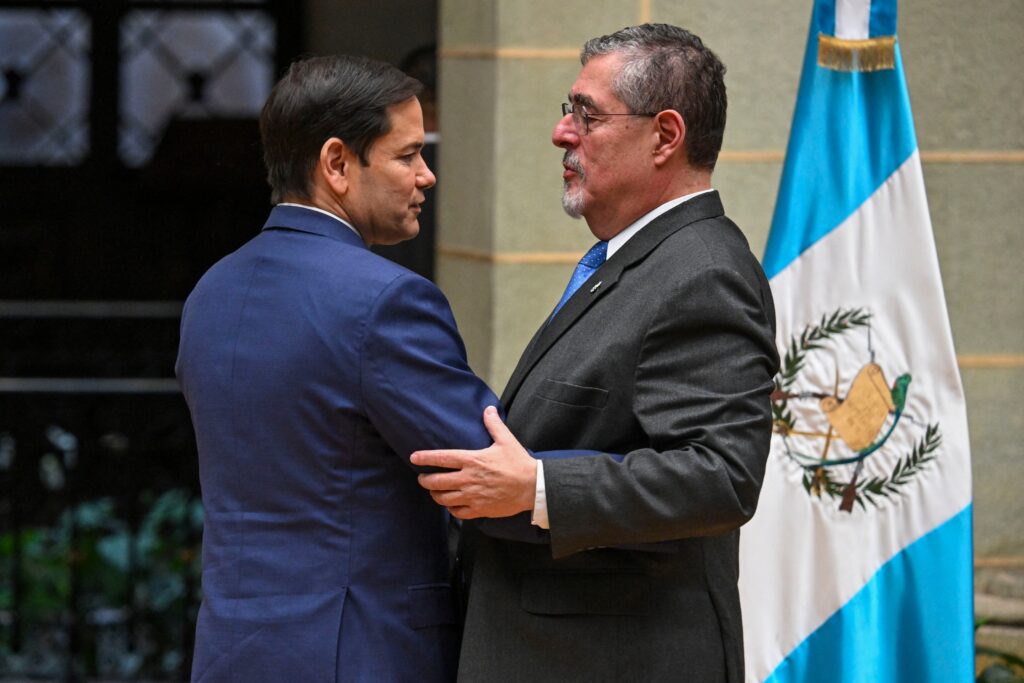
The administration has voiced no public complaints about Arévalo — the first elected leftist leader in Guatemala in decades. Standing at Arévalo’s side when he visited Guatemala City early last year, Secretary of State Marco Rubio said, “We’re not just neighbors, we’re allies, we’re friends.”
While Arévelo’s minority government has come under withering attack from Guatemala’s right-wing political and business communities, he has tried not to antagonize Trump. Last year, the U.S. and Guatemala signed a reciprocal trade agreement. Arévelo has signed military accords and contracts with the Trump administration, worked to stem cartel influence and drug transit, and agreed to accept U.S. migrant deportees from third countries as well as Guatemalans.
Asked about ongoing relations, a State Department spokesperson called bilateral ties “both positive and productive.”
Yet in recent months, after intense criticism of Arévelo’s government by former Trump aide Roger Stone, influencer Laura Loomer, former Trump national security adviser Michael Flynn, right-wing media outlets and GOP lawmakers from southern Florida, Trump removed U.S. Ambassador to Guatemala Tobin Bradley and his deputy, Patrick Ventrell.
In articles on his website, Stone described members of Arévalo’s administration and progressive political movement as money launderers and fronts for Mexican drug cartels. He charged that Biden-appointed Bradley and Ventrell, career Foreign Service officers with extensive Latin America experience, had maneuvered to put Arévalo in office as part of a socialist plot to promote drug smuggling. Arévalo, one Stone headline asserted, was the “Maduro of Guatemala.”
In 2024, the two diplomats had been widely credited with helping avoid a right-wing coup in Guatemala and ensuring Arévalo would be sworn in.
Nonetheless, Bradley and Ventrell soon became enemies of Trump’s MAGA warriors.
“We cannot let the remnants of the Biden Administration push their socialist priorities in our conservative allies’ countries,” Rep. María Elvira Salazar (R-Florida) wrote in a November letter to Rubio that urged the two diplomats be removed.
Loomer accused them of “potential treasonous activities.”
Most directly, the pressure campaign accused Bradley and Ventrell of using the power of the U.S. Embassy to keep right-wing candidates — some under U.S. sanctions for corruption — from selection for top judicial and law-enforcement jobs.
In a text responding to a request to discuss his interest in Guatemala, Stone said, “I can honestly say that I have never discussed Guatemala with either the President or any member of his administration.”
Loomer did not respond to requests for comment.
Other Arévelo critics have used different paths to press their case with the Trump administration.
Arenas is a client of Esteban “Steve” Bovo, a partner in the Florida-based lobbying group Corcoran Partners. Arenas told The Washington Post that he contracted the firm last year in hopes of attracting administration attention to a project aimed at improving U.S.-Central American relations. According to Treasury Department filings under the Foreign Agents Registration Act, he paid Corcoran a fee of $420,000.
Corcoran, Arenas said, has “good access to the State Department,” where Bovo’s wife, Viviana Bovo, a longtime aide to Rubio from his days as a Florida senator, is his senior adviser on Latin American affairs. Other clients of Steve Bovo — a longtime Florida politician who joined the firm shortly after Trump took office — include former South American officials seeking to reverse pre-Trump U.S. visa bans for alleged corruption and human rights violations.
Neither Bovo responded to requests for comment. Corcoran Partners did not respond to a request for comment.
The White House referred questions about Guatemala to the State Department, where the spokesperson declined to address questions about what influence Stone and others might have had on administration decisions.
Recall of an ambassador was “a standard process for any administration,” said the spokesperson, noting that more than two dozen other Biden-appointed diplomats, most in Latin America and Africa, were dismissed at the same time as Bradley.
Ventrell, six months short of the end of his assignment in Guatemala, was the only deputy removed in the sweep.
“An ambassador is a personal representative of the president,” the spokesperson said, speaking on the condition of anonymity because of ground rules set by the department, “and it is the president’s right to ensure that he has individuals in these countries who advance the ‘America First’ agenda.”
A legacy of pressure
The U.S. has a long history of interference in Guatemala, much of whose economy depends on aid and migrant remittances. During the Cold War in 1954, a CIA-backed coup ousted a leftist president, leading to a series of military and civilian dictatorships and a civil war. Over the past decade, the rise of gang violence, use of Guatemala as a transit route for drugs and migrants heading north, and Chinese efforts to increase Beijing’s economic influence there have elevated U.S. attention.
Across administrations, the U.S. Embassy has intervened in Guatemalan politics by promoting certain candidates and blacklisting others. The Biden administration pushed to turn back right-wing efforts to prevent Arévalo from taking office after he won a resounding victory as the most liberal leader since the 1950s.
Early this year, Guatemala began choosing a new attorney general and judges in a complicated, months-long process designed to limit executive power. Under a constitution adopted in late 1985, the Congress, the Supreme Court, the bar association, directors at the main university and the president each select two magistrates for five-year terms on the Constitutional Court, which has the last word on the constitutionality of all laws and government actions.
The attorney general’s office is designed to be independent of any particular executive or party. The president chooses from a list of six candidates selected by the Supreme Court and the deans of the country’s law schools.
Ventrell began calling key players to warn that the U.S. did not look favorably on some candidates.
He “certainly didn’t go off on his own agenda, his own tangent,” said a former State Department official familiar with the calls. Ventrell, the former official said, “was acting in accordance and with the knowledge of his leadership” at the department.
Neither Bradley nor Ventrell responded to requests for interviews.
Among those singled out were allies of sitting Attorney General Consuelo Porras, a right-wing magistrate candidate for the Constitutional Court.
Porras was sanctioned by 40 countries and had her U.S. visa revoked for allegedly obstructing anti-corruption efforts, trying to overturn Arévalo’s electoral victory on spurious grounds and attempting to prosecute political opponents, journalists and former justice officials, many of whom fled the country during her tenure. A spokesperson for Porras did not respond to a request for comment from her.
The U.S. Embassy last year also attempted to block another right-wing magistrate, Claudia Paredes, from becoming president of the Supreme Court, reportedly by revoking her visa. Paredes had repeatedly supported Porras’s efforts and is an ally of lawmakers sanctioned by the U.S., according to Guatemalan officials and former U.S. officials.
Ventrell’s efforts soon caught the eye of Trump allies. “Our embassies should not be interfering in judicial elections in Guatemala,” Salazar wrote to Rubio in her November letter. “It is critical that you remove” Bradley and Ventrell, she added.
As word began to spread in Guatemala that the two top diplomats would be recalled from the embassy, Arévalo telephoned Landau, the U.S. deputy secretary of state, with an appeal, according to three people familiar with the call. Both Bradley and Ventrell were steeped in Guatemalan politics and integral to keeping democracy intact, he argued. It was important that at least one stay until a new attorney general was chosen in May.
Landau agreed, the people familiar with the calls said, telling Arévalo to “consider it a done deal” that Ventrell could stay until the court selections were over at the end of May. But Landau later called back to say it was out of his hands.
Both diplomats were recalled in December, with the State Department couching their removals as part of a larger mission to align representation with the “America First” agenda.
After their departures, Paredes — the right-wing judge whose visa was revoked — was elected president of the Supreme Court.
Our new man in Guatemala City
John Barrett, a career diplomat who had been chargé d’affaires in Panama, arrived in Guatemala in mid-January to run the embassy.
He quickly launched an influence campaign of his own, promoting the candidacy of conservative Roberto Molina Barreto, a longtime judge and former attorney general, according to several people who were on the receiving end of calls from Barrett or who had knowledge of them. Arévalo allies had accused Molina Barreto of rulings favoring drug traffickers and impeding corruption prosecutions.
Barrett did not respond to requests for comment.
The State Department spokesperson, asked about embassy calls for or against certain candidates, said that “our policy with regard to selection of Guatemalan officials is to respect the Guatemalan constitution and Guatemalan sovereignty.” While declining to address possible recommendations of any candidates, they said they were interested only in advising Guatemalan authorities of ”derogatory information linking a candidate to narcos, organized crime or malign foreign actors.”
Asked whether that applied to candidates whose U.S. visas had been revoked for activities deemed corrupt, the spokesperson did not respond.
On the day before the Constitutional Court selection, Barrett visited Paredes, the new chief of the Supreme Court. One person who was briefed on that meeting said in an interview that they came away with the impression that the embassy had expressed support for Porras. In a text message, Paredes denied any interference from Barrett in the election.
But as the court selection approached, Arévalo became increasingly furious with what he considered a U.S. influence campaign in support of his opponents and dispatched his ambassador in Washington to lodge a protest at the State Department. At the same time, he issued a public statement saying that it appeared the U.S. Embassy was asking for votes in favor of “candidates who lack integrity, such as Roberto Molina Barreto and Consuelo Porras.”
Arévalo again called Landau, this time to ask whether Barrett was acting on a new directive from the State Department. Landau assured him that the U.S. had no desire to intervene in the selections process, two people familiar with the call said.
The State Department declined requests to speak with Landau or other senior officials.
In April, the opposition-majority Congress elected Molina Barreto to the Constitutional Court. In a recent interview with The Post, he said allegations that his rulings have benefited organized crime groups were “baseless” and accused political opponents of spreading falsehoods about him.
Concern about what was happening in Guatemala quickly reached U.S. lawmakers, sparking a bipartisan letter to Rubio from Sens. Tim Kaine (D-Virginia) and Mike Lee (R-Utah) urging “constructive and consistent engagement of the U.S. Department of State” and the U.S. Embassy “to support and strengthen democratic institutions during this critical period.”
Porras was not chosen for the court and quickly turned her attention to her application for reselection as attorney general. But she ultimately was left off the shortlist. Despite attempts to challenge the decision, a candidate selected by Arévalo took office as attorney general in May.
At the end of April, the Senate Foreign Relations Committee held a hearing for Trump’s newly nominated ambassador to Guatemala, Florida lawyer Juan Rodriguez, a Cuban American with no diplomatic experience but a long career representing Guatemalan business clients.
“With this appointment, President Trump is only doubling down on his agenda toward Guatemala,” Arenas posted on X. “Guatemala is now left with a 100% MAGA team — no more half-measures, just in case there were still any doubts.”
Claudia Méndez Arriaza in Guatemala City contributed to this report.
The post U.S. shifts its Latin America approach. Here’s how it’s playing out in Guatemala. appeared first on Washington Post.